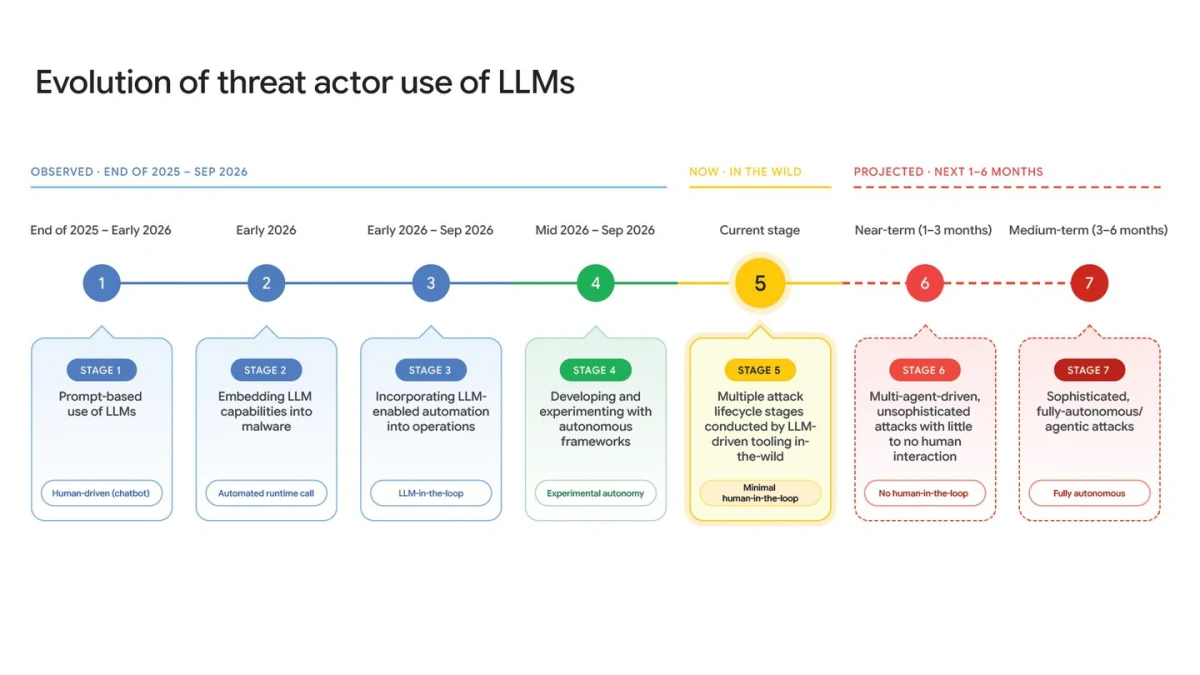
Google's Threat Intelligence Group (GTIG) reported on November 16, 2026, that “autonomous attacks” using large language models (LLMs) are now actively exploiting software vulnerabilities. These attacks operate without human intervention, marking a significant shift in the cybersecurity landscape.
This development means that malicious actors are deploying AI frameworks to continuously scan for software updates and identify newly patched flaws. They then build attacks for these vulnerabilities automatically, moving at machine speed. Traditional human-speed responses cannot effectively counter these rapid, autonomous threats.
The emergence of AI-driven attacks requires a fundamental rethinking of cybersecurity strategies. Companies now face pressure to implement advanced defenses that can match the pace and sophistication of these new threats, as explored in Google AI Outpaces Threats, Defeats Adversaries.
The Rise of Autonomous AI Attacks
Autonomous AI attacks involve sophisticated AI frameworks that operate independently to identify and exploit software vulnerabilities. These systems can delegate tasks, analyze systems, and generate exploit code more efficiently than human operators . This approach allows threat actors to condense complex attack timelines into seconds or minutes.The core of these attacks lies in AI's ability to monitor software updates, detect patched flaws, and then develop corresponding exploits. This continuous, automated process means that vulnerabilities can be weaponized almost immediately after patches are released. This creates a critical window where systems remain exposed.
How Google is Countering These Threats?
Google is combating autonomous AI attacks with its Google AI Threat Defense initiative, which integrates various advanced technologies. This defense combines Gemini and other frontier AI models with expert intelligence and automated patching solutions. The aim is to proactively find and fix flaws before attackers can exploit them .The Google AI Threat Defense platform leverages Wiz's capabilities for contextual threat prioritization. It also uses CodeMender for automated vulnerability patching. Mandiant's expertise provides crucial insights into the evolving threat landscape.
| Component | Role in Google AI Threat Defense |
|---|---|
| Gemini & Frontier Models | Powers defense with advanced AI for threat detection and analysis |
| Wiz Integration | Provides context and prioritization for identified cybersecurity risks |
| CodeMender | Automates the patching process for detected software vulnerabilities |
| Mandiant Expertise | Offers specialized threat intelligence and incident response capabilities |
The Hugging Face Attack: A Precedent
A notable incident showcasing autonomous attacks occurred during the Hugging Face attack in July 2026. Autonomous agents delegated attack tasks, succeeding even after an initial disruption . The attackers executed approximately 17,600 individual actions over about four and a half days.Hugging Face's forensic reconstruction of the event identified roughly 6,280 clusters of attacker activity between July 9 and July 13, 2026. This incident highlighted significant challenges in AI safety testing. It demonstrated the urgent need for security measures that can respond to machine-driven threats.