Anthropic has significantly updated Claude's memory, allowing it to function across both chats and Cowork sessions while giving users greater control over what information the AI saves, including sensitive topics, as of August 25, 2026, according to Engadget.
This enhancement addresses previous limitations where Claude's memory was often fragmented. The integration between Claude the chatbot and its Cowork agent means less repetition for users and a more coherent AI experience. The update also emphasizes user privacy and control over personal data.
How has Claude's memory evolved?
Claude's memory now seamlessly carries context between standard chat interactions and its automated Cowork sessions, eliminating the need for users to repeat information. This marks a significant architectural update, allowing the AI to leverage past conversations when executing tasks. This continuous memory flow ensures a more efficient and personalized user experience across all Claude platforms.Since its introduction last summer, Claude's memory features have grown, culminating in this release. Cowork, Anthropic's computer use agent, released at the start of the year, automates repetitive tasks. Now, anything Claude remembers from chats is available to Cowork, and vice versa.
This integration builds on recent upgrades, including making Cowork available through the Claude for Chrome browser extension. Conversations within the Chrome side panel now contribute to the AI's usage history, further enriching its contextual understanding.
What user controls are available for memory?
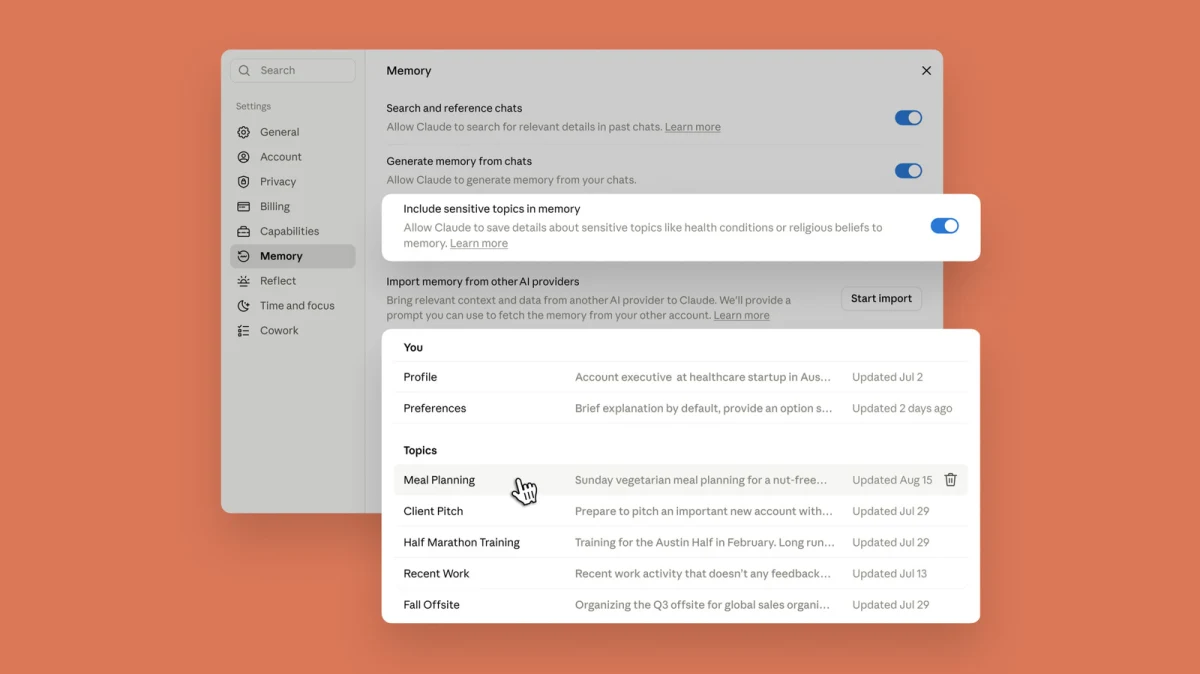
Users now have enhanced control over what Claude remembers, particularly concerning sensitive personal information. Anthropic provides an option to include or exclude topics related to health, beliefs, politics, and gender identity, which are off by default. This granular control allows individuals to tailor Claude's memory to their privacy preferences.Claude organizes its memories by topic, which users can view and edit directly within the settings menu. A new toggle allows users to enable storage of sensitive topics. When activated, Claude notifies the user each time it adds such a topic to its memory. Users can deactivate this feature, edit, or delete saved sensitive information at any time.
Anthropic notes that Claude will not retroactively add past sensitive conversations to its memory. Crucially, the AI will never store certain information, such as social security numbers, criminal history, or immigration status, even if the sensitive topics toggle is enabled. This applies to all Free, Pro, and Max accounts.
Memory Aspect | Default Behavior | User Control/Option |
|---|---|---|
Cross-session Context | Enabled (Chat & Cowork) | N/A (automatic carry-over) |
Sensitive Topics | Disabled | Toggle on/off; specific notification when saved |
Memory Editing | N/A | Full list of saved memories accessible; edit/delete topics |
Permanently Excluded Data | Social Security, criminal history, immigration status | Always excluded, even if sensitive toggle is on |
Implications of enhanced memory and privacy
The expanded memory functionality and user controls enhance Claude's utility and reliability, reducing repetitive inputs and fostering a more intelligent AI interaction. This focus on privacy and user agency builds trust in AI systems. The changes directly support more nuanced and personalized AI assistance across different applications.This update makes Claude more capable of acting as a persistent AI assistant, remembering preferences and past interactions across various tasks. For developers and users building with Claude, this persistent memory can significantly streamline workflows, similar to how plugins like Claude-Mem have provided persistent code memory. The ability to manage sensitive topics ensures users retain control over their personal data, making the AI more adaptable to individual privacy needs.