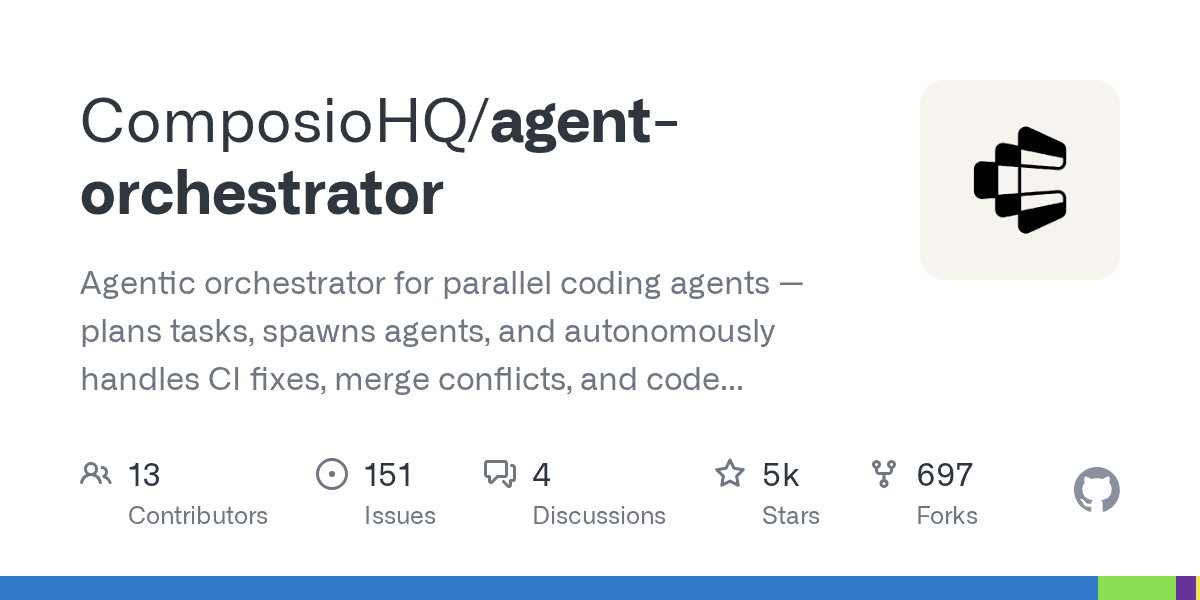
The ComposioHQ Agent Orchestrator is transforming how developers manage AI coding agents by creating an autonomous fleet that handles everything from CI fixes to code reviews. This open-source tool allows a single developer to supervise multiple AI agents working in parallel across different issues, branches, and pull requests, drastically reducing manual overhead and accelerating development cycles. With over 5,400 GitHub stars, it signals a major shift towards highly automated, agentic software development.
Imagine a bustling construction site where each specialized worker (AI agent) autonomously tackles their specific task—one fixing plumbing issues, another handling electrical wiring, and a third performing quality checks. The Agent Orchestrator acts as the site supervisor, managing each worker, ensuring they have the right tools (isolated git worktrees), and automatically addressing any problems that arise, like a failed inspection (CI failure) or a change request from the architect (code review comment). The human overseer only steps in for critical decisions, not day-to-day grunt work.
This powerful system liberates developers from the tedious coordination problems that emerge when scaling AI agent use. Instead of manually creating branches, starting agents, checking their progress, and routing feedback, developers simply initiate the orchestrator and focus on higher-level judgment calls.
Orchestrating Parallel AI Coding Agents
The Agent Orchestrator acts as the central intelligence for a swarm of AI coding agents. When you initiate it with a simpleao start command, it launches a dashboard and an orchestrator agent. This orchestrator then spawns individual worker agents, assigning each a distinct issue and an isolated git worktree along with its own branch and pull request.These agents operate autonomously. They read code, write tests, and create PRs. Crucially, the orchestrator handles feedback loops: if CI fails, the agent receives the logs and fixes the issue; if a reviewer requests changes, the agent addresses them. Human intervention is only necessary when complex judgment is required, such as merging a fully approved and green PR, which can also be automated.
The system is highly flexible due to its plugin architecture. It boasts eight swappable slots, meaning it is agent-agnostic (supporting models like Claude Code, Codex, Aider), runtime-agnostic (working with tmux, Docker, Kubernetes), and tracker-agnostic (integrating with GitHub, Linear). Configuration is straightforward via an agent-orchestrator.yaml file, allowing users to customize defaults for runtime, agents, notifiers, and reaction policies. The project currently runs 3,288 test cases, ensuring robust functionality.
What This Means for the Agentic Future
ComposioHQ's Agent Orchestrator exemplifies the growing trend of the "agentic enterprise," where layers of AI agents execute and coordinate work under human supervision. This approach is not about replacing human roles but redefining them, as noted by Forbes. Instead of performing tedious, repetitive tasks, humans shift to supervisory, guiding, and intervention roles where their unique judgment is indispensable.
This "manager for AI workers" model aligns with broader industry movements. Companies like Parallel are deploying AI agents for hospital administrative tasks, operating on existing systems without deep integration. Similarly, platforms like OpenClaw are designed as complete AI execution systems that act and execute tasks independently, capable of local execution. Even major players like Deloitte and UiPath have partnered to launch Agentic ERP, leveraging agentic automation for optimizing complex ERP environments.
The Agent Orchestrator, with its requirement for Node.js 20+ and Git 2.25+, significantly boosts developer velocity by automating the tedious aspects of code creation and maintenance. It enables engineering teams to scale their output without proportionally increasing manual effort, allowing human developers to focus on innovation, architectural design, and complex problem-solving. This tool helps us bridge the gap between individual AI agents and truly autonomous, coordinated software development teams.