Perplexity's Personal Computer: What It Is and What It Costs

Jeff Liu··3 min read·Consumer Tech
Perplexity's Personal Computer: What It Is and What It Costs

Key Takeaways

  1. 1Perplexity's Personal Computer is a cloud-based AI agent, not physical hardware.
  2. 2It operates 24/7 on a user's Mac mini, gaining local access to files and applications.
  3. 3The agent integrates 19-20 AI models, including specialized versions of Claude, Gemini, and Grok.
  4. 4Access requires a Perplexity Max subscription at $200 per month, initially for Mac users via a waitlist.
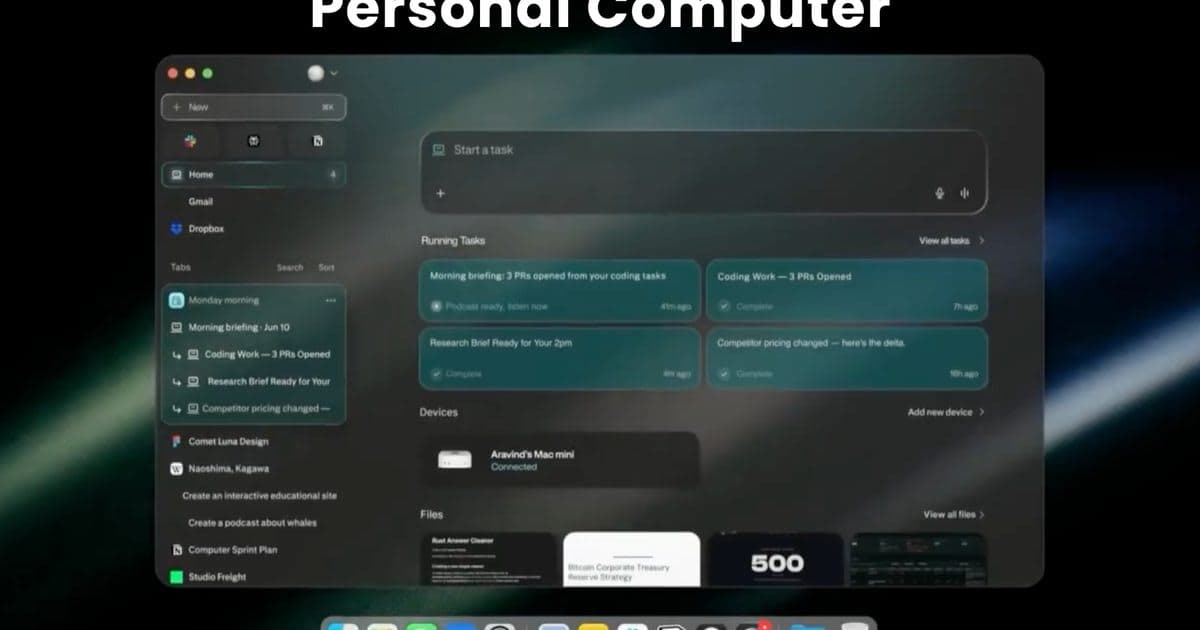
  5. 5Perplexity introduced its new Personal Computer at its inaugural Ask 2026 developer conference in San Francisco, pitching a vision of an AI assistant that never sleeps or takes a break. This isn't a new piece of hardware from Perplexity; it's sophisticated software, a persistent evolution of their earlier Perplexity Computer, designed to run continuously on a user-provided, always-on machine like a Mac mini, according to Digital Trends. This setup grants the AI direct, local access to your files, applications, and ongoing sessions.
Perplexity has unveiled its "Personal Computer," a cloud-based AI agent designed to operate as a persistent digital worker, continuously running on a user-provided Mac mini. This software aims to transform traditional computing by taking high-level objectives rather than mere instructions, coordinating across 19-20 different AI models to manage complex tasks asynchronously for weeks or months. Priced at $200 per month for Perplexity Max subscribers, it targets power users and businesses seeking advanced automation. Perplexity introduced its new Personal Computer at its inaugural Ask 2026 developer conference in San Francisco, pitching a vision of an AI assistant that never sleeps or takes a break. This isn't a new piece of hardware from Perplexity; it's sophisticated software, a persistent evolution of their earlier Perplexity Computer, designed to run continuously on a user-provided, always-on machine like a Mac mini, according to Digital Trends. This setup grants the AI direct, local access to your files, applications, and ongoing sessions.

The real power here lies in its ability to coordinate across a staggering 19 to 20 different AI models, including specialized iterations of Claude, Gemini, and Grok. This allows it to handle complex workflows asynchronously. You provide a high-level objective, and the Personal Computer breaks it down into subtasks, managing them from start to finish for extended periods, potentially weeks or months.

The obvious question for many developers and businesses is security. Perplexity asserts that every task performed by Personal Computer executes within a sandboxed cloud environment. Each task gets its own isolated filesystem and browser, preventing the AI from "going rogue" through your local directories. Furthermore, every action requires explicit user confirmation, and a built-in audit trail logs every command, providing transparency and control. You're not just screen-sharing into a Mac; you're directing a sophisticated AI agent running on it remotely, while you focus on other priorities.

Transforming Workflows with Autonomous Agents

This shift from instruction-following to objective-driven AI is significant. A developer could instruct Personal Computer to monitor a GitHub repository overnight for new commits and then drop a formatted summary into a Slack channel before the daily standup, eliminating manual scripting or last-minute panic. Researchers could hand it a messy, half-formed topic before bed and wake up to a structured report compiled from live sources, sitting in their inbox without late-night rabbit holes or dozens of open browser tabs.

For small business owners, the value proposition arguably becomes even stronger. Imagine pointing Personal Computer at your Gmail account and telling it to watch for client inquiries, draft replies based on your past communications, and only alert you when human intervention is absolutely essential. It connects to a suite of popular services, including Gmail, Slack, GitHub, Notion, and Salesforce, enabling it to monitor triggers and execute proactive tasks across them. As Aravind Srinivas, CEO of Perplexity, stated at the conference, "A traditional operating system takes instructions; an AI operating system takes objectives."
Related Articles

More insights on trending topics and technology

The Signal

Everything worth knowing in AI.

One email a week.