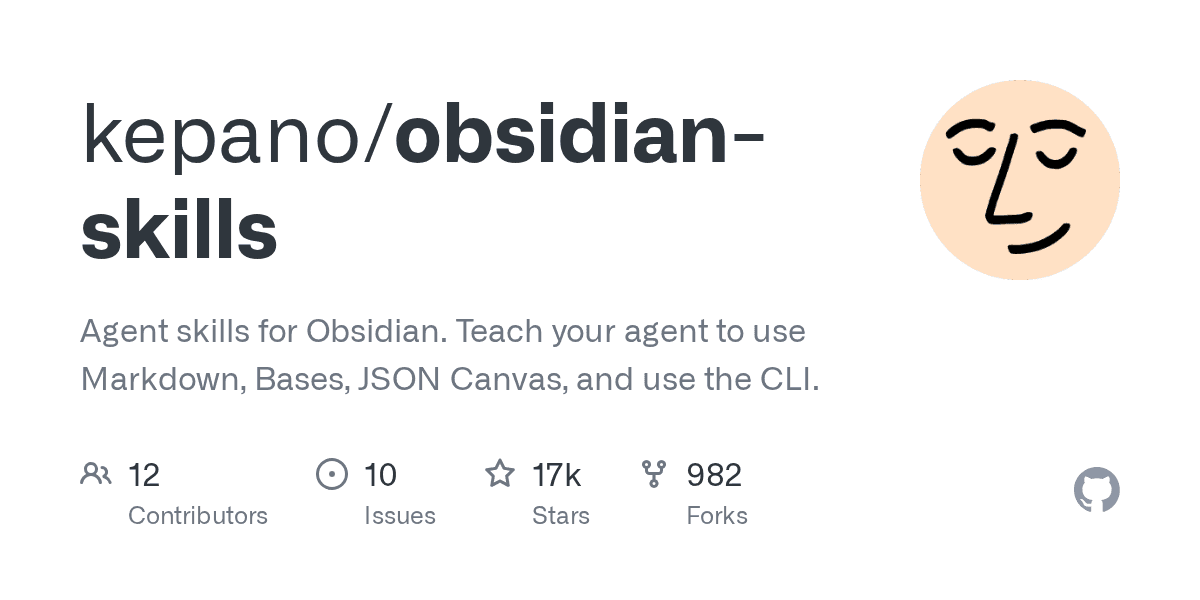
This shift empowers AI to become a truly specialized partner in organizing and generating information, leveraging Obsidian's unique features like Markdown, Bases, and JSON Canvas.
What Obsidian Skills Teach AI Agents
Imagine equipping a highly intelligent assistant with a comprehensive toolkit designed specifically for handling information, rather than just general conversation. That is exactly what `obsidian-skills` offers to AI agents. It functions as a specialized training program, enabling these agents to interact with an Obsidian vault not as a plain text file, but as a rich, interconnected knowledge base.
Previously, AI agents, even sophisticated ones designed to mimic professional roles, often struggled with nuanced, application-specific tasks. Arvind Vasudevan, a former McKinsey engagement manager, pointed out that even AI agents designed to replicate a McKinsey consultant's workflow lacked key, defining abilities. `obsidian-skills` addresses this gap by giving agents specific, actionable instructions for managing detailed knowledge.
This repository introduces five core skills, teaching an agent to master Obsidian's native formats. The `obsidian-markdown` skill allows agents to create and edit Obsidian Flavored Markdown, complete with wikilinks, embeds, callouts, and properties. This is crucial for maintaining the interconnected nature of Obsidian notes. Agents also learn to create and edit Obsidian Bases (`obsidian-bases`), working with views, filters, formulas, and summaries to manage structured data effectively.
Empowering Agents with Granular Control
Beyond text and structured data, `obsidian-skills` extends agent capabilities to visual organization. The `json-canvas` skill enables agents to create and edit JSON Canvas files, manipulating nodes, edges, groups, and connections to map out ideas visually. This skill moves AI agents past sequential text generation into spatial thinking and knowledge arrangement. Moreover, the `obsidian-cli` skill provides agents with direct interaction capabilities via the Obsidian CLI, supporting plugin and theme development—a significant leap in agent autonomy.
One of the most practical skills for data ingestion is `defuddle`, which trains agents to extract clean Markdown from web pages. This removes clutter and extraneous content, ensuring agents work with focused information and optimize token usage. This set of skills transforms a general-purpose AI into a specialized knowledge worker, capable of intricate interactions within the Obsidian ecosystem.
Installation is straightforward, supporting direct integration with Claude Code, Codex CLI, and OpenCode. Users can add the repository contents to a specific folder within their vault or skills path, making these specialized functions immediately available after a restart. The repository has been forked 982 times, indicating strong community interest and adoption.
The Impact on Knowledge Management and AI Development
The `obsidian-skills` project marks a pivotal moment for knowledge management and the development of AI agents. By providing specific, granular control over a sophisticated knowledge base like Obsidian, it transforms AI agents from passive content generators into active participants in an intelligent workflow. This specialization helps bridge the gap where AI agents might otherwise fall short, as noted by experts regarding their inability to perform specific, "key abilities" in professional contexts.
This initiative sets a precedent for how AI can move beyond general intelligence to acquire highly specialized "muscle memory" within specific applications. The ability to teach agents to use wikilinks, manipulate canvas boards, or filter databases means they can contribute to and maintain complex knowledge systems, freeing up human users for higher-level strategic thinking. As more tools adopt similar "Agent Skills specifications," we can expect a new generation of AI agents that are not just smart, but also incredibly precise and deeply integrated into our digital workflows.