Vercel Bypasses Vector Databases for AI Agents with Filesystem and Bash
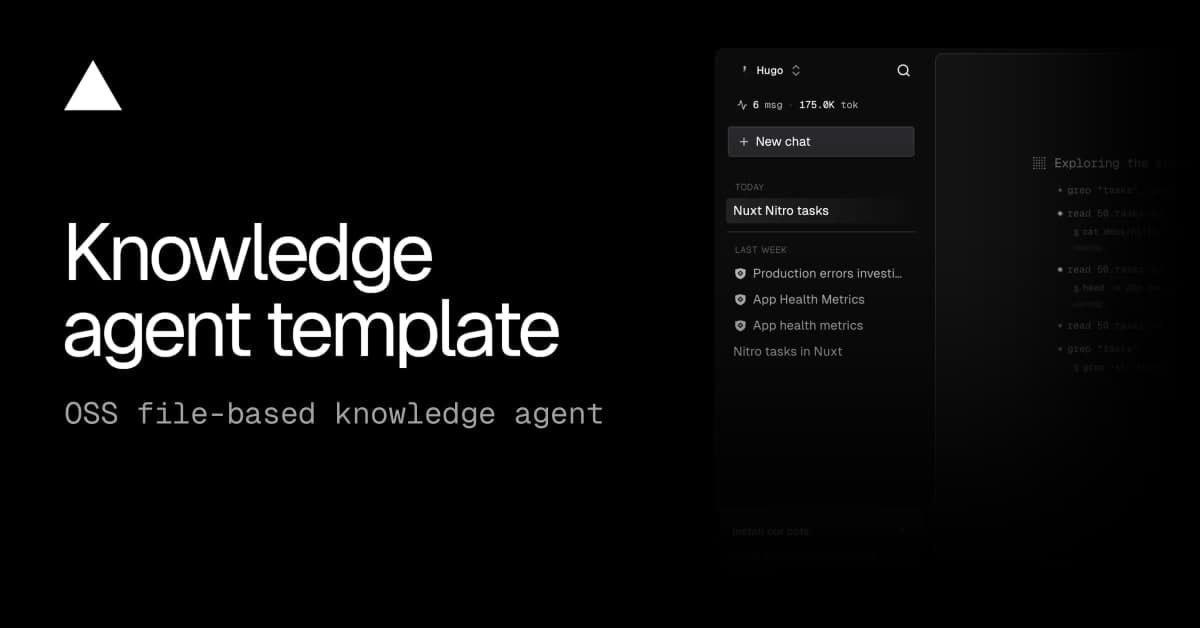
Vercel introduces a new approach to building AI knowledge agents, ditching traditional vector databases and embeddings in favor of a filesystem and standard Bash commands likegrep and find. This shift dramatically reduces costs, cutting a sales call summarization agent's operational cost from $1.00 to just $0.25 per call, while significantly improving debuggability and output quality. The company has open-sourced this architecture as the Knowledge Agent Template.Most AI agents start the same way: developers select a vector database, build a chunking pipeline, and tune retrieval parameters. However, this common process often leads to frustrating debugging challenges where agents confidently return incorrect information with no clear path to understanding why. Vercel identified this problem internally and among teams building agents on its platform.
The core issue stems from the opaque nature of embedding stacks. While effective for semantic similarity, they falter when precise values from structured data are required. Debugging involves deciphering abstract scoring mechanisms, which can be an exercise in futility. Vercel's solution avoids this complexity entirely.
Simplifying Agent Architecture with Filesystem Search
Vercel replaced its vector pipeline with a standard filesystem, equipping agents with familiar Bash commands. This enables agents to navigate directories, read files, and execute commands likegrep, find, and cat within isolated Vercel Sandboxes. This architectural pivot not only improved the output quality of their sales call summarization agent but also delivered a substantial 75% cost reduction.The process is straightforward: sources added via an admin interface are stored in Postgres and synced to a snapshot repository using Vercel Workflow. When a search is needed, a Sandbox loads the snapshot, and the agent's Bash tools execute filesystem commands, returning answers with optional references. This system offers deterministic and explainable results, a stark contrast to the "black box" nature of vector databases.
Debugging an agent built on this template means inspecting actual files and command traces, not deciphering complex embedding models or similarity thresholds. If an agent provides a wrong answer, developers can see the exact `grep` command it ran and which file it accessed, allowing for fixes in minutes. This transparency is crucial for building reliable agents, particularly in enterprise contexts where "tacit knowledge" or expert decision-making context is vital, a challenge Interloom is addressing with $16.5 million in venture funding.
Integrated Tools for Seamless Agent Deployment
The Knowledge Agent Template is built on Vercel Sandbox, AI SDK, and Chat SDK, enabling one-click deployment to Vercel. It supports various data sources like GitHub repos, YouTube transcripts, and markdown files, allowing deployment as a web chat app, GitHub bot, or Discord bot simultaneously.Chat SDK connects the agent to multiple platforms from a single codebase. It handles platform-specific concerns like authentication and event formats, allowing the agent logic to remain consistent. The template ships with GitHub and Discord adapters, with support for Slack, Microsoft Teams, and Google Chat also available.
The template also integrates deeply with the AI SDK via the `@savoir/sdk` package, providing tools to connect agents to the knowledge base. It includes a smart complexity router that automatically directs simple questions to cheaper, faster models and complex ones to more powerful models, optimizing costs without manual rules. This capability is compatible with any AI SDK model provider through Vercel AI Gateway.
Built-in Administration and Autonomous Debugging
A comprehensive admin interface is part of the template, offering usage stats, error logs, user management, and content sync controls. This eliminates the need for external observability tools, consolidating agent management into a single dashboard. Crucially, the template features an AI-powered admin agent.This admin agent responds to natural language queries about errors or common user questions by utilizing internal tools like `query_stats`, `query_errors`, `run_sql`, and `chart`. It facilitates debugging the agent with an agent, a practical application of autonomous systems that contrasts with the complexities of verifying probabilistic systems, which some experts note require specific human-on-the-loop or human-in-the-loop monitoring.
This approach highlights a key insight: Large Language Models (LLMs) are already proficient with filesystems, having been trained on vast amounts of code that involve navigating directories and grepping through files. Instead of teaching models a new skill, Vercel leverages an existing one, making agents more efficient and easier to maintain.
The Bigger Picture
- Vercel’s filesystem strategy aligns with the need for transparent AI agents, essential for businesses to debug and trust automated workflows, reducing "black box" frustration common with vector embeddings.
- By drastically cutting agent operational costs by 75%, Vercel addresses a critical economic barrier for wider AI agent adoption, making sophisticated agents more accessible.
- The emphasis on explainable outcomes and direct command tracing provides a strong foundation for AI-native security, allowing organizations to monitor agent actions and prevent "rogue agent break-ins" that Google Cloud's COO highlights as a major threat.
- This template simplifies the integration of agentic AI into existing systems, mirroring the approach of companies like Zalos, which automates finance operations by teaching agents to interact with systems as humans would, avoiding costly rip-and-replace scenarios.