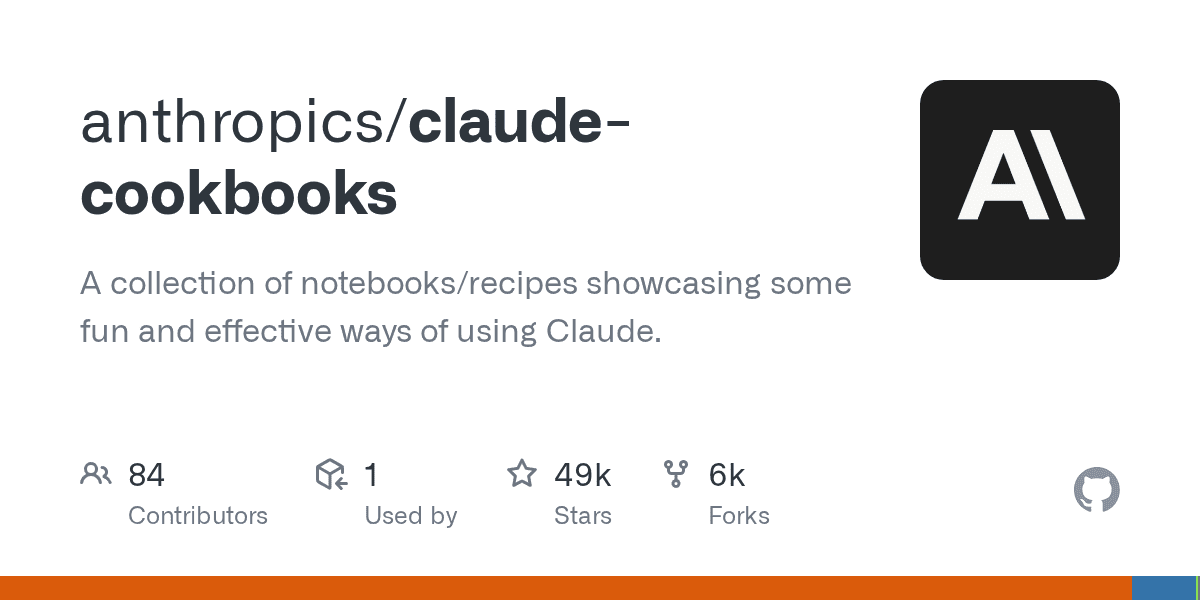
Anthropic has released the Claude Cookbooks, a GitHub repository to help developers build applications with its Claude AI. As of July 2026, the collection of code recipes has earned over 48,700 stars, providing copy-paste examples for various tasks, according to the repository page.
The cookbooks serve as a practical toolkit designed to lower the barrier to entry for developers. By offering official, ready-to-use code, Anthropic aims to standardize best practices and accelerate the development of robust applications powered by Claude. The examples are primarily in Python but are designed to be adaptable to other languages.
What Core Capabilities Do the Cookbooks Cover?
The repository focuses on foundational AI capabilities that developers frequently need. It provides recipes for text classification, summarization, and Retrieval-Augmented Generation (RAG), which allows Claude to enhance its responses using external knowledge. The cookbook also demonstrates basic tool use, such as integrating a calculator function.These core recipes act as building blocks for more complex applications. For example, the RAG guides show how to connect Claude to vector databases like Pinecone or live data sources like Wikipedia. This grounds the model's output in factual, up-to-date information, a crucial step for building reliable AI systems. The repository has also accumulated over 5,800 forks, indicating widespread developer experimentation.
How Does Claude Handle Advanced and Multimodal Tasks?
Beyond basic text tasks, the cookbooks explore advanced and multimodal functionalities. Recipes demonstrate how to use Claude's vision capabilities to interpret charts, analyze graphs, and extract structured text from forms and PDFs. It also includes a guide for generating images by having Claude write prompts for Stable Diffusion.
The advanced section also covers sophisticated architectural patterns. One key example is using the faster, cheaper Claude Haiku model as a sub-agent for the more powerful Opus model. This allows for efficient task routing. Other recipes detail how to enforce consistent JSON output, automate prompt evaluations, and implement prompt caching to improve performance and reduce costs.
| Recipe Category | Example Task | Developer Goal |
|---|---|---|
| Core: Tool Use | Calculator Integration | Extend basic logic and perform calculations. |
| Core: RAG | Wikipedia Search | Ground AI responses in external, verifiable facts. |
| Advanced: Vision | Chart Interpretation | Extract insights and data from visual information. |
| Advanced: Sub-agents | Haiku + Opus | Optimize application cost and speed. |
How Can Developers Get Started and Contribute?
Getting started requires a Claude API key, which is available for free. The repository is structured as a collection of Jupyter Notebooks, making the code immediately executable for developers with a Python environment. The cookbooks are explicitly designed to welcome community involvement, as noted by AIToolly.Anthropic encourages developers to review existing issues and pull requests before submitting new ideas to avoid duplicating efforts. The open contribution model helps grow the resource, allowing developers to share their own solutions and build on the provided recipes. This approach is key to developing complex systems, including the kinds of production-ready agentic workflows that are becoming increasingly important in AI.