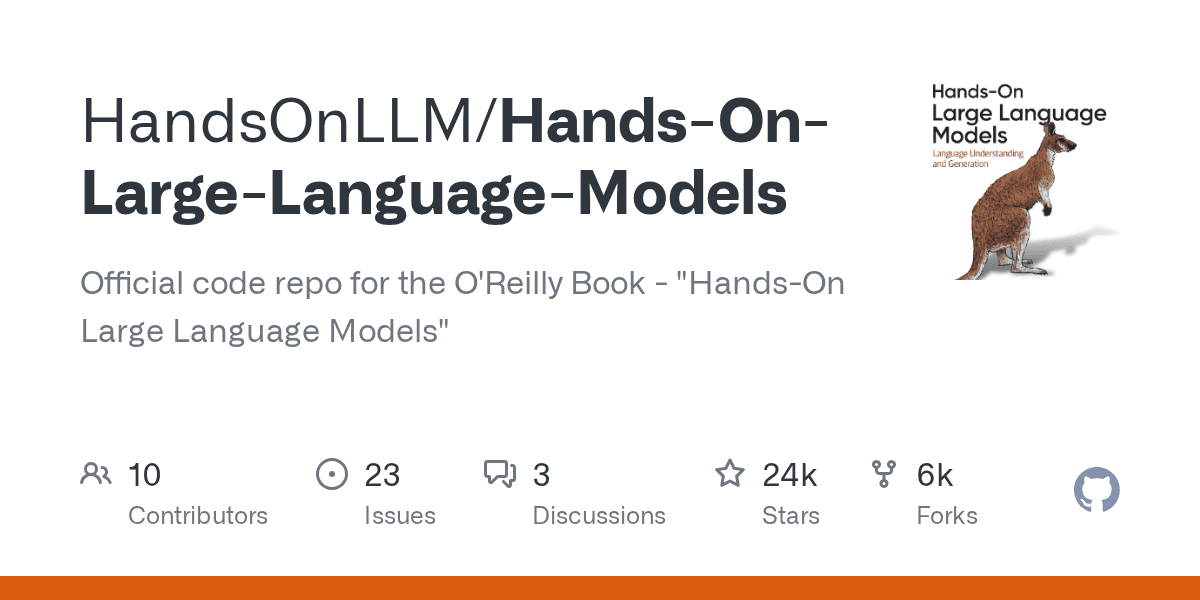
The official code repository for O'Reilly's "Hands-On Large Language Models" book, by authors Jay Alammar and Maarten Grootendorst, is rapidly becoming a vital resource for developers navigating the complex world of AI. With over 24,500 GitHub stars, this open-source collection offers practical, visually-driven examples that demystify everything from transformer architecture to advanced fine-tuning techniques.
This GitHub repository provides direct access to all code examples from "The Illustrated LLM Book," making it easier for engineers to learn and implement large language models. It addresses the growing need for practical LLM skills as AI increasingly shapes industries, from enhancing cybersecurity defenses to revolutionizing mobile robot navigation in smart manufacturing.
The rapid evolution of large language models impacts every sector, creating both immense opportunities and significant challenges. This repository serves as a crucial bridge, guiding developers through the actionable steps required to build, customize, and deploy robust LLM solutions, rather than simply consuming pre-built models.
Imagine LLMs not as mysterious black boxes, but as highly skilled, versatile interns who excel at complex tasks—if you provide them with clear, specific instructions. This repository gives you the "training manual" to become an effective manager of these AI interns, teaching you how to articulate your needs and get the best results. It breaks down sophisticated concepts into digestible, runnable code examples, ensuring clarity through practical application.
The repository's 12 chapters cover fundamental LLM components, starting with basic tokens and embeddings, and then delving into the intricate workings of Transformer LLMs. Crucially, it moves beyond theory to practical applications such as text classification, clustering, and advanced prompt engineering. Users learn to craft precise queries that unlock an LLM's full potential.
A key focus is on techniques like Semantic Search and Retrieval-Augmented Generation (RAG), which allow LLMs to access and integrate external, up-to-date information, significantly improving accuracy and relevance. The resource also explores multimodal LLMs—a critical area as AI integrates various data types, from text to images, enhancing capabilities like vision-language models for robot navigation in smart manufacturing, as highlighted by EurekAlert!. But beyond specific applications, the broader context makes mastering these tools non-negotiable.
The sheer velocity of AI development demands that developers not only understand LLMs but actively engage with them. Heavy reliance on LLMs without deep understanding can lead to a "blandification" of content and ideas, where AI-generated output diverges significantly from human intent, according to NBC News. This repository helps mitigate that risk by providing the tools to personalize and refine LLM behavior.
Beyond content generation, practical LLM skills are essential for navigating the broader geopolitical and technological landscape. As Reuters reports, China's dominance in open-source AI is growing, with an estimated 80% of US tech startups using Chinese open-source AI models, per China Economic Review. Understanding LLMs allows developers to strategically evaluate and integrate these powerful tools, maintaining competitive edge and security.
The rise of agentic AI also introduces new cybersecurity threats, with experts warning of AI-powered attacks that could even lead to a "satellite apocalypse" within two years, according to NEWS.am TECH. Developers armed with deep LLM knowledge are better equipped to build robust, secure systems and identify vulnerabilities, transforming them into critical assets in this new era.
All examples in the repository are built using Python and tested primarily within Google Colab, offering free access to T4 GPUs with 16GB of VRAM. This accessible setup ensures that anyone can dive in and start experimenting immediately, leveraging the book's nearly 300 custom-made figures across its 400 pages for unparalleled visual learning.
It's the official code repository for the O'Reilly book, "Hands-On Large Language Models" by Jay Alammar and Maarten Grootendorst. The repository contains practical, visually-driven examples to help developers learn, build, customize, and deploy robust AI solutions. It has over 24,500 stars on GitHub.
The repository covers fundamental LLM components, starting with tokens and embeddings, and then delves into Transformer LLMs. It also includes practical applications such as text classification, clustering, prompt engineering, semantic search, and Retrieval-Augmented Generation (RAG).
Mastering LLMs is crucial for developers to actively engage with AI development and personalize and refine LLM behavior. A deep understanding of LLMs helps mitigate the risk of AI-generated output diverging from human intent and is essential for navigating the broader geopolitical and technological landscape.
Retrieval-Augmented Generation (RAG) allows LLMs to access and integrate external, up-to-date information, significantly improving accuracy and relevance. RAG is a key focus of the "Hands-On LLMs" repository, enabling LLMs to provide more informed and contextually appropriate responses.
Practical LLM skills are essential for various applications, including enhancing cybersecurity defenses and revolutionizing mobile robot navigation in smart manufacturing. Mastering LLMs also allows developers to build, customize, and deploy robust LLM solutions tailored to specific needs.
More insights on trending topics and technology
![[KDD'2026] "VideoRAG: Chat with Your Videos"](/_next/image?url=https%3A%2F%2Fres.cloudinary.com%2Fdeilllfm5%2Fimage%2Fupload%2Fv1774511565%2Ftrendingsociety%2Fog-images%2F2026-03%2Fhkuds-s-videorag-transforms-video-into-live-chat.png&w=3840&q=75)