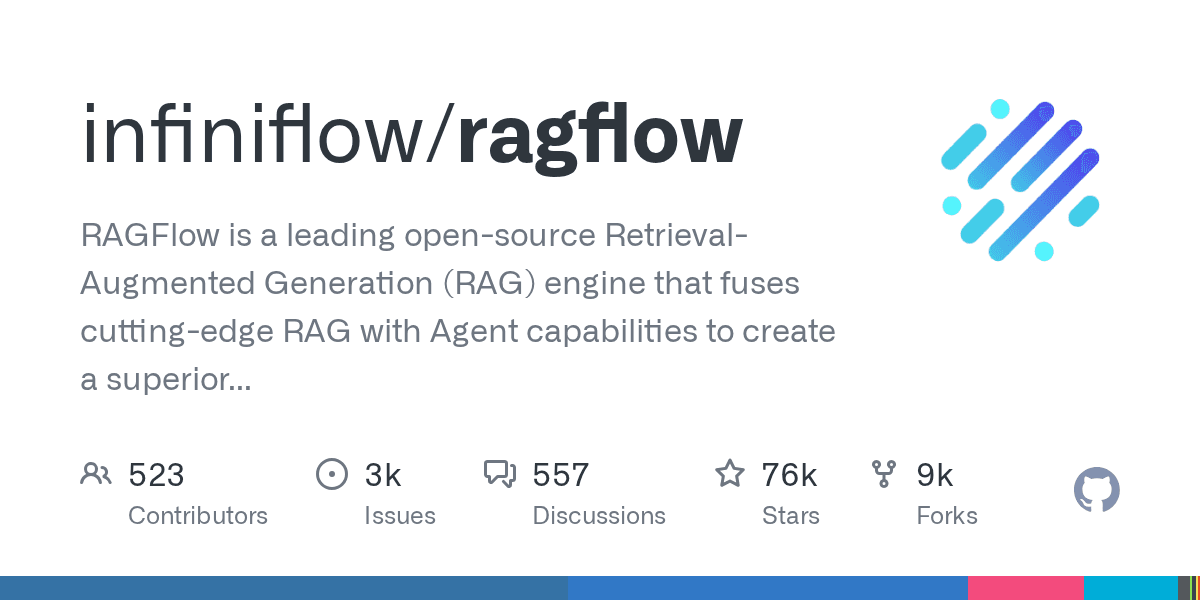
RAGFlow, an open-source Retrieval-Augmented Generation (RAG) engine, revolutionizes how Large Language Models (LLMs) access and utilize information by integrating advanced RAG with Agent capabilities. This powerful combination establishes a superior context layer for LLMs, enabling them to deliver more accurate and grounded responses from complex, unstructured data. Developers can leverage RAGFlow's streamlined workflow to efficiently build high-fidelity, production-ready AI systems.
The core challenge for many LLM applications is reliably extracting relevant information from diverse, often messy, enterprise data and presenting it in a format an LLM can effectively use without "hallucinating" facts. RAGFlow addresses this head-on with a "quality in, quality out" approach, emphasizing deep document understanding and intelligent knowledge extraction. The project has garnered significant attention, boasting 76.3k stars on GitHub as of early 2024.
The engine features template-based chunking, offering intelligent and explainable options to segment data optimally for LLM consumption. This process leads to grounded citations, significantly reducing hallucinations by providing traceable references and allowing for human intervention through visualization of text chunking. RAGFlow also ensures broad compatibility, integrating heterogeneous data sources including Word documents, slides, excel files, text, images, scanned copies, structured data, and web pages.
The platform streamlines the RAG orchestration process, making it automated and effortless for both personal and large-scale business applications. It provides configurable LLMs and embedding models, alongside multiple recall mechanisms paired with fused re-ranking to optimize retrieval accuracy. RAGFlow is primarily built with Python, comprising 47.3% of its codebase, alongside TypeScript, C++, and Go.
Other planned enhancements include support for MinerU and Docling as document parsing methods, an orchestrable ingestion pipeline, and compatibility with OpenAI's GPT-5 series models. A Python/JavaScript code executor component for Agents and cross-language query support are also slated, indicating a move towards more dynamic and versatile AI applications. Deployment is simplified via Docker, with pre-built images for x86 platforms and detailed guides for launching services from source.
RAGFlow is an open-source Retrieval-Augmented Generation (RAG) engine that enhances Large Language Model (LLM) performance by integrating advanced RAG with Agent capabilities. It acts as a superior context layer for LLMs, enabling them to deliver more accurate and grounded responses from complex, unstructured data. Developers use RAGFlow to build high-fidelity, production-ready AI systems.
RAGFlow improves LLM accuracy by providing precise, verifiable context from vast libraries of information. Its Agent capabilities process, analyze, and even execute code based on the retrieved information, ensuring the LLM receives deeply understood and actionable insights, reducing the chance of 'hallucinating' facts. RAGFlow emphasizes deep document understanding and intelligent knowledge extraction.
RAGFlow is designed to handle diverse data types, including Word documents, slides, Excel files, text, images, scanned copies, structured data, and web pages. It supports knowledge extraction from unstructured data with complicated formats, allowing LLMs to find relevant information across virtually unlimited tokens. The engine also features template-based chunking to segment data optimally for LLM consumption.
RAGFlow is primarily built with Python, which comprises 47.3% of its codebase. It also incorporates TypeScript, C++, and Go. The platform provides intuitive APIs for seamless integration with existing business workflows, making it accessible for developers with varying language preferences.
RAGFlow plans to add several enhancements, including support for 'Memory' in AI agents by December 2025 and integration with Gemini 3 Pro by November 2025. Data synchronization from platforms like Confluence, S3, Notion, Discord, and Google Drive is also planned for November 2025. Other planned features include support for MinerU and Docling as document parsing methods, an orchestrable ingestion pipeline, and compatibility with OpenAI's GPT-5 series models.
More insights on trending topics and technology
![[KDD'2026] "VideoRAG: Chat with Your Videos"](/_next/image?url=https%3A%2F%2Fres.cloudinary.com%2Fdeilllfm5%2Fimage%2Fupload%2Fv1774511565%2Ftrendingsociety%2Fog-images%2F2026-03%2Fhkuds-s-videorag-transforms-video-into-live-chat.png&w=3840&q=75)