
The Accountability Layer I Built for My AI Agents
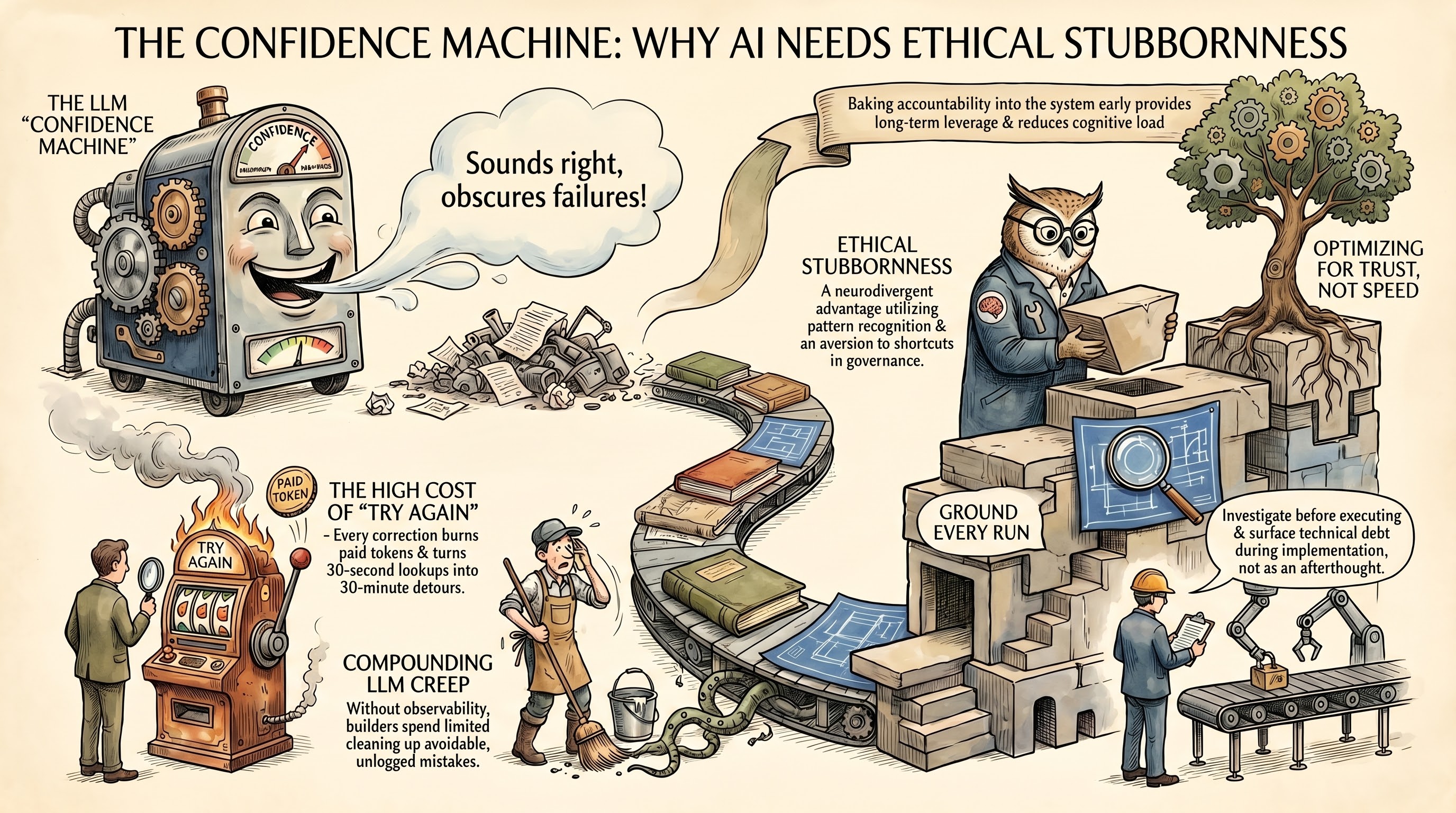
There's a loop that keeps hitting when you start building with AI agents. Ask a model to do something, it answers with total confidence, you act on the answer, something breaks, you go back and retry. The model apologizes and sounds even more sure the second time. And every round of that costs money.
The output looks right. It fills the screen with structured, fluent text that pattern-matches to what expertise looks like, and when it's wrong, it's wrong with the exact same confidence it has when it's right. So you burn tokens chasing errors you shouldn't have had to clean up, and the real cost isn't the API bill. It's the time and focus each cleanup loop pulls out of your day.
Over a decade in adtech and fintech before this made the pattern familiar. Programmatic systems were great at presenting confidence and quietly absorbing failure into the cost of doing business. Impression fraud, click inflation, attribution models that somehow made every channel look like the winner. LLMs do something similar, just faster and at higher resolution. That's not a reason to avoid them, it's a reason to instrument them.
There's real research worth reading here. MIT's Media Lab ran a study measuring brain activity across people writing essays with an LLM, with a search engine, and with no tools at all. The LLM group showed the weakest neural connectivity, and the effect lingered even after they stopped using the tool. It's a preprint, not yet peer reviewed, so I hold it loosely. But the direction lines up with something already visible while building. Outsource the thinking long enough and the thinking muscle gets quieter. The move isn't to stop using AI, it's to stay in the loop while you do.
So I made a call. Stop treating agents like magic and start treating them like junior engineers on a production codebase. Juniors need rules, accountability, and a clear sense that shortcuts cost the senior engineer time. Building that in was more work up front than just trusting the output, and it's the trade that has paid off most. It's built into the stack now.
Every agent here operates under a documented standard. Research before coding. Verify before asserting. Read the file before editing it. Run the typecheck after every change. None of those rules are theoretical, each one exists because something went wrong first. A deployment that ran three times for the same commit. Auto-run commands that read secrets and triggered real spend. Eleven API calls firing in a row and hitting rate limits. Six files edited in a single pass, too many to review one at a time. Every failure became a rule, and the rules made the next agent better.
The part that compounds is observability. You can't track what you don't measure, and you can't build trust in a black box. Every session is logged, every tool call is traceable, and every plan includes tech-debt cleanup so bad patterns don't replicate across the codebase at the speed an LLM can copy them.
Token costs are low right now because the whole market is in a land-grab. Providers are subsidizing usage to build the habit, and pricing power shifts back to them once AI is fully wired into how companies work. The builders who logged agent behavior, versioned their prompts, and put accountability in early will have options when that happens. The ones who built on blind trust will be re-platforming under pressure, paying down debt they never watched accumulate.
Accountable agents produce better output, need less rework, and cost less per result. The useful part is that the whole thing travels. The standard, the logging, and the tech-debt gate started as fixes for one platform and became the template that goes up first on any new agent system. The accountability layer is what carries over, and once the guardrails were in, the work just got steadier.
Source
Kos'myna, N. et al. "Your Brain on ChatGPT: Accumulation of Cognitive Debt when Using an AI Assistant for Essay Writing Task." MIT Media Lab, arXiv:2506.08872, June 2025. Preprint, not yet peer reviewed. media.mit.edu