Back to Articles
Consumer Tech
|4 min read|

Apple brings its M5 Pro and Max silicon to the next MacBook Pro generation

Apple brings its M5 Pro and Max silicon to the next MacBook Pro generation
Trending Society

AI Overview

  • Apple released new 14-inch and 16-inch MacBook Pro models with M5 Pro and M5 Max chips.
  • The M5 Pro and M5 Max feature a new "Fusion Architecture" and dedicated Neural Accelerators.
  • New models boast up to 4x AI performance compared to the previous generation and faster SSDs.
  • Prices have increased across the lineup, with base storage now starting at 1TB or 2TB depending on…
  • After a notable delay from the initial M5 chip announcement, Apple has finally launched the updated…
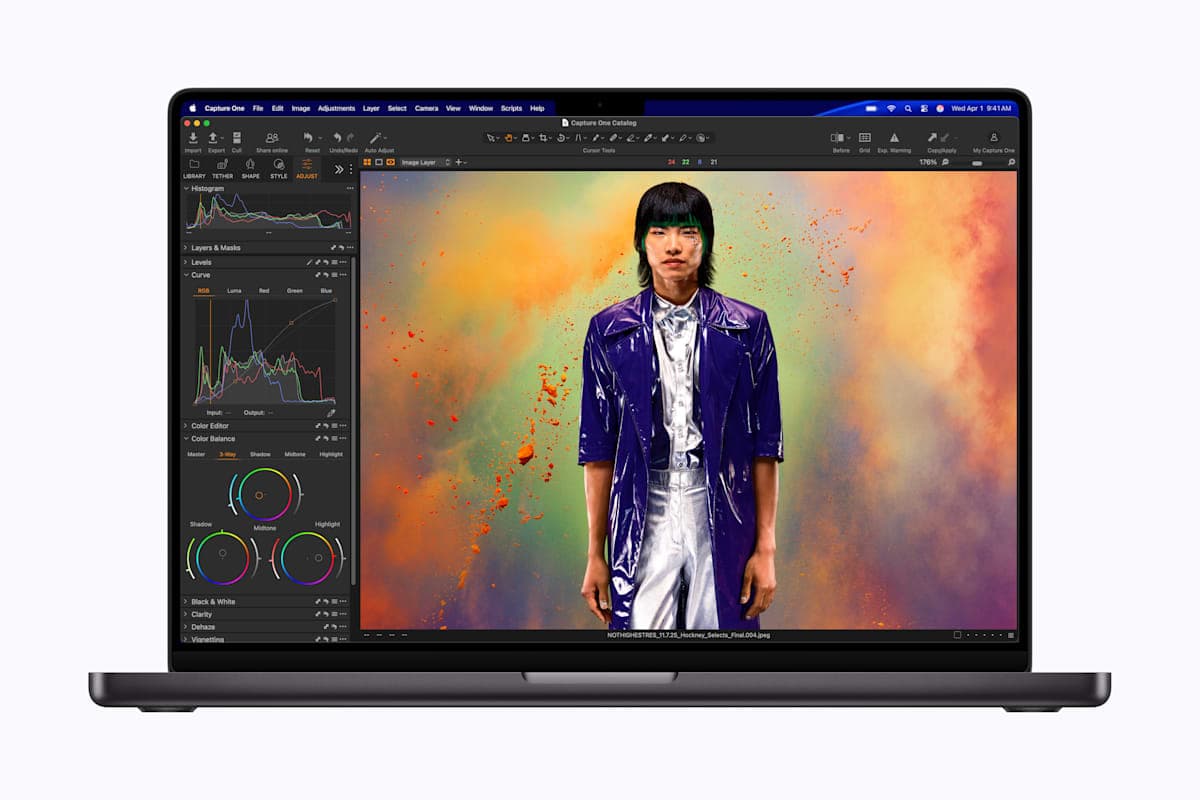
Apple has unveiled its latest MacBook Pro models, integrating the new M5 Pro and M5 Max chips designed with a "Fusion Architecture" to deliver significant performance boosts, particularly in AI workloads. These updated 14-inch and 16-inch laptops arrive with increased base storage, enhanced connectivity via the N1 chip, and higher price points, setting a new bar for professional-grade portable computing.

Apple Silicon's New Frontier: M5 Pro and M5 Max

The core of these new MacBook Pros lies in the M5 Pro and M5 Max chips, which are built around Apple's innovative "Fusion Architecture." This advanced design merges two dies (a small, individual unit of semiconductor material) into a single, high-performance system on a chip (SoC). This integration includes a powerful CPU, a scalable GPU, a Media Engine, a unified memory controller, a Neural Engine, and Thunderbolt 5 capabilities .

The M5 Pro chip is configurable with a CPU that features either 15 or 18 cores, paired with 16 or 20 GPU cores. The M5 Max pushes these limits further, offering 18 CPU cores alongside a more robust 32 or 40 GPU cores. A key highlight is the inclusion of Neural Accelerators within each GPU core, which contributes to a substantial increase in AI processing power. Apple claims these chips deliverup to 4x AI performance compared to the previous generation and an even more impressive 8x AI performance over M1 models, unlocking new AI-enabled workflows for developers, researchers, and creatives.

M5 Pro & M5 Max Core Configurations

Chip Model CPU Cores GPU Cores Base Unified Memory Designed For
M5 Pro 15 or 18 16 or 20 24GB or 48GB Data modelers, post-production sound designers, STEM students
M5 Max 18 32 or 40 36GB (14-inch), 2TB Storage (16-inch) 3D animators, app developers, AI researchers

What Do the New MacBook Pros Offer?

Beyond the raw chip power, the new MacBook Pros come with several significant upgrades. The base model 14-inch MacBook Pro with an M5 Pro now starts with either 24GB or 48GB of unified RAM and a minimum of 1TB of storage, which is double the 512GB standard of the prior generation. For the 16-inch MacBook Pro, the M5 Pro configuration begins with 18 CPU cores, 20 GPU cores, 24GB of RAM, and 1TB of storage, again doubling the previous model's storage. The M5 Max models push this further, starting with 36GB of RAM and 2TB of storage.

Apple also notes that the storage in these new laptops is twice as fast as the previous generation, meaning not only more space but also quicker data access. Connectivity receives an upgrade with the inclusion of the Apple-designed N1 chip, enabling Wi-Fi 7 and Bluetooth 6, promising improved wireless performance and reliability. The laptops retain the "excellent" Liquid Retina XDR display and a 12-megapixel "Center Stage" front-facing camera, features that have been mainstays in recent generations. Battery life is also impressive, with Apple rating the new MacBook Pro for up to 24 hours of use on a single charge.


Pricing and Availability: A Premium for Power

The most notable change for many consumers will be the increased pricing across the entire MacBook Pro lineup. The 14-inch M5 model, which previously started at $1,599, is now priced at $1,699. Similarly, the 14-inch model with the M5 Pro starts at $2,199, up from $1,999, while the 16-inch M5 Pro model now begins at $2,699, an increase from $2,499. The M5 Max configurations start at $3,599 for the 14-inch variant and $3,899 for the 16-inch, both including 2TB of storage and 36GB of RAM. While these are substantial price hikes, Apple does offset some of this by doubling the base storage configurations on many models, providing more value for the increased cost. Pre-orders started on March 4, with shipping and in-store availability beginning March 11.

What This Means For You

1

For Developers and AI Researchers

The significant boost in AI performance, up to 4x compared to the previous generation, driven by the new Fusion Architecture and Neural Accelerators, means you can run more complex models and AI-enabled workflows directly on your laptop. This could accelerate development cycles and reduce reliance on cloud compute for certain tasks. For Founders and Creative Professionals: While the price increase—for instance, the 14-inch M5 Pro model is now $200 more expensive at $2,199—might impact initial hardware investment, the doubled base storage (e.g., 1TB for the 14-inch M5 Pro) and twice-as-fast SSDs could lead to long-term efficiency gains. This translates to quicker project load times and smoother handling of large media files. For Power Users: The addition of Wi-Fi 7 and Bluetooth 6 via the N1 chip ensures future-proofed, faster, and more reliable wireless connectivity. This is particularly beneficial in congested environments or for high-bandwidth applications, ensuring your MacBook Pro remains a top performer for years to come. For Potential Upgraders: If you're coming from an older Intel-based Mac or even an M1 model, the performance leap, especially in GPU and AI tasks, will be substantial. However, if you recently purchased an M3 or M4 Pro/Max MacBook, the incremental gains, while significant for specific workloads, might not justify the immediate upgrade given the higher price points. Research Sources techcrunch.com 9to5mac.com theverge.com

FAQ

The latest MacBook Pro models feature Apple's M5 Pro and M5 Max chips, which use a 'Fusion Architecture' for enhanced performance, especially in AI tasks. These laptops come in 14-inch and 16-inch sizes, offer increased base storage, and improved connectivity via the N1 chip. The chips also include Neural Accelerators within each GPU core, significantly boosting AI processing power.

The M5 Pro and M5 Max chips deliver up to 4x the AI performance compared to the previous generation of MacBook Pro models. Compared to the older M1 models, the new chips offer an even more impressive 8x increase in AI performance. This improvement unlocks new AI-enabled workflows for professionals in various fields.

The M5 Pro chip offers configurations with either 15 or 18 CPU cores and 16 or 20 GPU cores. The M5 Max chip features 18 CPU cores and either 32 or 40 GPU cores. These configurations allow users to choose the chip that best suits their specific needs, whether it's data modeling, 3D animation, or AI research.

Apple's new MacBook Pro models with M5 Pro and M5 Max chips were released after a delay from the initial M5 chip announcement. Pre-orders for the new models opened on March 4, with an expected ship date of March 11. The updated MacBook Pro lineup aims to deliver top-tier performance for intensive tasks, especially in AI.

Related Articles

More insights on trending topics and technology

Newsletter

Stay informed without the noise.

Daily AI updates for builders. No clickbait. Just what matters.