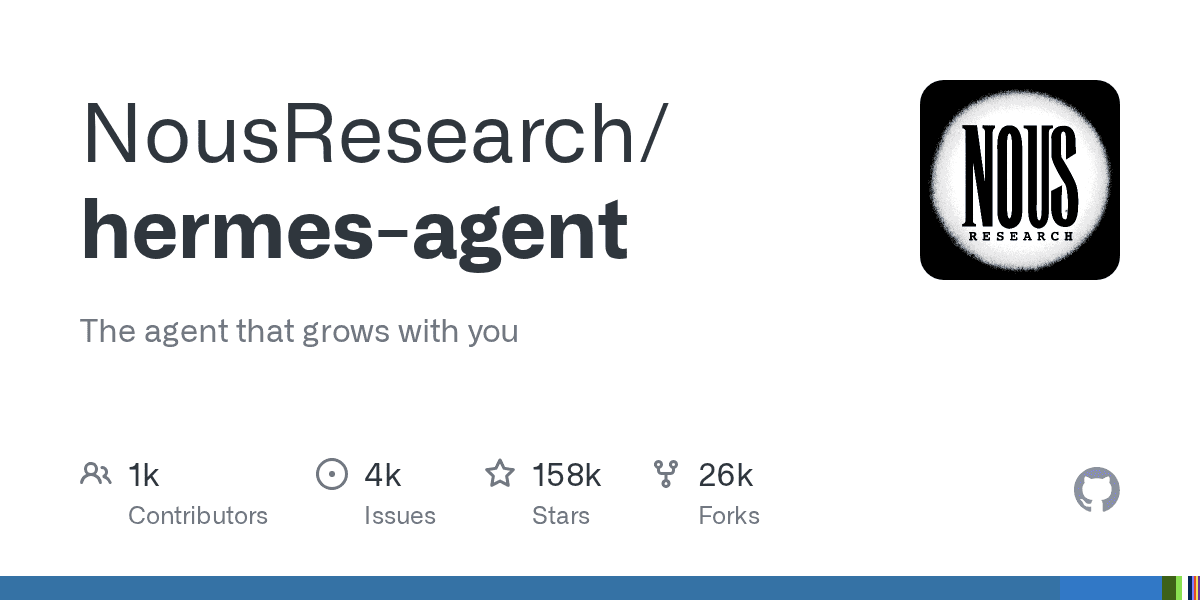
Hermes Agent is an open-source AI agent from Nous Research designed to learn and evolve through user interaction. Unlike static tools, it autonomously creates and refines its own skills, recalls past conversations to build context, and runs on diverse platforms, from local machines to cloud servers. As of its v0.14.0 release in May 2026, it supports over 200 large language models, according to its official GitHub repository.
This project represents a shift from single-session, command-based AI assistants to persistent partners that improve over time. The agent is built to remember user preferences and past project details, creating a deepening model of the user across multiple sessions and platforms. With over 158,000 stars on GitHub, it has gained significant traction within the developer community.
The agent's architecture is model-agnostic, allowing users to switch between providers like OpenAI, Kimi, NVIDIA NIM, and various open-source alternatives via OpenRouter without code changes.
What is the "Closed Learning Loop"?
The core of Hermes Agent is its closed learning loop, a system designed for continuous self-improvement. Instead of relying on developers to manually update its capabilities, the agent learns directly from its own operations and user feedback. This process involves several key functions.
First, it can autonomously generate new "skills" after completing a complex task. These skills are reusable procedures it can call upon later. The agent then refines these skills during subsequent use, optimizing them for better performance. It also uses periodic "nudges" to reinforce its knowledge and maintains a searchable memory of past conversations, allowing for cross-session recall and context.
This functionality directly addresses a common pain point in agent development: the reliance on manual "vibe-checking" to gauge quality. By creating an automated feedback mechanism, Hermes aims to build a more robust and reliable assistant that grows with the user.
How Does Hermes Agent Run Anywhere?
A key design principle of Hermes Agent is its platform independence. It is not tethered to a single desktop or development environment. The agent can be deployed and interacted with across a wide range of platforms:
- Messaging Gateways: A single gateway process connects the agent to Telegram, Discord, Slack, WhatsApp, and Signal. This allows for continuous conversation and task management from any device.
- Terminal Backends: It supports seven different terminal backends, including local terminals, Docker containers, SSH, and serverless platforms like Modal and Daytona.
- Hardware Flexibility: The agent is designed to run on minimal hardware, such as a $5 virtual private server (VPS), as well as on powerful GPU clusters. Serverless options allow it to hibernate when idle, reducing costs significantly.
This flexibility extends to its tooling. The agent can spawn isolated subagents for parallel tasks and execute Python scripts that call tools via remote procedure calls (RPC). For developers migrating from similar projects, Hermes even provides an automated migration path from the OpenClaw agent, importing settings, skills, and API keys.
The Trending Society Take
The Hermes Agent isn't just another tool; it's a statement about the future of AI interaction. The industry is moving past one-shot, stateless assistants toward persistent, stateful partners. By building a "memory" directly into its core loop, Hermes provides a practical blueprint for agents that build relationships and institutional knowledge over time.
For AI founders and builders, this project highlights the next frontier: creating systems that don't just execute commands but learn from them. The focus on a closed learning loop and platform independence makes it a powerful reference for anyone building truly personalized and adaptive AI experiences. This is how agents move from being simple utilities to indispensable collaborators.