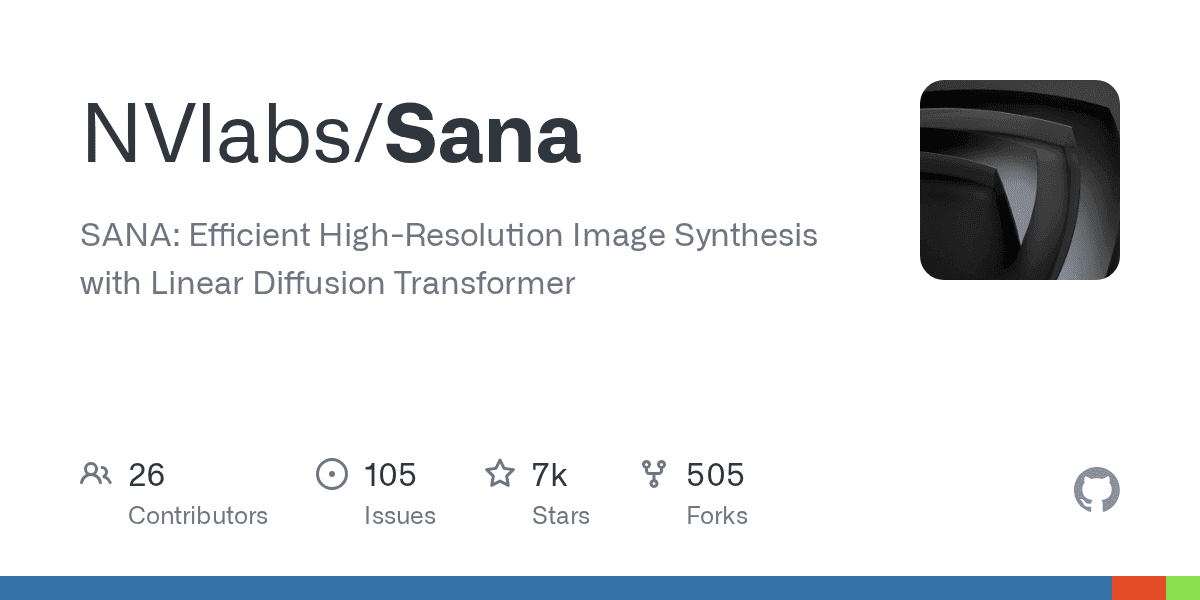
NVlabs has released Sana, an open-source project designed for highly efficient, high-resolution image and video generation. The framework uses a Linear Diffusion Transformer to deliver performance comparable to much larger models, while being trainable and deployable on significantly less powerful hardware, according to the project's GitHub repository.
The most recent update in May 2026 introduced SANA-WM, a 2.6 billion parameter controllable world model. This new component can generate 720p, one-minute-long videos and allows for 6-degrees-of-freedom (6-DoF) camera control. This positions Sana as a new baseline for world modeling and embodied AI research, pushing beyond simple image or short-clip generation into creating explorable digital scenes.
What Is the Sana Ecosystem?
Sana is not a single model but a comprehensive, efficiency-focused codebase with complete training and inference pipelines. The project is structured as a family of specialized models, each targeting a different generative task while sharing a core architecture.
The main components include:
- Sana: The foundational text-to-image model capable of generating images up to 4K resolution.
- Sana-Sprint: A distilled version for one-step image generation, creating a 1024px image in just 0.1 seconds on an H100 GPU.
- Sana-Video: A model specifically for text-to-video and TextImage-to-Video tasks, which can be upscaled to 2K resolution.
- Sol-RL: An infrastructure for reinforcement learning that enables faster model convergence using low-precision data for rollouts.
This modular approach allows developers to use the entire pipeline or select specific components for their needs, from rapid prototyping with Sana-Sprint to creating complex video sequences with SANA-WM.
How Does It Achieve This Efficiency?
Sana's performance advantage comes from a few key architectural choices that move away from the brute-force scaling seen in other large generative models. Instead of relying on ever-larger parameter counts, it focuses on computational efficiency at its core.
The primary technique is the use of Linear Attention instead of the standard attention mechanism found in most Diffusion Transformers (DiT). This avoids the quadratic scaling of computational cost and memory that traditionally limits high-resolution image synthesis, making 4K generation feasible.
Another key innovation is the DC-AE (Deep-learning based Compression AutoEncoder), which compresses images by a factor of 32x before they are processed by the diffusion model. This is a significant improvement over the typical 8x compression, drastically reducing the amount of data the model needs to handle. Through 4-bit quantization, some Sana models can run on consumer GPUs with less than 8GB of VRAM, making advanced AI media generation widely accessible.
The Trending Society Take
Sana represents a critical counter-current in the AI arms race. While many labs are pursuing scale at any cost, NVlabs is delivering elite performance through algorithmic efficiency. By open-sourcing a full image and video pipeline that can run on consumer hardware, Sana empowers individual builders and startups to compete in a space currently dominated by trillion-dollar companies.
This isn't just about making free tools; it's about changing the direction of innovation. Efficient, adaptable, and open models like Sana ensure the future of AI development remains decentralized and accessible, preventing the ecosystem from consolidating into a handful of closed, expensive platforms. For AI founders, this is a clear signal that smart architecture can be a more powerful advantage than raw compute.