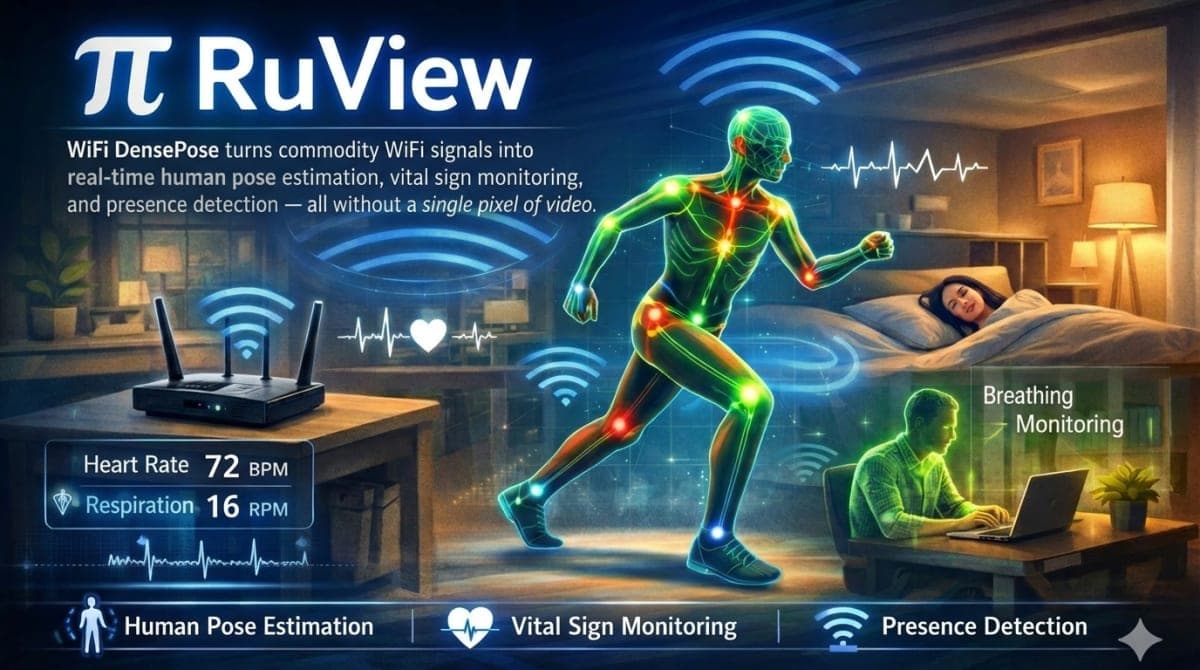
An open-source project called RuView turns commodity WiFi signals into a spatial sensing system capable of detecting human presence, monitoring vital signs, and even estimating body pose through walls. According to its GitHub repository, the system uses low-cost hardware and sophisticated signal processing to achieve this without using any cameras, microphones, or wearables.
The project, which has gained over 59,800 stars on GitHub, leverages a phenomenon known as Channel State Information (CSI). Every WiFi router fills a space with radio waves; when these waves are disturbed by movement, breathing, or even a heartbeat, the changes can be measured. RuView captures these minute disturbances with low-cost ESP32 hardware and processes them at the edge to create actionable intelligence. A recent update on May 14, 2026, introduced new low-latency capabilities.
How Does It Turn WiFi Into a Sensor?
RuView works by analyzing how radio signals from existing WiFi networks scatter and change as they pass through a room. The system doesn't require special routers; it uses either existing access points or a mesh of dedicated ESP32-S3 sensor nodes, which cost as little as $9 per node.
The core of the system runs entirely on edge hardware, eliminating the need for a cloud connection and associated privacy concerns. Data from the ESP32 mesh can be processed by a companion device called a Cognitum Seed for more advanced AI tasks and persistent memory. Key capabilities of the system include:
- Presence and Occupancy: Detecting people through walls, counting them, and tracking entries or exits.
- Vital Signs: Contactlessly measuring breathing rate (6-30 BPM) and heart rate (40-120 BPM).
- Activity Recognition: Identifying actions like walking, sitting, or falling from patterns in the WiFi signal.
- Pose Estimation: Reconstructing a 17-point human skeleton, similar to the COCO model, using an architecture called WiFlow.
The system is designed for privacy by default. Since it processes signal disturbances rather than images or audio, it bypasses many privacy regulations like GDPR for video or HIPAA for medical imaging.
What Are the Real-World Applications?
The range of applications spans from home automation to emergency services. In elderly care, RuView can provide fall detection with an alert time of less than two seconds and monitor nighttime breathing without requiring a wearable device. In commercial settings, it can provide GDPR-compliant foot traffic analysis for retail stores or optimize HVAC systems in offices based on actual room occupancy.
For developers, RuView offers a comprehensive platform with over 60 pre-built edge intelligence modules. These are small WebAssembly (WASM) programs that run directly on the ESP32 for tasks like "Sleep Apnea Detection," "Forklift Proximity," and "Perimeter Breach." This modularity allows builders to deploy specific sensing capabilities for unique use cases, from monitoring crowd density at events to detecting survivors through rubble in disaster scenarios.
The Trending Society Take
RuView represents a powerful trend in ambient computing, turning passive infrastructure into an active sensing layer. The project's depth is remarkable, offering not just a proof-of-concept but a full-stack solution from firmware to deployable WASM modules and even a plugin for the AI assistant Claude.
However, the project's bet on a Claude plugin arrives at an interesting time. As The Verge reports, giants like Microsoft are consolidating their developer tools, pushing engineers toward integrated solutions like GitHub Copilot CLI and away from third-party tools. While RuView's open platform is a massive strength for independent builders, its long-term adoption may depend on how it navigates a developer ecosystem increasingly dominated by walled gardens.