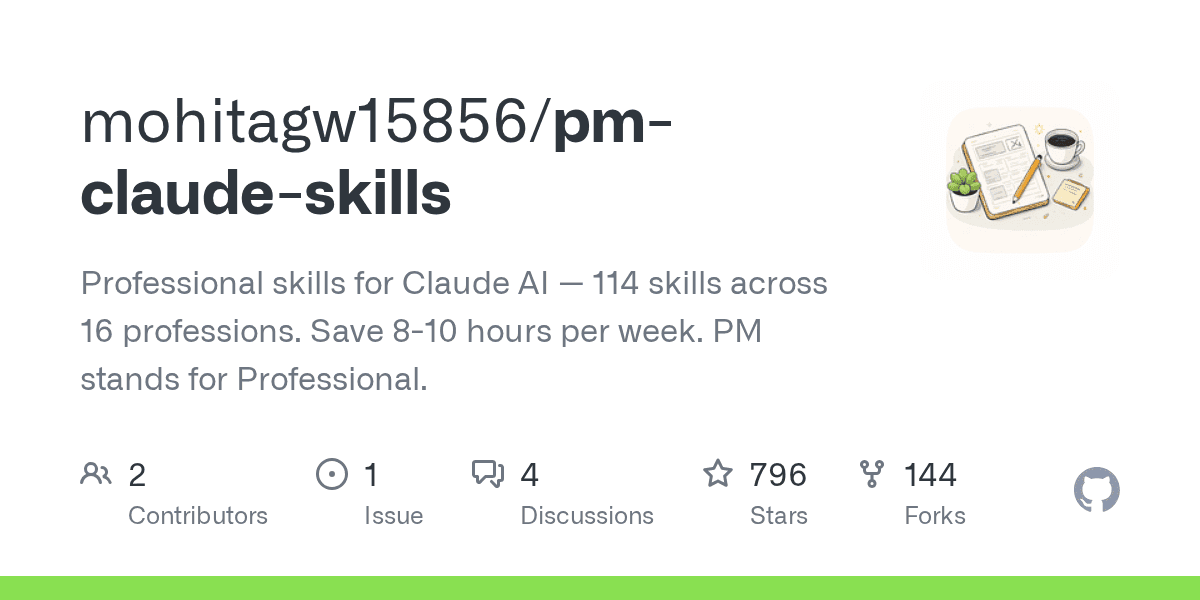
An open-source library called `pm-claude-skills` now offers 114 pre-built skills for Anthropic's Claude AI, spanning 16 professions from engineering to finance and law. The project, detailed on its GitHub repository, provides structured templates that teach Claude to perform specific, professional-grade tasks, aiming to reduce workflows that take hours down to just minutes.
This initiative comes as Anthropic itself pushes deeper into specialized vertical markets. The company recently released agent templates for financial services on May 5, 2026, and is expanding its formal offerings for legal and small business clients. The `pm-claude-skills` library represents a massive, community-driven parallel effort to bring that same level of automation to a much broader range of professions.
What Are Claude Skills?
Unlike a standard prompt, a Claude "Skill" is a detailed markdown file that gives the AI a structured framework for a recurring task. Each skill file defines the trigger, context, and desired output format, teaching Claude how to produce a consistent, professional-grade document like a project status report, a legal contract review, or a customer health scorecard.
The library was built by product manager Mohit Aggarwal and has grown to include contributions from a wider community. The collection bundles skills by profession, with notable toolkits for:
- Engineering: 14 skills including a `Debugging Log Analyser`, `PR Description Writer`, and `CI/CD Playbook`.
- Product Management: 34 skills covering the entire product lifecycle, from discovery to launch.
- Customer Success: Skills for creating QBR decks, escalation briefs, and churn analysis reports.
- Legal & Finance: Templates for contract review, NDA analysis, and financial model narratives.
This approach allows users to install entire professional toolkits with a single command, making specialized AI capabilities immediately accessible without extensive prompt engineering.
How Do Agent Templates Automate Workflows?
The library has evolved beyond individual skills to include four pre-built "Agent Templates." These templates represent a significant step up in automation by chaining together multiple components to execute an entire workflow. An agent template typically combines three elements:
1. Skills: The structured output formats for each step of the process. 2. Connectors: Governed access to a team's internal data sources, like Jira, Notion, or Salesforce. 3. Subagents: Focused Claude models assigned to perform specialized sub-tasks, such as risk scoring or data synthesis.
For example, the PM Sprint Agent template automates the entire sprint planning process. It uses connectors to pull backlog items from Jira, leverages a `sprint-planning` skill to structure the plan, and deploys subagents to analyze team capacity and score risks. The repository claims this turns a 90-minute planning session into a 90-second task. The library now includes four working agent templates for sprint planning, customer discovery, stakeholder communication, and product launches.
These templates serve as reference implementations, demonstrating how developers and teams can build their own custom agents for workflows in sales, HR, marketing, and operations using the library's 114 modular skills.
The Trending Society Take
The `pm-claude-skills` project highlights a powerful trend in the AI ecosystem: the move from monolithic, general-purpose models to composable, task-specific agents. While major AI labs like Anthropic build official, enterprise-grade solutions for high-value verticals, open-source libraries like this empower individual builders to assemble their own sophisticated automations for any niche. This is the next layer of the AI stack, where value shifts from the base model to the orchestration and workflow intelligence built on top.