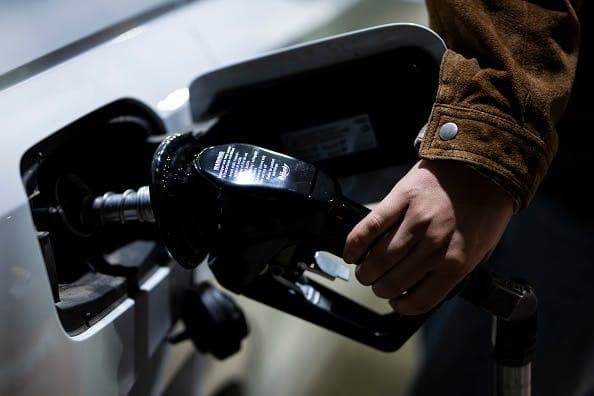
The primary driver is the soaring price of crude oil, which has at times pushed past $100 per barrel due to the ongoing conflict in the Middle East. To mitigate these rising energy costs, the U.S. Department of Energy announced it would release 172 million barrels of oil from strategic reserves over the next four months. This is part of a broader international effort to stabilize the market.
But that's not the whole story. The real concern is how high prices could climb from here.
Prediction markets, which allow people to trade on the outcome of future events, are signaling further pain at the pump. Traders are factoring in an implied 62% probability that the national average price of gasoline will exceed $4.00 by the end of this month, per Sherwood News.
The outlook gets even more expensive from there. Markets are pricing in roughly even chances that gas could finish above $4.10, and a non-trivial 22% chance that the average hits $4.50 per gallon by March 31. These figures reflect deep uncertainty in the global energy supply chain.
This volatility isn't just a market phenomenon; it's creating a significant political problem. The spike in gas prices is clashing with Republican plans to win the November elections on a message of affordability, according to CNBC. Some lawmakers expressed hope that the conflict would end soon, allowing prices to fall before voters head to the polls.
| Region/State | Recent Price Increase | Current Average (approx.) |
|---|---|---|
| National Average | +$0.35 / gallon (last week) | $3.60 / gallon |
| Indiana | +$0.53 / gallon (last week) | $3.36 / gallon |
| Laredo, TX | +$0.73 / gallon (last week) | $3.15 / gallon |
| Arizona | +$0.60 / gallon (last month) | N/A |
| California | +$0.27 / gallon (last week) | $4.89 / gallon |
Re-evaluate Your Commuting Budget
The 62% market probability of $4 gas is a direct signal to prepare for higher costs. This isn't a minor fluctuation; it's a trend that will directly impact your monthly expenses, especially if you have a long commute.
Watch Geopolitical News
The price at the pump is a lagging indicator. The real driver is the price of crude oil, which is tied to the conflict in the Middle East. News of escalation or de-escalation in that region will be the best predictor of where prices go next.
Anticipate Continued Regional Differences
As the data shows, states in the Midwest and South are seeing the most dramatic increases. If you're planning a road trip, be aware that fuel costs could vary significantly along your route, with interior states bearing the brunt of the hikes.
Gas prices are surging due to rising crude oil costs, which have exceeded $100 per barrel at times, and geopolitical tensions. The national average has jumped nearly $0.60 in under two weeks, reaching almost $3.60 per gallon. Increased travel demand with warmer weather also contributes to the rising prices.
Prediction markets indicate a 62% probability that the national average gas price will exceed $4.00 per gallon by the end of the month. There's also a roughly even chance that gas could finish above $4.10, and a 22% chance the average hits $4.50 per gallon by the end of the month.
The U.S. Department of Energy will release 172 million barrels of oil from strategic reserves over the next four months to help stabilize the market. This action is part of a broader international effort to mitigate rising energy costs driven by global instability.
Laredo, Texas saw the largest increase at +$0.73 per gallon last week, followed by Arizona at +$0.60 per gallon last month, and Indiana at +$0.53 per gallon last week. California has the highest average gas price at $4.89 per gallon after an increase of $0.27 last week.
More insights on trending topics and technology