
Open Sources
Curated repos, tools, and frameworks shaping the developer ecosystem.
Live data from GitHub.
Curated repos, tools, and frameworks shaping the developer ecosystem.
Live data from GitHub.
by HKUDS
DeepTutor: Lifelong Personalized Tutoring. https://deeptutor.info/.





Features · Get Started · Explore · CLI · Ecosystem · Community
🤝 We welcome any kinds of contributing! Vote on roadmap items or propose new ones at
Roadmap, and see our Contributing Guide for branching strategy, coding standards, and how to get started.
[2026.7.24] v1.5.4 — Maintenance sweep: the post-answer "generating" stall is gone, IM partners render Markdown tables faithfully, LLM JSON parsing is sturdier, plus quiz, create-KB form, and Math Animator fixes.
[2026.7.24] v1.5.3 — Themeable code blocks, four more coding CLIs in My Agents (Gemini, Kimi, opencode, MiMo), an Atlas Cloud LLM provider, and a broad chat, memory, embedding, and parsing reliability sweep.
[2026.7.19] v1.5.2 — Configurable chat attachment limits, PageIndex retrieval that reasons across your documents via agentic tool calls, broader Anthropic/OpenAI model support, and steadier Book, Knowledge Base, and chat UI.
[2026.7.9] v1.5.1 — Remove a single failed document from a knowledge base — even one stuck in an error state — instead of deleting and rebuilding the whole base.
[2026.7.4] v1.5.0 — LlamaIndex ingestion now honors your Document Parsing engine with multimodal image extraction, Partner & Soul ids stay URL-safe for non-Latin names, and optional RAG extras install cleanly on Python 3.14+.
[2026.6.30] v1.4.15 — A native Mattermost channel for Partners, plus fixes so Guided Learning multiple-choice questions grade correctly and a configured zero chunk overlap is honored.
[2026.6.29] v1.4.14 — Click an assigned partner to chat in one step, Deep Research flags partial reports, LightRAG indexes without MinerU, FAISS handles non-ASCII paths, and PocketBase sessions are isolated per user.
[2026.6.27] v1.4.13 — Partners support non-Latin names and become assignable to users, logos render after login (#599), tiny knowledge bases retrieve reliably, and containers start cleanly under rootless Podman.
[2026.6.24] v1.4.12 — A new LightRAG Server retrieval engine, a lightweight PyMuPDF4LLM parsing engine, and a FAISS vector backend that makes large knowledge-base retrieval dramatically faster.
[2026.6.23] v1.4.11 — Native tool calling on every cloud OpenAI-compatible provider, a redesigned admin Users page, LaTeX in quiz options, an honest session-loading spinner, and configurable container host binding.
[2026.6.21] v1.4.10 — A self-service Profile page with avatars, a rootless-ready container guide with a single-port request-time proxy, and deny-by-default MCP tools for non-admin users.
[2026.6.19] v1.4.9 — Settings polish: Search shows only the fields your provider needs, connection profiles can be renamed and auto-named by provider, and graded Mastery Path questions flow into your Question Bank.
[2026.6.18] v1.4.8 — Connect your own Partners under My Agents and consult them live in chat — answering through their own persona, library and skills — and each Partner gains its own private memory.
[2026.6.18] v1.4.7 — Connect your local Claude Code / Codex and consult it live mid-turn, My Agents graduates to a top-level
/agents, and Partner conversations gain branch / resume / delete with a replayable trace.
[2026.6.17] v1.4.6 — Four-surface consolidation: a Space learning dashboard with importable My Agents and top-level Memory, a Knowledge Center with GraphRAG / PageIndex / LightRAG / linked-KB / Obsidian, opened-up Settings, and per-model capability gating.
[2026.6.14] v1.4.5 — Guided Learning rebuilt on the chat agent loop with a hard per-type mastery gate and a
/learningdashboard, a new loop-plugin framework, plus Markdown export / save-to-notebook for Partner conversations.
[2026.6.13] v1.4.4 — Install community skills from ClawHub with
deeptutor skill installbehind a security gate, plus real in-browser DOCX/XLSX previews for knowledge-base files.
[2026.6.12] v1.4.3 — TutorBot becomes Partners on a production-grade IM pipeline (15 channels, live streaming), Chat moves to a single agent loop, real per-user isolation, and a rebuilt Visualize.
[2026.5.28] v1.4.2 — Stability + polish: Gemini 2.5+ unblocked across Visualize and Chat, auth-routing fix (#485), smooth-streaming chat UX, a Recents sidebar, and Lemonade local-provider support.
[2026.5.27] v1.4.1 — Security + stability: TutorBot tool sandbox locked down, per-user resource isolation, multimodal image fallback, an HTTP/SSE API for TutorBots, and a v1.4.0 chat regression fix.
[2026.5.22] v1.4.0 — GA cut of v1.4: Auto Mode, three-layer Memory, agentic Deep Research / Solve / Question, LlamaIndex RAG refactor, Visualize/Animator merge, and restart-safe turn runtime.
[2026.5.21] v1.4.0-beta — Three-layer Memory workbench (L1/L2/L3), every chat capability rebuilt on a single agentic engine, LlamaIndex-only RAG, and a unified Settings + Capabilities surface.
[2026.5.10] v1.3.10 — Remote Docker CORS recovery,
DISABLE_SSL_VERIFYacross SDK providers, safer code-block citations, and optional Matrix E2EE add-on.
[2026.5.9] v1.3.9 — TutorBot Zulip and NVIDIA NIM support, safer thinking-model routing,
deeptutor start, sidebar tooltips, and session-store parity.
[2026.5.8] v1.3.8 — Optional multi-user deployments with isolated user workspaces, admin grants, auth routes, and scoped runtime access.
[2026.5.4] v1.3.7 — Thinking-model/provider fixes, visible Knowledge index history, and safer Co-Writer clear/template editing.
[2026.5.3] v1.3.6 — Catalog-based model selection for chat and TutorBot, safer RAG re-indexing, OpenAI Responses token-limit fixes, and Skills editor validation.
[2026.5.2] v1.3.5 — Smoother local launch settings, safer RAG queries, cleaner local embedding auth, and Settings dark-mode polish.
[2026.5.1] v1.3.4 — Book page chat persistence and rebuild flows, chat-to-book references, stronger language/reasoning handling, RAG document extraction hardening.
[2026.4.30] v1.3.3 — NVIDIA NIM + Gemini embedding support, unified Space context for chat history/skills/memory, session snapshots, RAG re-index resilience.
[2026.4.29] v1.3.2 — Transparent embedding endpoint URLs, RAG re-index resilience for invalid persisted vectors, memory cleanup for thinking-model output, Deep Solve runtime fix.
[2026.4.28] v1.3.1 — Stability: safer RAG routing & embedding validation, Docker persistence, IME-safe input, Windows/GBK robustness.
[2026.4.27] v1.3.0 — Versioned KB indexes with re-index workflow, rebuilt Knowledge workspace, embedding auto-discovery with new adapters, Space hub.
[2026.4.25] v1.2.5 — Persistent chat attachments with file-preview drawer, attachment-aware capability pipelines, TutorBot Markdown export.
[2026.4.25] v1.2.4 — Text/code/SVG attachments, one-command Setup Tour, Markdown chat export, compact KB management UI.
[2026.4.24] v1.2.3 — Document attachments (PDF/DOCX/XLSX/PPTX), reasoning thinking-block display, Soul template editor, Co-Writer save-to-notebook.
[2026.4.22] v1.2.2 — User-authored Skills system, chat input performance overhaul, TutorBot auto-start, Book Library UI, visualization fullscreen.
[2026.4.21] v1.2.1 — Per-stage token limits, Regenerate response across all entry points, RAG & Gemma compatibility fixes.
[2026.4.20] v1.2.0 — Book Engine "living book" compiler, multi-document Co-Writer, interactive HTML visualizations, Question Bank @-mention.
[2026.4.18] v1.1.2 — Schema-driven Channels tab, RAG single-pipeline consolidation, externalized chat prompts.
[2026.4.17] v1.1.1 — Universal "Answer now", Co-Writer scroll sync, unified settings panel, streaming Stop button.
[2026.4.15] v1.1.0 — LaTeX block math overhaul, LLM diagnostic probe, Docker + local LLM guidance.
[2026.4.14] v1.1.0-beta — Bookmarkable sessions, Snow theme, WebSocket heartbeat & auto-reconnect, embedding registry overhaul.
[2026.4.13] v1.0.3 — Question Notebook with bookmarks & categories, Mermaid in Visualize, embedding mismatch detection, Qwen/vLLM compatibility, LM Studio & llama.cpp support, and Glass theme.
[2026.4.11] v1.0.2 — Search consolidation with SearXNG fallback, provider switch fix, and frontend resource leak fixes.
[2026.4.10] v1.0.1 — Visualize capability (Chart.js/SVG), quiz duplicate prevention, and o4-mini model support.
[2026.4.10] v1.0.0-beta.4 — Embedding progress tracking with rate-limit retry, cross-platform dependency fixes, and MIME validation fix.
[2026.4.8] v1.0.0-beta.3 — Native OpenAI/Anthropic SDK (drop litellm), Windows Math Animator support, robust JSON parsing, and full Chinese i18n.
[2026.4.7] v1.0.0-beta.2 — Hot settings reload, MinerU nested output, WebSocket fix, and Python 3.11+ minimum.
[2026.4.4] v1.0.0-beta.1 — Agent-native architecture rewrite (~200k lines): Tools + Capabilities plugin model, CLI & SDK, TutorBot, Co-Writer, Guided Learning, and persistent memory.
[2026.1.23] v0.6.0 — Session persistence, incremental document upload, flexible RAG pipeline import, and full Chinese localization.
[2026.1.18] v0.5.2 — Docling support for RAG-Anything, logging system optimization, and bug fixes.
[2026.1.15] v0.5.0 — Unified service configuration, RAG pipeline selection per knowledge base, question generation overhaul, and sidebar customization.
[2026.1.9] v0.4.0 — Multi-provider LLM & embedding support, new home page, RAG module decoupling, and environment variable refactor.
[2026.1.5] v0.3.0 — Unified PromptManager architecture, GitHub Actions CI/CD, and pre-built Docker images on GHCR.
[2026.1.2] v0.2.0 — Docker deployment, Next.js 16 & React 19 upgrade, WebSocket security hardening, and critical vulnerability fixes.
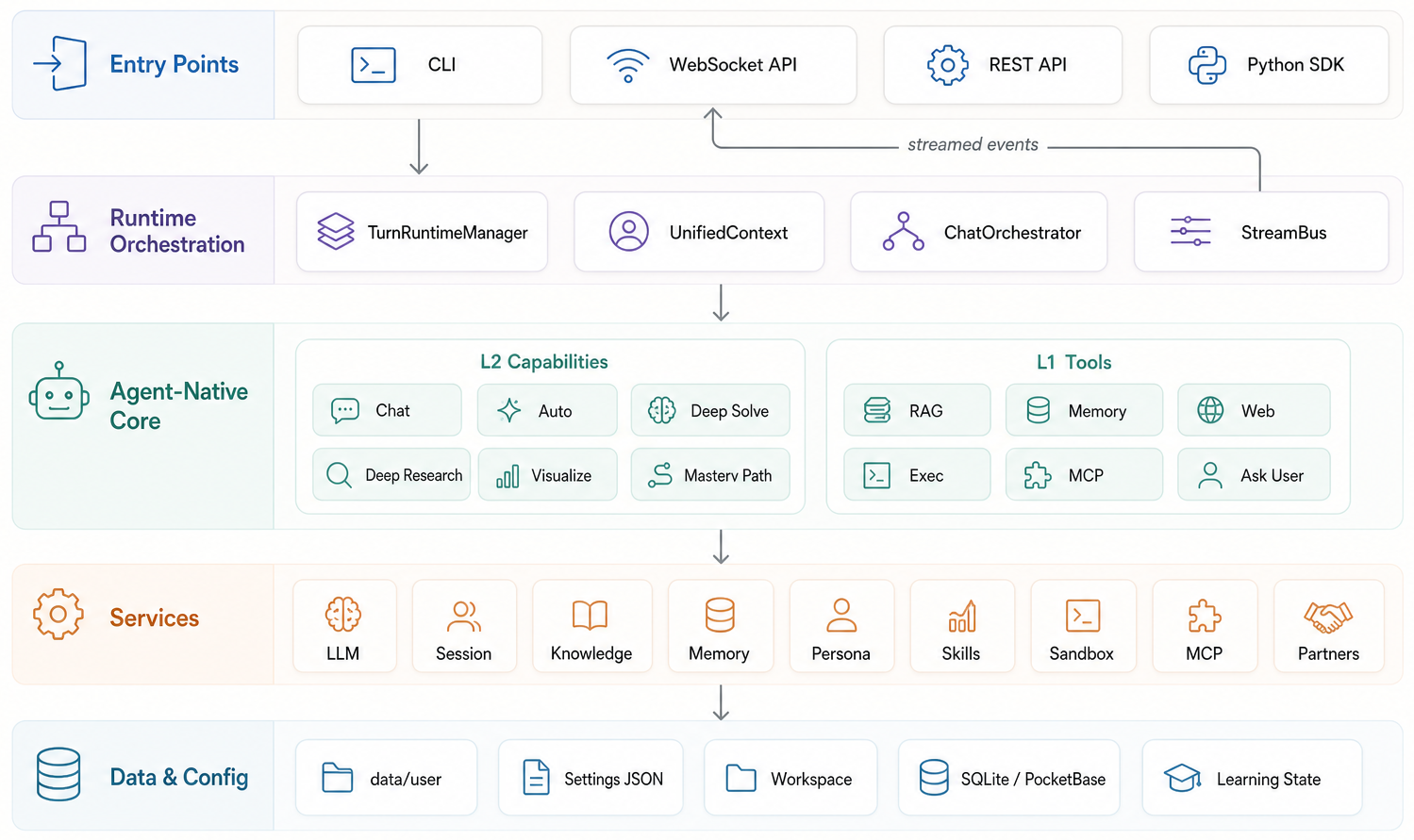
DeepTutor is an agent-native learning workspace that connects tutoring, problem solving, quiz generation, research, visualization, and mastery practice in one extensible system.
DeepTutor ships four installation paths. They all share one workspace layout: settings live in data/user/settings/ under the directory you launch from (or under DEEPTUTOR_HOME / deeptutor start --home if you set one explicitly). For the full app, the recommended flow is pick a workspace directory → install → deeptutor init → deeptutor start.
Full local Web app + CLI, no clone required. Needs Python 3.11–3.13 and a Node.js 20+ runtime on PATH (the packaged Next.js standalone server is spawned by deeptutor start).
mkdir -p my-deeptutor && cd my-deeptutor
pip install -U deeptutor
deeptutor init     # prompts for ports + LLM provider + optional embedding
deeptutor start    # starts backend + frontend; keep the terminal open
deeptutor init prompts for backend port (default 8001), frontend port (default 3782), LLM provider / base URL / API key / model, and an optional embedding provider for Knowledge Base / RAG.
After deeptutor start, open the frontend URL printed in the terminal — by default http://127.0.0.1:3782. Press Ctrl+C in that terminal to stop both backend and frontend. Skipping deeptutor init is fine for a quick trial; the app boots with default ports and empty model settings, configure them later in Settings → Models.
For development against a checkout. Use Python 3.11–3.13 and Node.js 22 LTS to match CI and Docker.
git clone https://github.com/HKUDS/DeepTutor.git
cd DeepTutor

# Create a venv (macOS/Linux). Windows PowerShell:
#   py -3.11 -m venv .venv ; .\.venv\Scripts\Activate.ps1
python3 -m venv .venv && source .venv/bin/activate
python -m pip install --upgrade pip

# Install backend + frontend deps
python -m pip install -e .
( cd web && npm ci --legacy-peer-deps )

deeptutor init
deeptutor start
Source installs run Next.js in dev mode against the local web/ directory; everything else (config layout, ports, stop with Ctrl+C) matches Option 1.
venv)conda create -n deeptutor python=3.11
conda activate deeptutor
python -m pip install --upgrade pip
pip install -e ".[dev]"             # tests/lint tools
pip install -e ".[partners]"        # Partner IM channel SDKs + MCP client
pip install -e ".[matrix]"          # Matrix channel without E2EE/libolm
pip install -e ".[matrix-e2e]"      # Matrix E2EE; requires libolm
pip install -e ".[math-animator]"   # Manim addon; requires LaTeX/ffmpeg/system libs
Changing frontend dependencies: run npm install --legacy-peer-deps to refresh web/package-lock.json, then commit both web/package.json and web/package-lock.json.
Stuck dev server: if deeptutor start reports an existing frontend that isn't responding, stop the PID it prints. If no Next.js process is actually running, the lock files are stale — remove them and retry:
rm -f web/.next/dev/lock web/.next/lock
deeptutor start
One container for the full Web app. Images on GitHub Container Registry:
ghcr.io/hkuds/deeptutor:latest — stable releaseghcr.io/hkuds/deeptutor:pre — pre-release, when availableSee CONTAINERIZATION.md for podman/rootless/read-only-rootfs deployments and the full per-installation guide.
docker run --rm --name deeptutor \
  -p 127.0.0.1:3782:3782 \
  -v deeptutor-data:/app/data \
  ghcr.io/hkuds/deeptutor:latest
Only
3782needs to be published. The browser talks exclusively to the frontend origin; the Next.js middleware (web/proxy.ts) forwards/api/*and/ws/*to the FastAPI backend inside the container. Publishing8001(-p 127.0.0.1:8001:8001) is optional — handy only for hitting the API directly with curl or scripts.
Open http://127.0.0.1:3782. The container creates /app/data/user/settings/*.json on first boot; configure model providers from the Web Settings page. Config, API keys, logs, workspace files, memory, and knowledge bases persist in the deeptutor-data volume.
-p host:container mapping (e.g. -p 127.0.0.1:8088:3782). If you change container-side ports in /app/data/user/settings/system.json, restart and update the right side of each mapping to match.-d, then docker logs -f deeptutor to follow, docker stop deeptutor to stop, docker rm deeptutor before reusing the name. The deeptutor-data volume keeps your settings and workspace across restarts.Remote Docker / reverse proxy: the browser only talks to the frontend
origin (:3782); the in-container Next.js middleware forwards /api/* and
/ws/* to the backend server-side. For the common single-container case you
don't configure an API base at all — just point your reverse proxy / TLS
terminator at :3782. You only need an API base for a split deployment
(backend in a separate container/host): set next_public_api_base in
data/user/settings/system.json to the in-network address the frontend server
uses to reach the backend (it's read server-side, never sent to the browser).
{
  "next_public_api_base": "http://backend:8001"
}
next_public_api_base_external (and its alias public_api_base) are accepted as
lower-precedence fallbacks. CORS uses frontend origins, not API URLs. With
auth disabled, DeepTutor permits normal HTTP/HTTPS browser origins by default.
With auth enabled, add exact frontend origins:
{
  "cors_origins": ["https://deeptutor.example.com"]
}
Inside Docker, localhost is the container itself, not your host machine. To reach a model service running on the host, use the host gateway (recommended):
docker run --rm --name deeptutor \
  -p 127.0.0.1:3782:3782 -p 127.0.0.1:8001:8001 \
  --add-host=host.docker.internal:host-gateway \
  -v deeptutor-data:/app/data \
  ghcr.io/hkuds/deeptutor:latest
Then in Settings → Models, point the provider Base URL at host.docker.internal:
http://host.docker.internal:11434/v1http://host.docker.internal:11434/api/embedhttp://host.docker.internal:1234/v1http://host.docker.internal:8080/v1http://host.docker.internal:13305/api/v1Docker Desktop (macOS/Windows) usually resolves host.docker.internal without --add-host. On Linux, the flag is the portable way to create that hostname on modern Docker Engine.
Linux alternative — host networking: add --network=host and drop the -p flags. The container shares the host network directly, so open http://127.0.0.1:3782 (or the frontend_port in system.json), and host services can be reached with normal localhost URLs like http://127.0.0.1:11434/v1. Note that host networking exposes container ports directly on the host and may conflict with existing services — to keep them on loopback, set BACKEND_HOST=127.0.0.1 and FRONTEND_HOST=127.0.0.1 (see CONTAINERIZATION.md).
When you don't need the Web UI. The CLI-only package is installed from a source checkout, not from PyPI.
git clone https://github.com/HKUDS/DeepTutor.git
cd DeepTutor

# Create a venv (macOS/Linux). Windows PowerShell:
#   py -3.11 -m venv .venv-cli ; .\.venv-cli\Scripts\Activate.ps1
python3 -m venv .venv-cli && source .venv-cli/bin/activate
python -m pip install --upgrade pip

python -m pip install -e ./packaging/deeptutor-cli
deeptutor init --cli
deeptutor chat
deeptutor init --cli shares the same data/user/settings/ layout as the full app but skips the backend/frontend port prompts and defaults embeddings to off (choose Yes if you plan to use deeptutor kb … or RAG tools). It still writes a complete runtime layout (system.json, auth.json, integrations.json, model_catalog.json, main.yaml, agents.yaml) and still prompts for the active LLM provider and model.
deeptutor chat                                          # interactive REPL
deeptutor chat --capability deep_solve --tool rag --kb my-kb
deeptutor run chat "Explain Fourier transform"
deeptutor run deep_solve "Solve x^2 = 4" --tool rag --kb my-kb
deeptutor kb create my-kb --doc textbook.pdf
deeptutor memory show
deeptutor config show
The local deeptutor-cli install ships no Web assets or server dependencies. Keep the source checkout around — the editable install points to it. To add the Web app later, install the PyPI package (Option 1) and run deeptutor init + deeptutor start from the same workspace.
The built-in office skills — docx / pdf / pptx / xlsx — work by having the
model write a short Python script (python-docx, reportlab, openpyxl, …),
run it through the exec / code_execution tools, and hand back a download URL.
Those tools mount whenever a sandbox backend is active, which it is by default
in every deployment shape:
Dockerfile.runner) via DEEPTUTOR_SANDBOX_RUNNER_URL — the
strongest posture, and preferred automatically when present.The subprocess sandbox is controlled by the sandbox_allow_subprocess setting in
data/user/settings/system.json (default true). Running model-generated code
on your host is a real trust decision — set it to false (or export
DEEPTUTOR_SANDBOX_ALLOW_SUBPROCESS=0) to disable host-side execution, at the
cost of the office skills no longer being able to produce files.
data/user/settings/ (JSON/YAML)Everything under data/user/settings/ is plain JSON/YAML. The Settings page in the browser is the recommended editor.
| File | Purpose |
|---|---|
model_catalog.json | LLM, embedding, and search provider profiles; API keys; active models |
system.json | Backend/frontend ports, public API base, CORS, SSL verification, attachment directory and upload/extraction limits |
auth.json | Optional auth toggle, username, password hash, token/cookie settings |
integrations.json | Optional PocketBase and sidecar integration settings |
interface.json | UI language / theme / sidebar preferences |
main.yaml | Runtime behavior defaults and path injection |
agents.yaml | Capability/tool temperature and token settings |
Project-root .env is not read as an application config file. For a minimal model setup, open Settings → Models, add an LLM profile (Base URL / API key / model name), and save. Add an embedding profile only if you plan to use Knowledge Base / RAG features.
Start with the main surfaces you will use day to day: Chat, Partners, My Agents, Co-Writer, Book, Knowledge Center, Learning Space, Memory, and Settings. The tour then covers Multi-User deployments for shared, isolated workspaces.
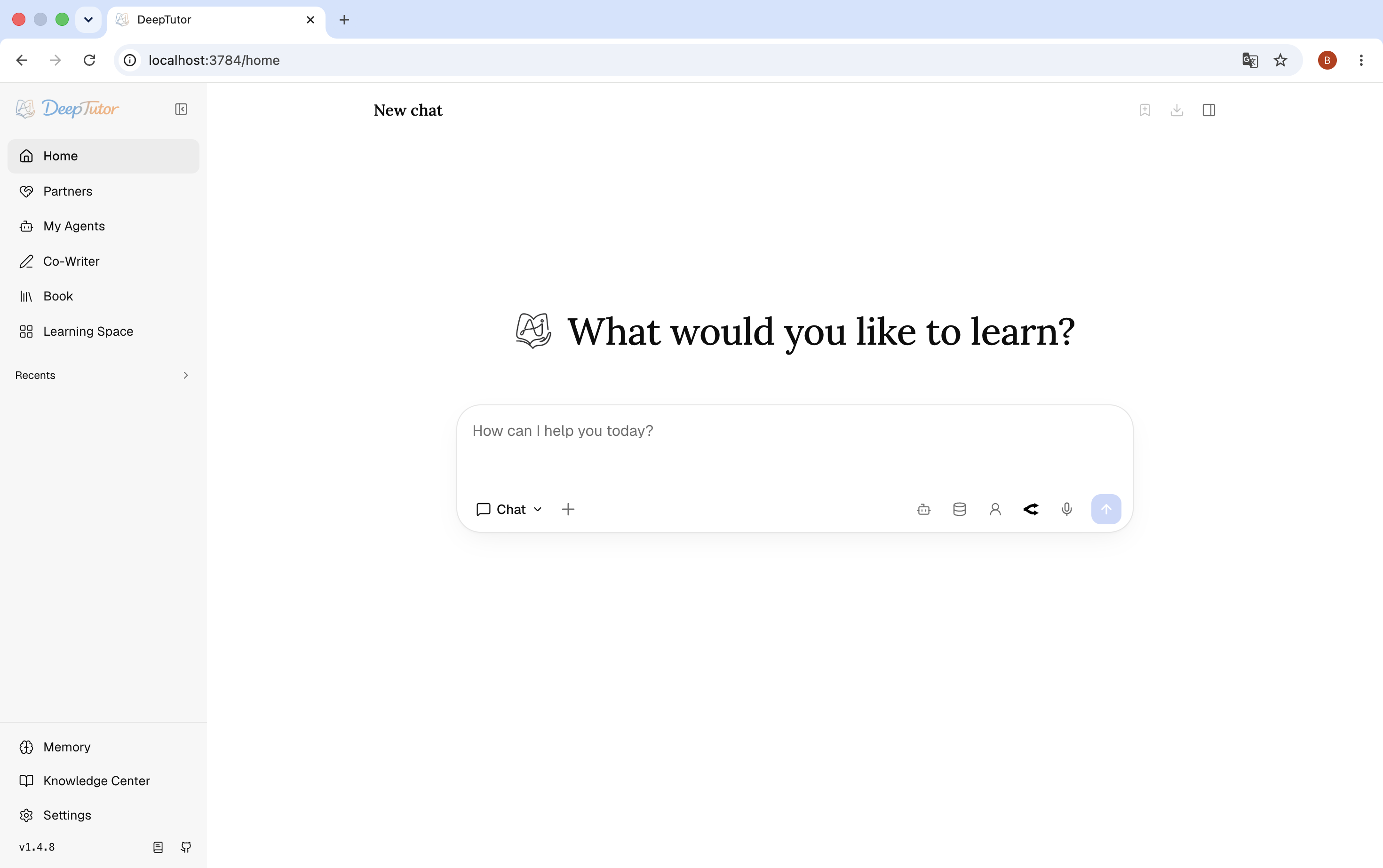
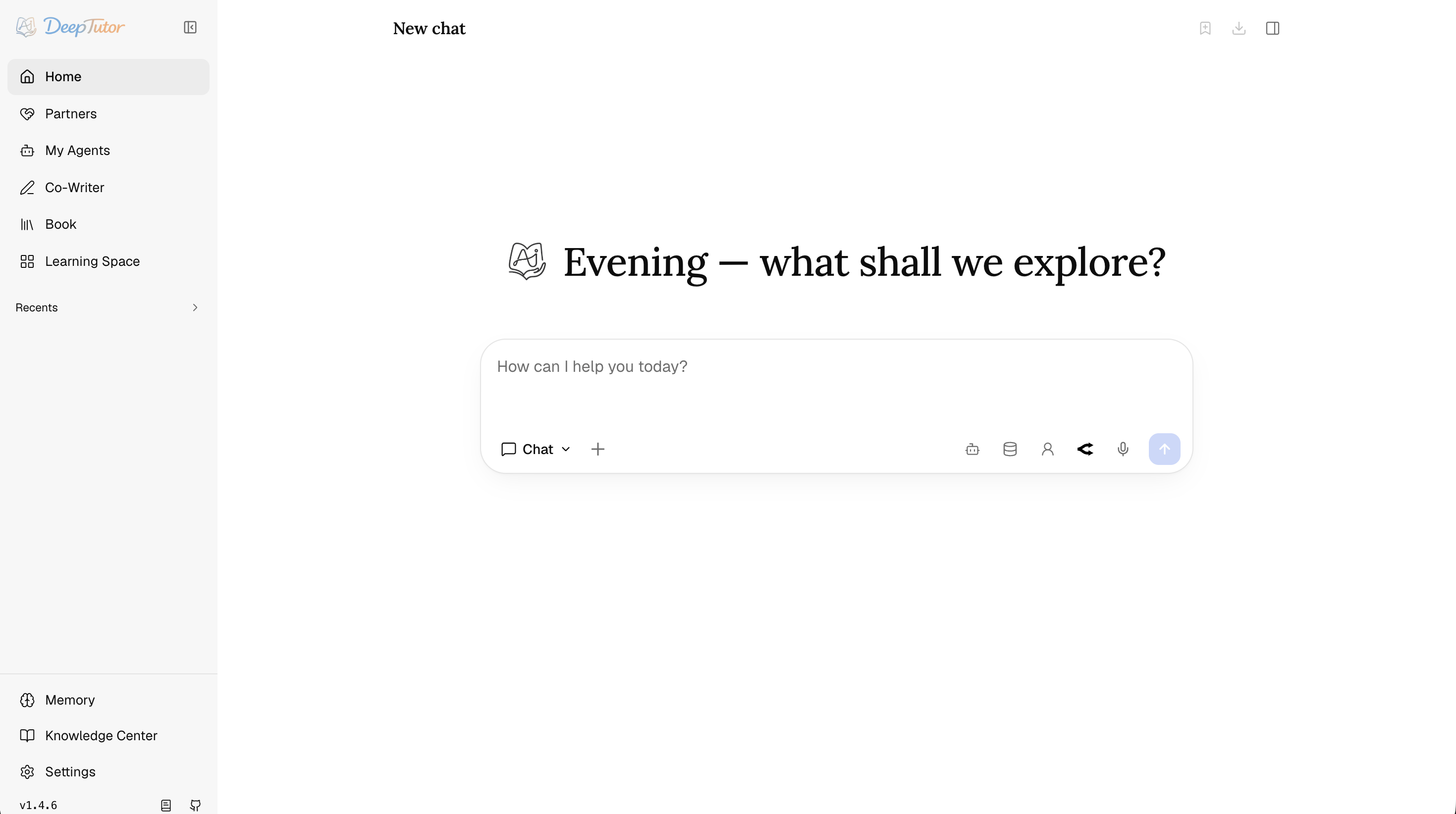
Chat is the default capability and where most work begins. A single thread can talk normally, call tools, ground itself in selected knowledge bases, read attachments, generate images, consult subagents, write notebook records, and continue with the same context across turns.
The loop is deliberately simple: the model thinks in rounds, calls tools when useful, observes the results, and finishes with a tool-free message. ask_user is special — instead of guessing, the agent can pause the turn, ask a structured clarifying question, and resume once you answer.
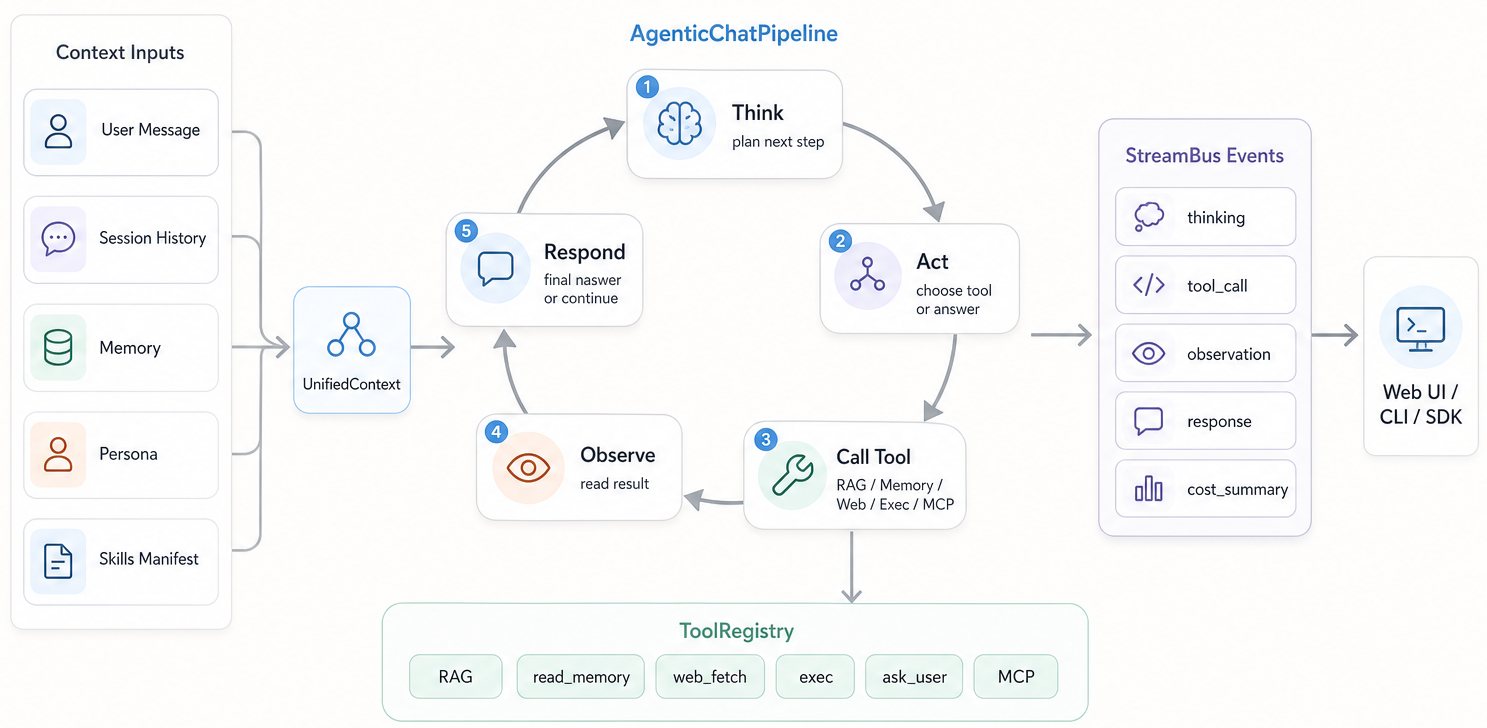
User-toggleable tools are brainstorm, web_search, paper_search, reason, and geogebra_analysis — plus imagegen and videogen once you configure the matching generation model. Contextual tools such as rag, read_source, read_memory, write_memory, read_skill, load_tools, exec, web_fetch, ask_user, list_notebook, write_note, github, and consult_subagent mount automatically when the turn has the right context.
Context comes in two kinds: sticky session context (subagent, knowledge bases, persona, model, voice) lives on the composer toolbar and persists across turns; one-time references (files, chat history, books, notebooks, question bank, imported agents) come from the + menu for a single turn.
Chat is also the launch point for deeper capabilities: Quiz for question generation, Research for cited reports, Visualize for charts / diagrams / animations, and — under More Capabilities — Solve for worked reasoning and Mastery Path for learning-plan flows.
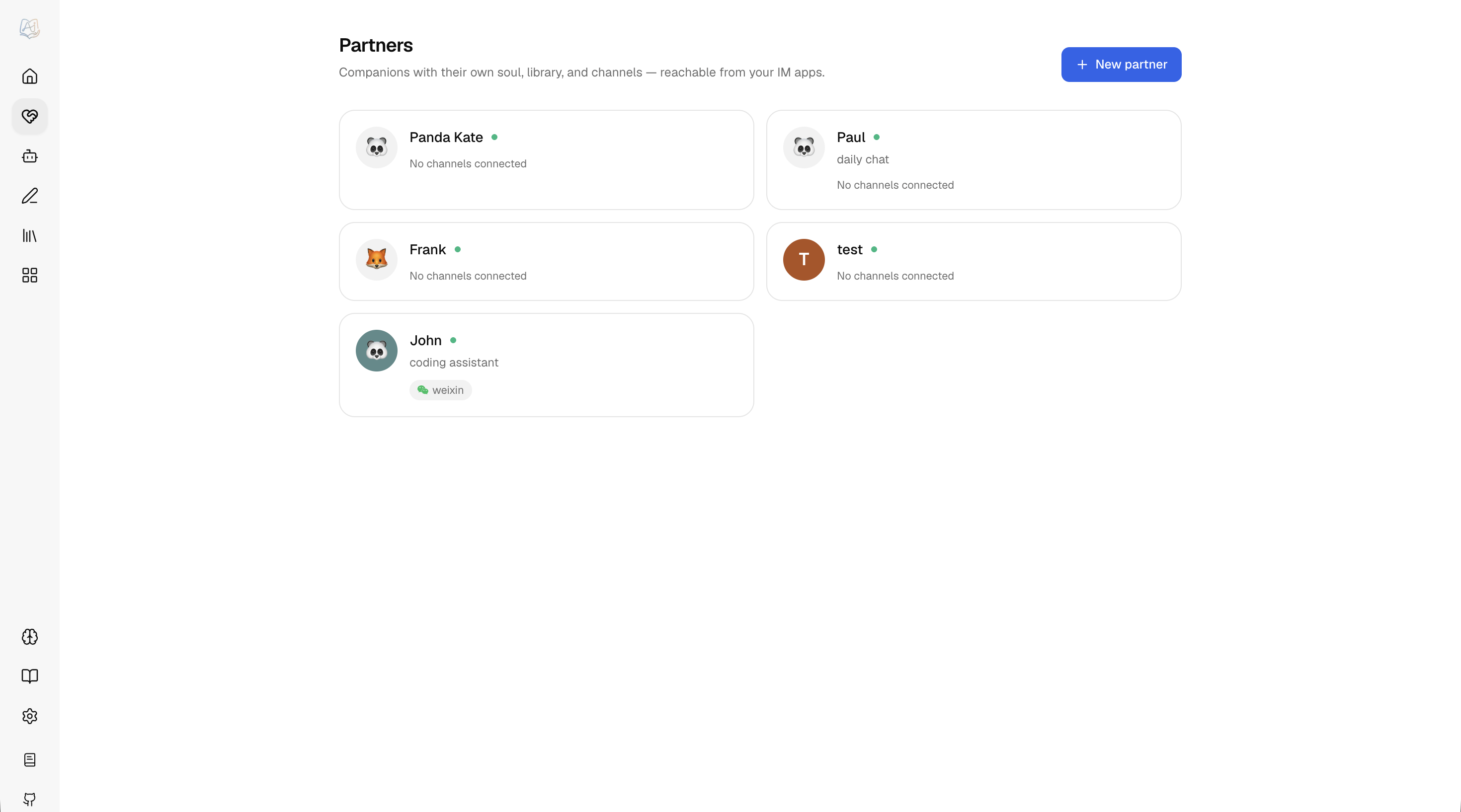
Partners are persistent companions with their own soul, model policy, library, memory, and channels. They are not a separate bot engine: every inbound web or IM message becomes a normal ChatOrchestrator turn inside a partner-scoped workspace. A partner is "a chat that has a personality and a phone number."
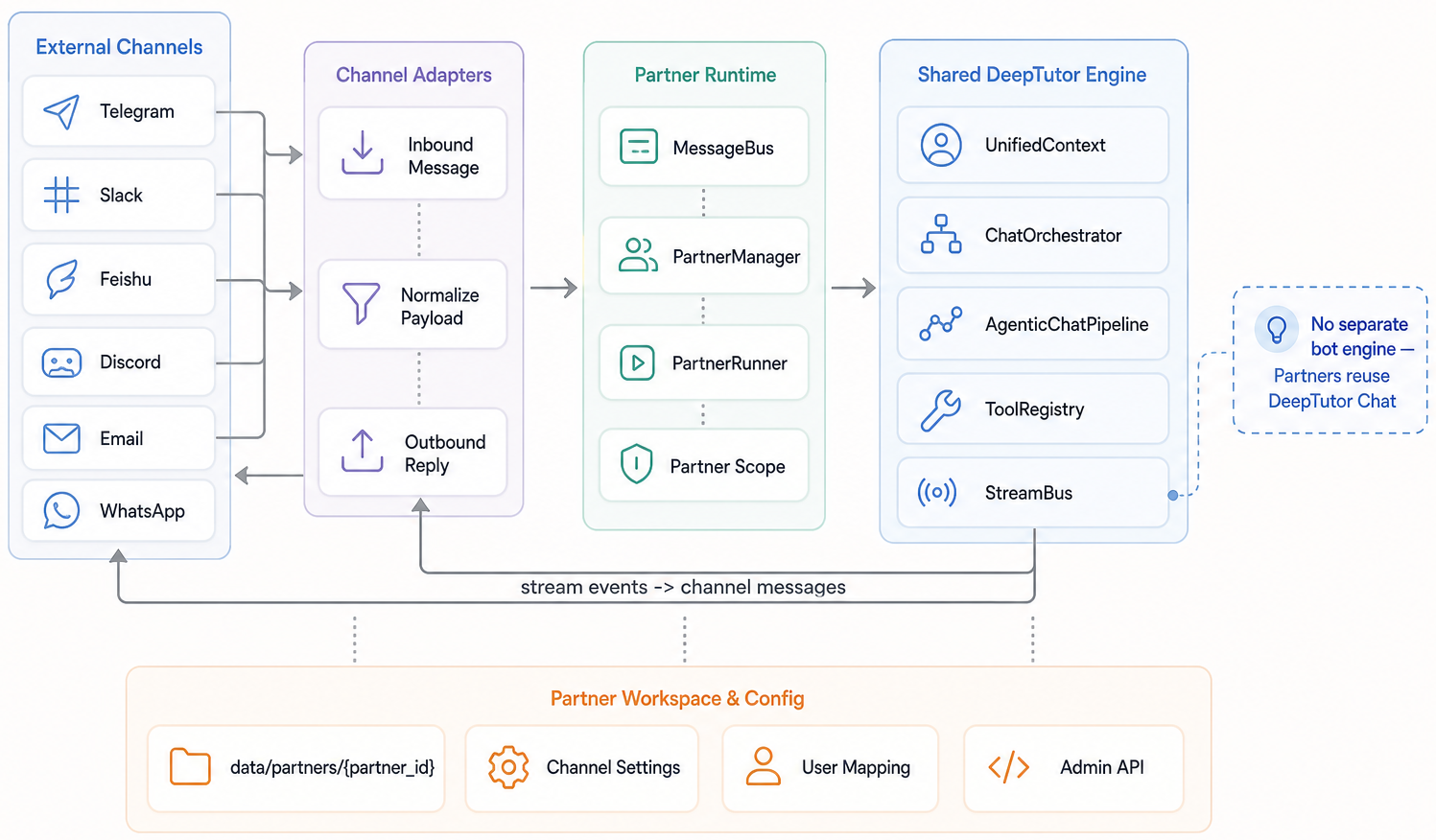
Each partner has a SOUL.md, model selection, channels, tool policy, and assigned library. Knowledge bases, skills, and notebooks are copied into data/partners/<id>/workspace/, so the same RAG, skill, notebook, and memory tools work without special cases. A partner reads its owner's memory but writes only its own.
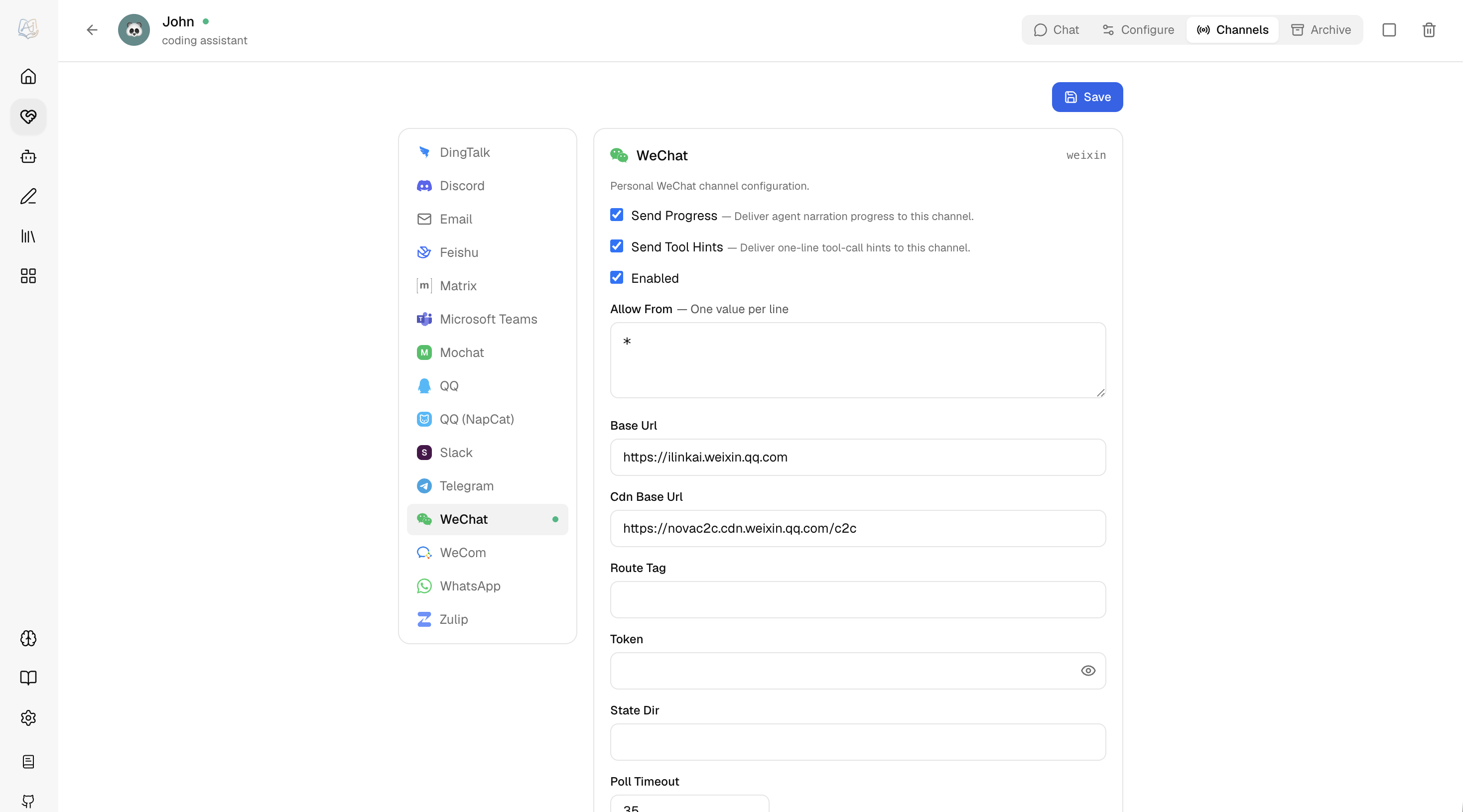
The channel layer is schema-driven and can connect to IM platforms such as Feishu, Telegram, Slack, Discord, DingTalk, QQ/NapCat, WeCom, WhatsApp, Zulip, Mattermost, Matrix, Mochat, and Microsoft Teams depending on installed extras and configured credentials. A partner can also be connected as a subagent and consulted from a normal chat turn — see My Agents below.
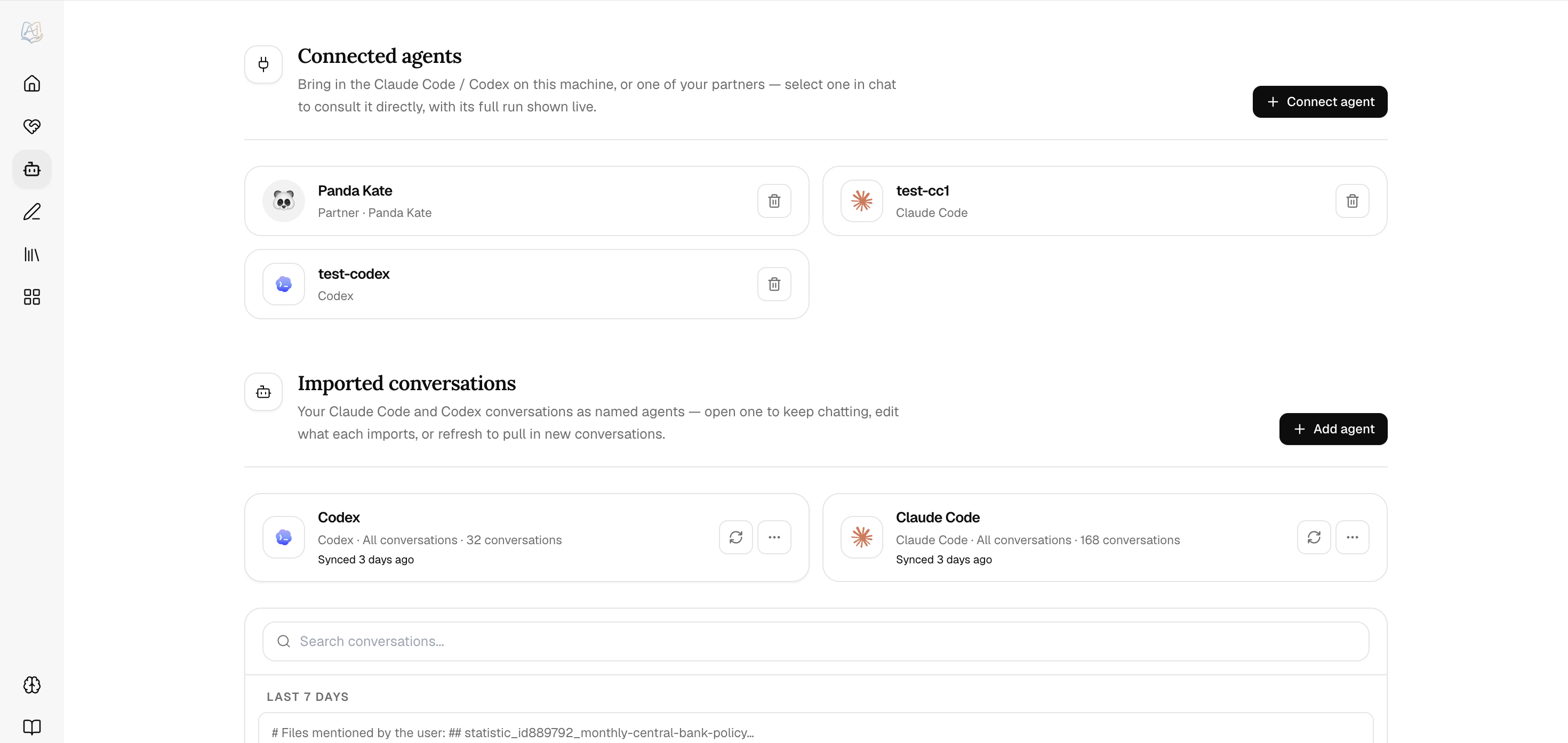
My Agents turns other agents into context for DeepTutor, and does two distinct things. Connect a live agent — a Claude Code, Codex, Gemini, Kimi, opencode, or MiMo Code CLI on your machine, or one of your Partners — and consult it from inside a chat turn: DeepTutor actually runs the other agent and streams its work into the Activity panel via the consult_subagent tool. Select it with the Agent chip (or type @), and set how many rounds the consult may take.
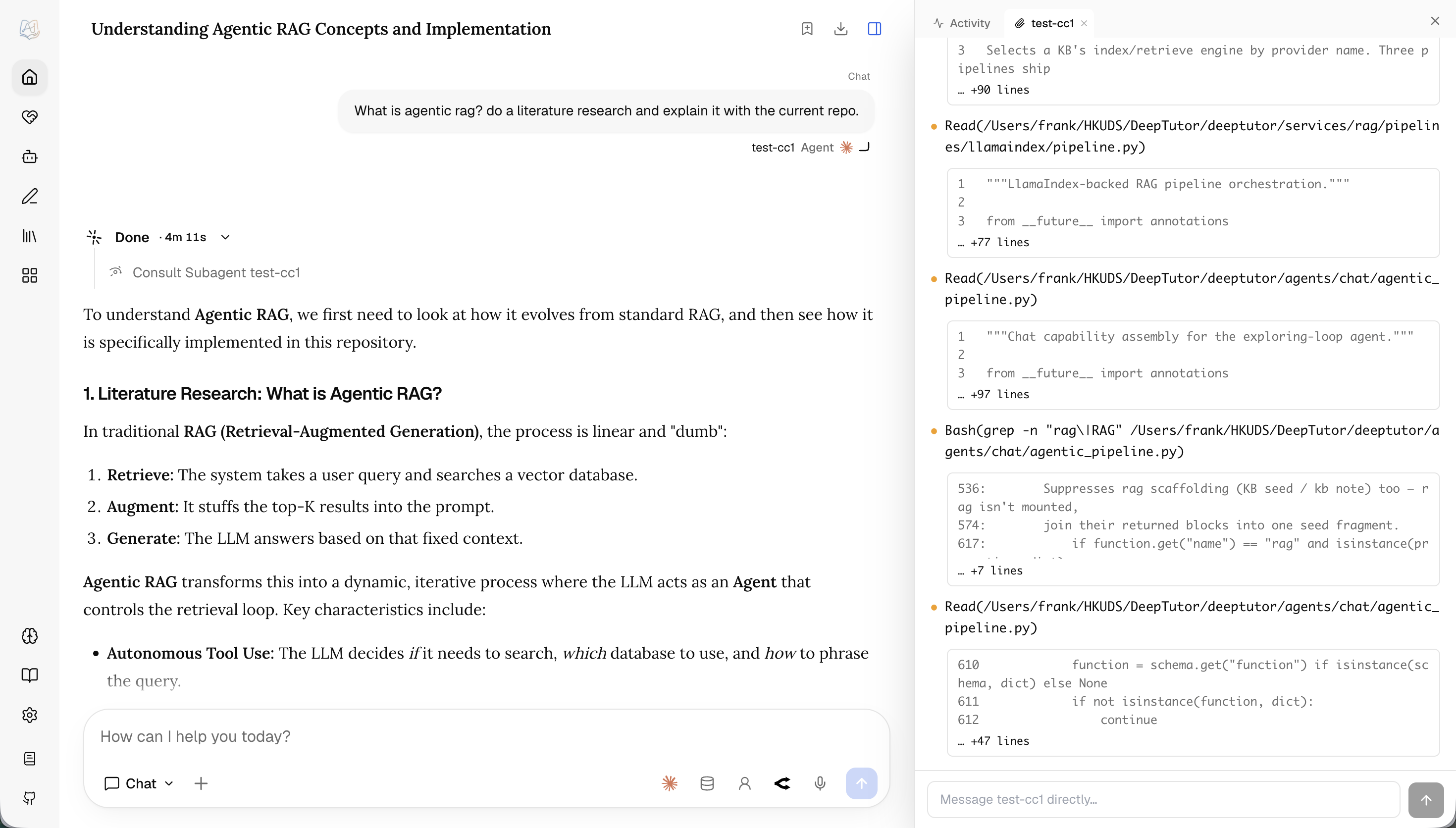
Import past conversations — bring in your existing Claude Code and Codex history as named, searchable, resumable agents. Pick which days to import; refreshing re-syncs them. Reference an imported conversation from any chat turn via + → My Agents, and DeepTutor reads it as a third-party transcript — it stays their conversation, not DeepTutor's own voice.
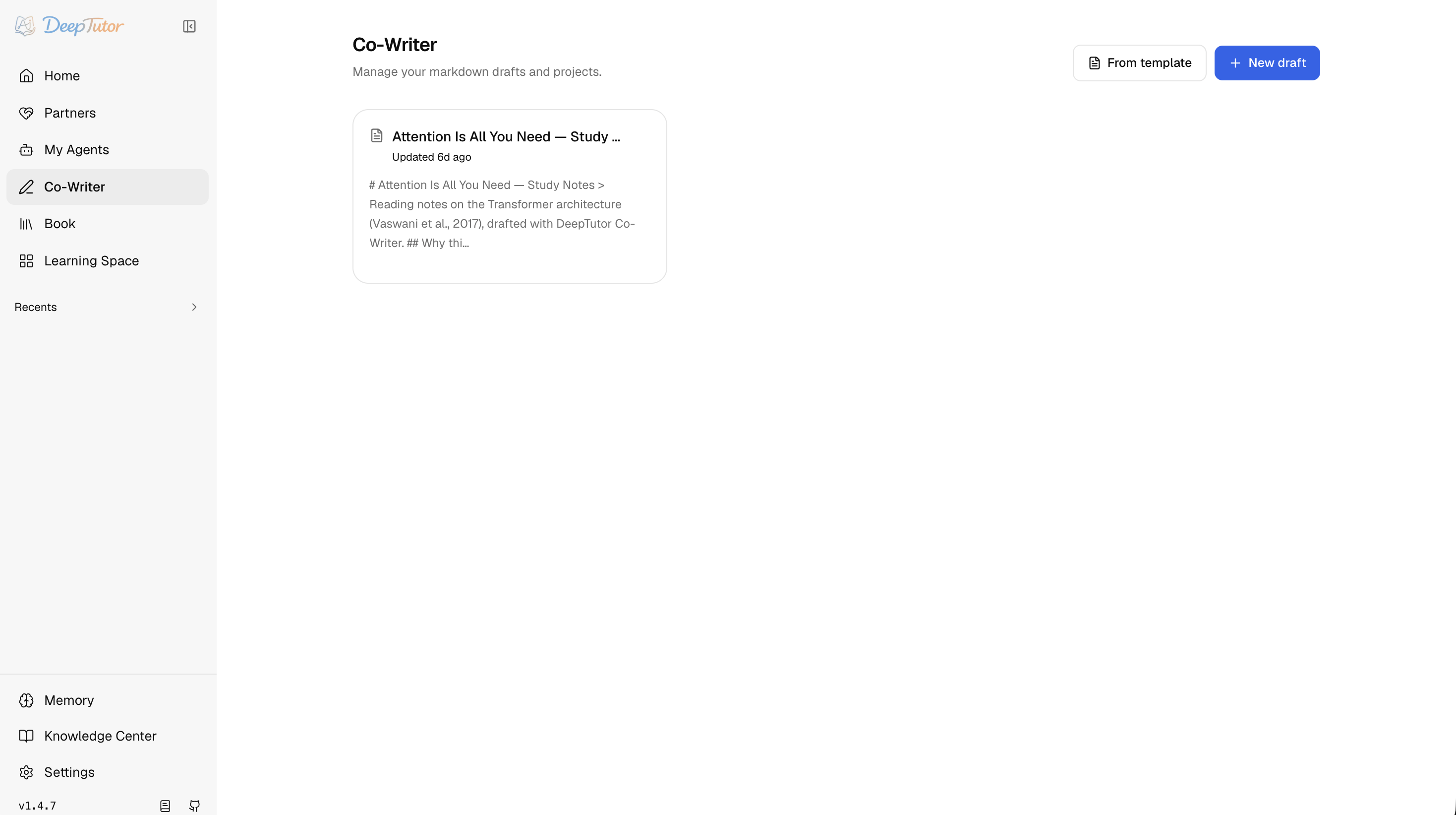
Co-Writer is a split-view Markdown workspace for reports, tutorials, notes, and long-form learning artifacts. Documents autosave and render a live preview (KaTeX math, diagram fences), and can be saved back into notebooks when a draft becomes reusable context.
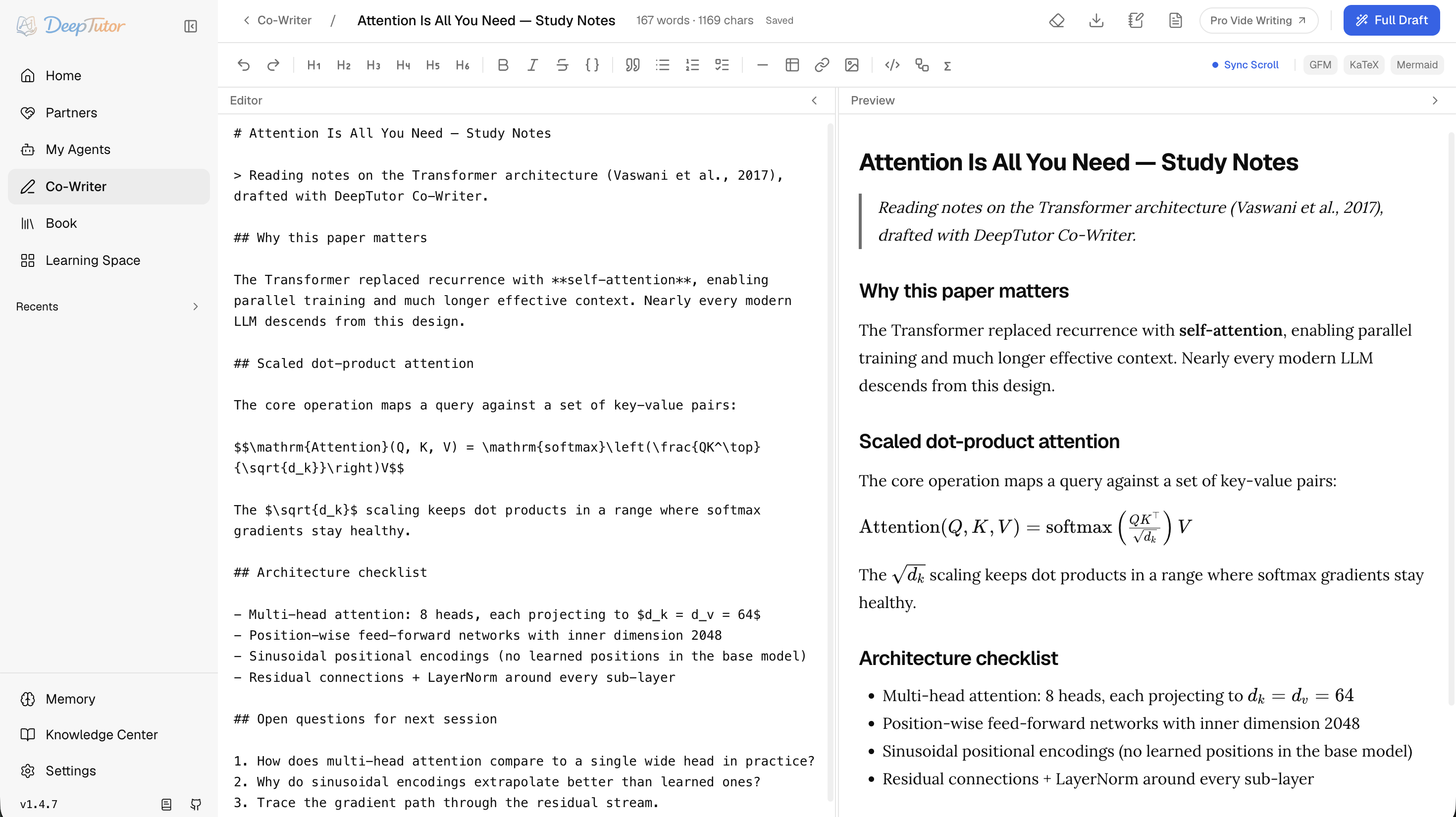
Its defining idea is surgical editing: select a span and ask DeepTutor to rewrite, expand, or shorten it. The edit agent can ground the change in a knowledge base or web evidence, keeps a trace of its tool calls, and shows every change as an accept/reject diff — so nothing lands until you approve it.
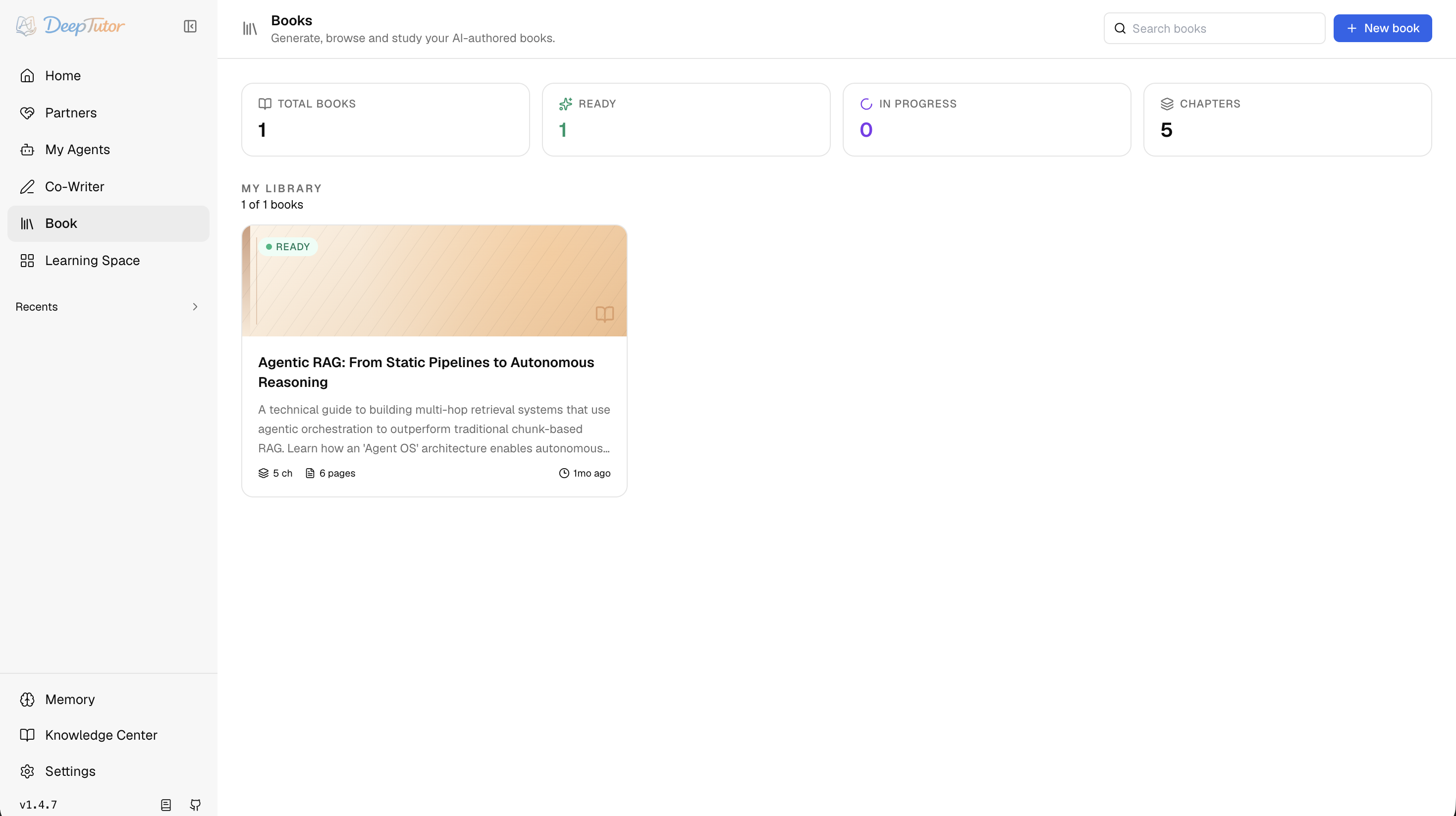
Book turns selected sources into an interactive living book — not a static PDF, but a reading environment built from typed blocks. A book can start from knowledge bases, notebooks, question banks, or chat history; the creation flow proposes a chapter outline before content is generated, so you review the shape instead of accepting a blind one-shot output.
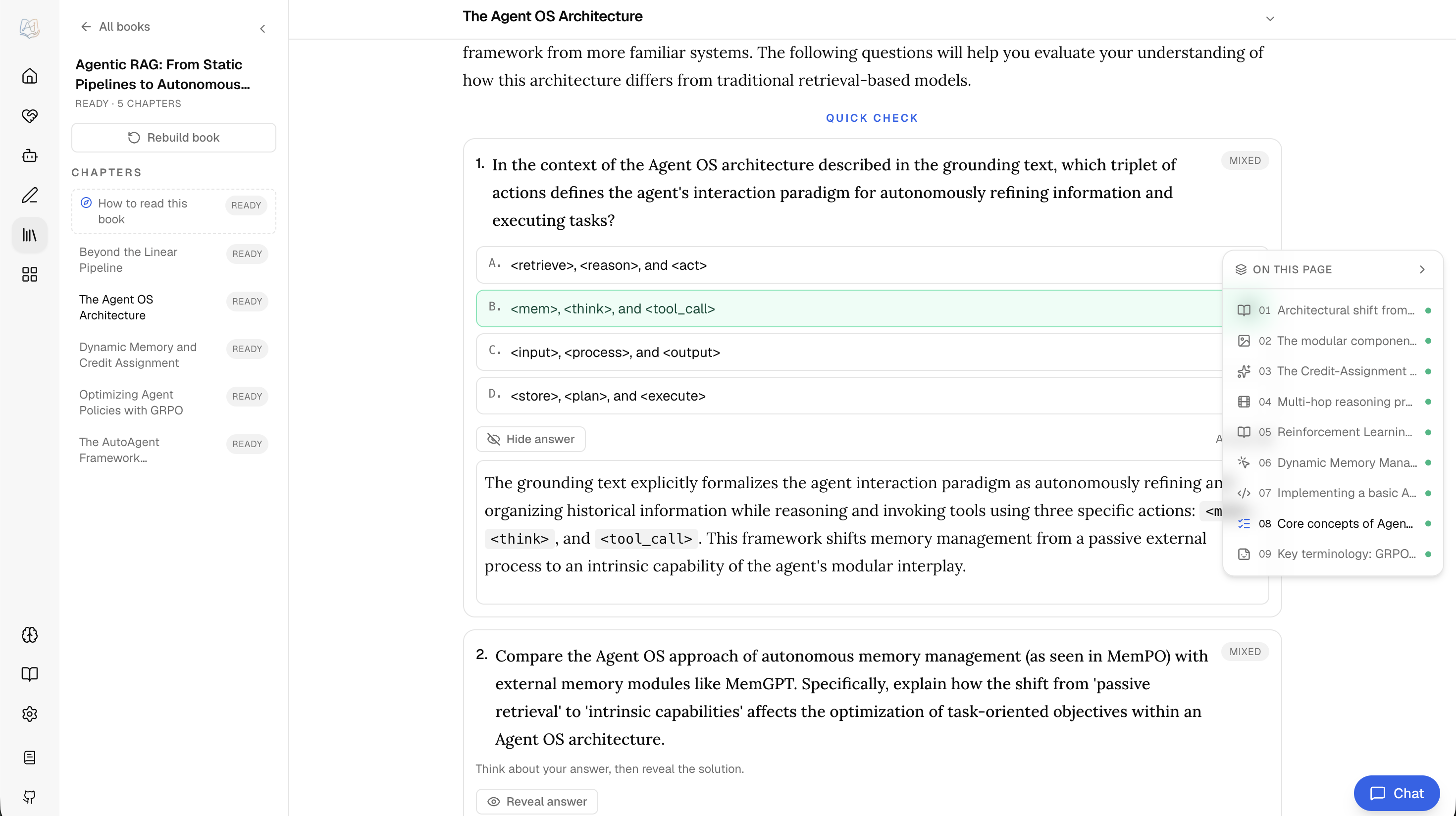
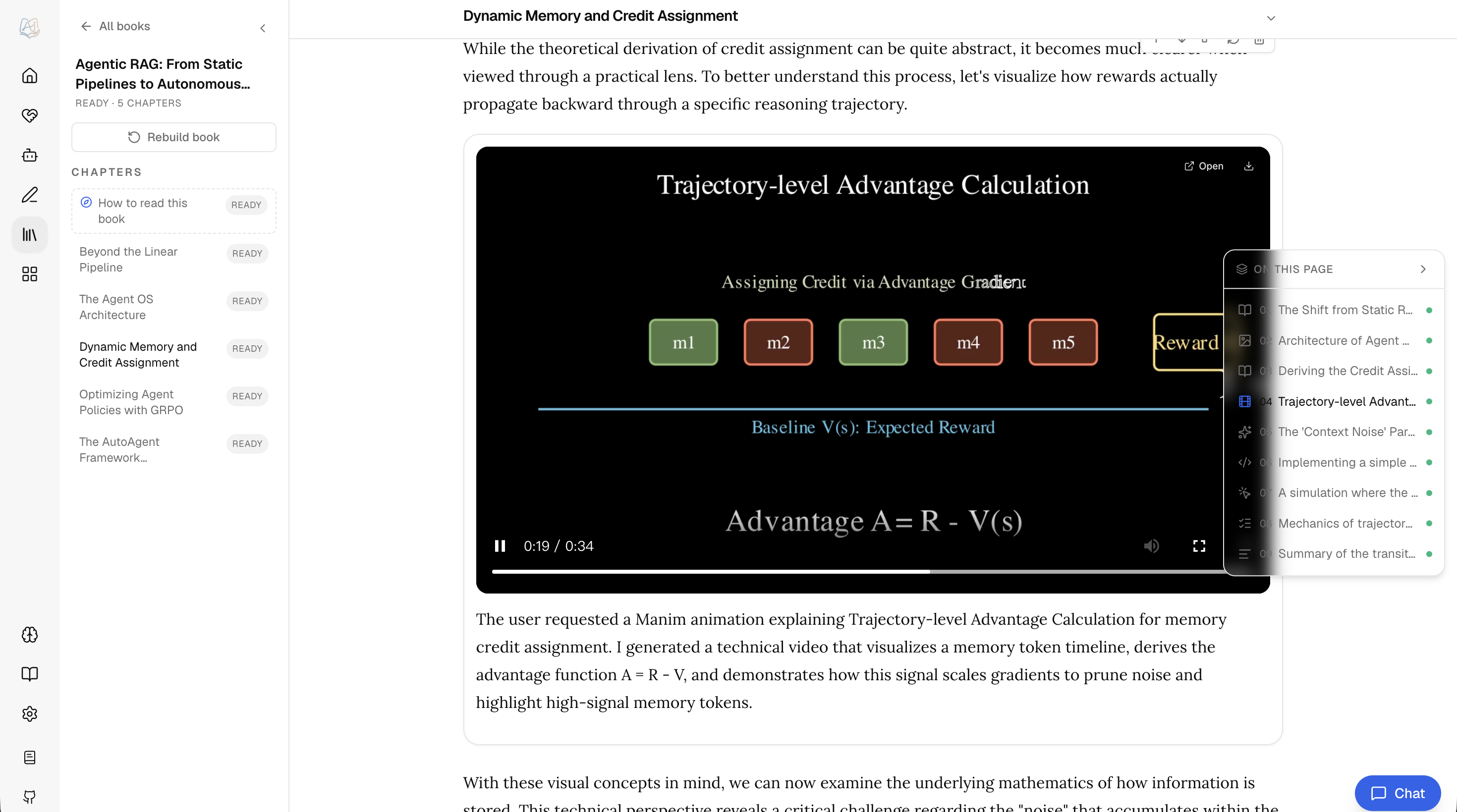
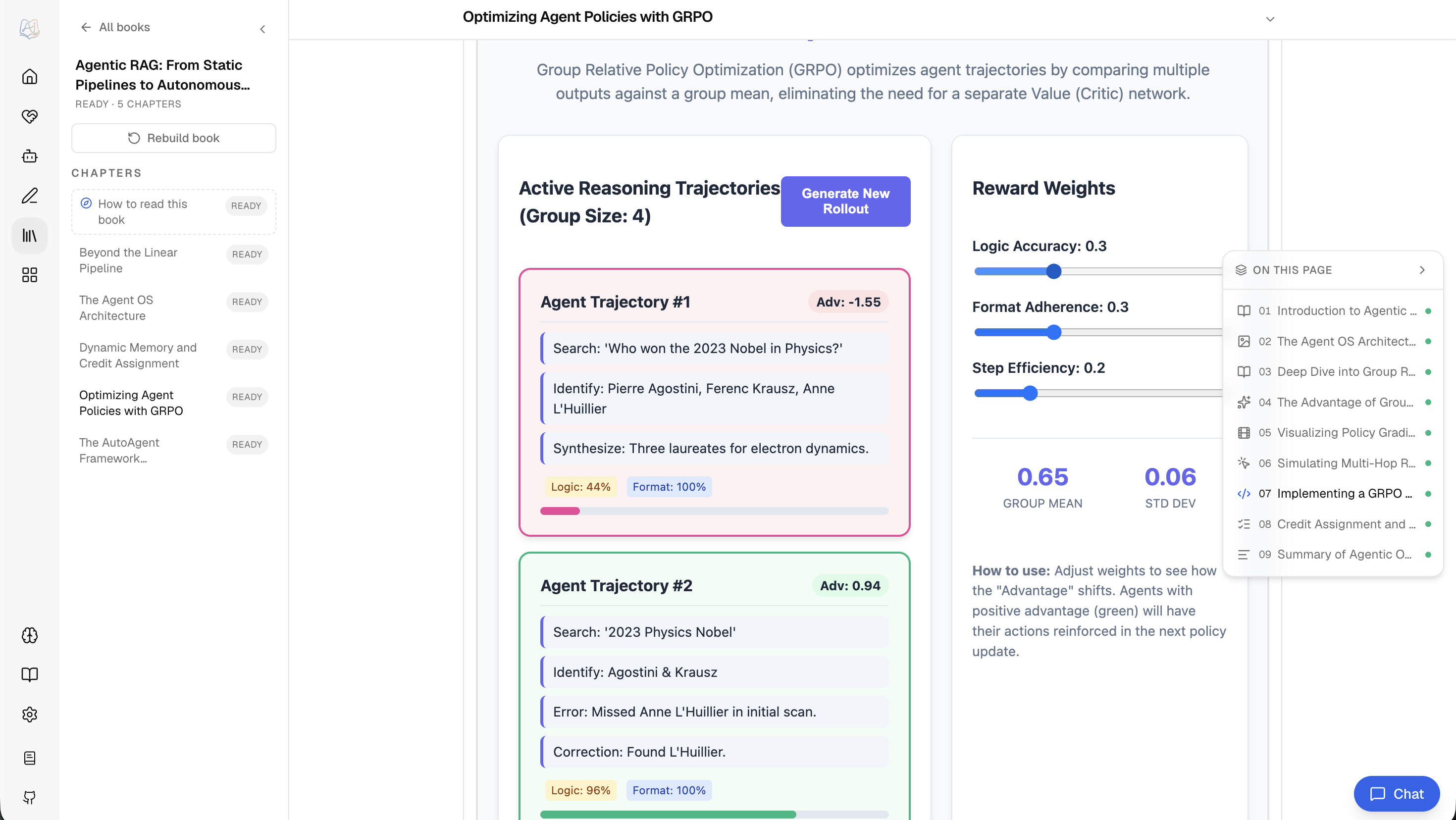
Each chapter compiles into typed blocks — text, callouts, quizzes, flash cards, timelines, code, figures, interactive HTML, animations, concept graphs, deep dives, and user notes — and every page has its own Page Chat. Blocks are editable: insert, move, regenerate, or switch a block's type without rewriting the chapter. Maintenance commands such as deeptutor book health and deeptutor book refresh-fingerprints help detect when source knowledge has drifted from compiled pages.
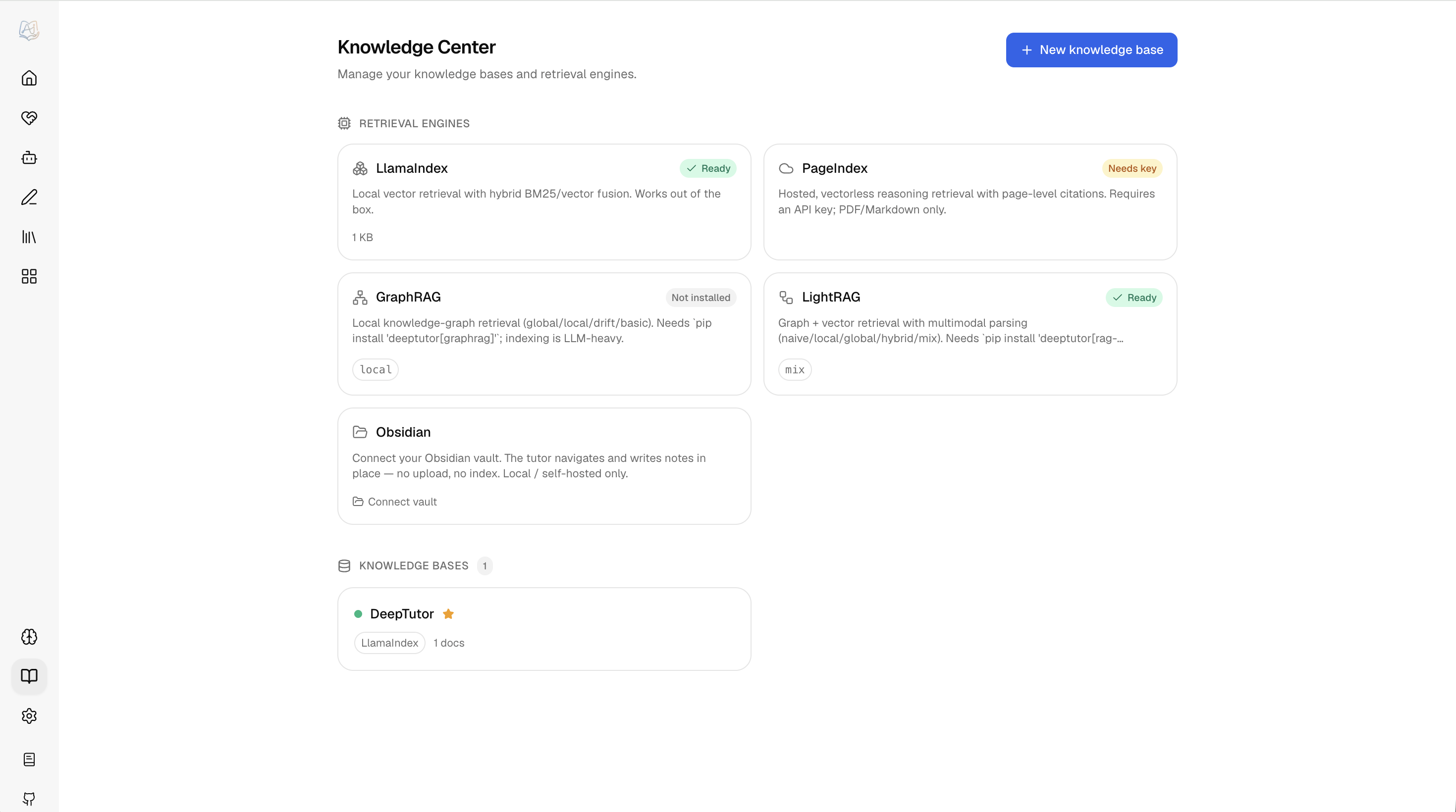
Knowledge bases are the document collections behind RAG — they ground Chat turns, Co-Writer edits, Book generation, and Partner conversations. What's distinctive is a choice of retrieval engines: LlamaIndex (the default, local vector + BM25), PageIndex (hosted, reasoning retrieval with page-level citations), GraphRAG and LightRAG (knowledge-graph retrieval), LightRAG Server (retrieval offloaded to an external LightRAG instance you connect over HTTP), or a linked Obsidian vault the tutor reads and writes in place. Each KB is bound to one engine.
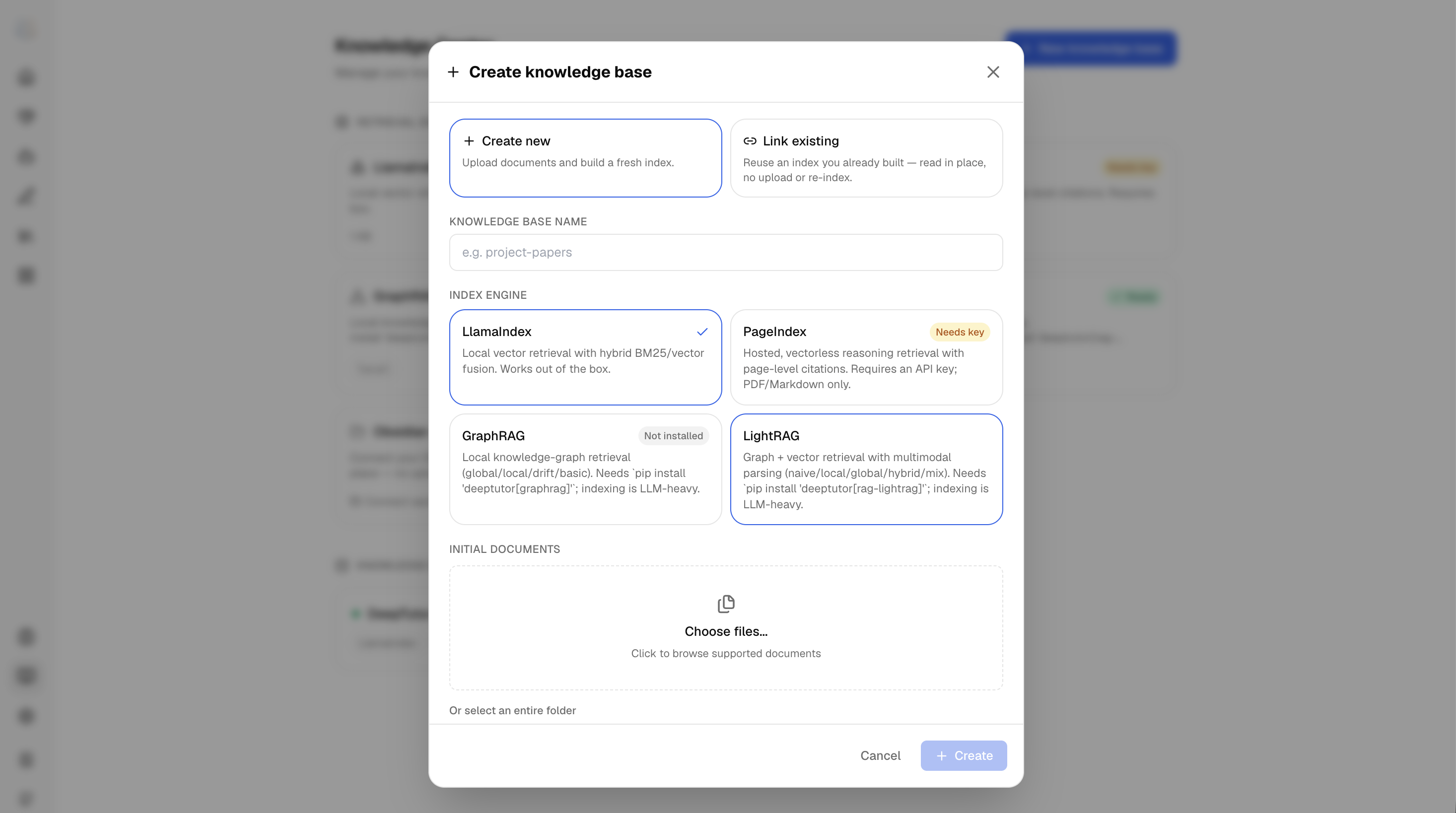
Creating a KB, you either create new (upload documents and build a fresh index) or link existing (reuse an index built elsewhere, read in place with no re-index). Re-indexing writes a new flat version-N directory and keeps prior ones, so a working index is never destroyed mid-rebuild. A single document can be removed even from an error-state base — dropping a file that failed to parse without a full delete-and-rebuild. Document parsing — Text-only, MinerU, Docling, markitdown, or PyMuPDF4LLM — is chosen in Settings → Knowledge Base, with local model downloads off by default. The CLI mirrors the lifecycle with deeptutor kb list, info, create, add, search, set-default, and delete.
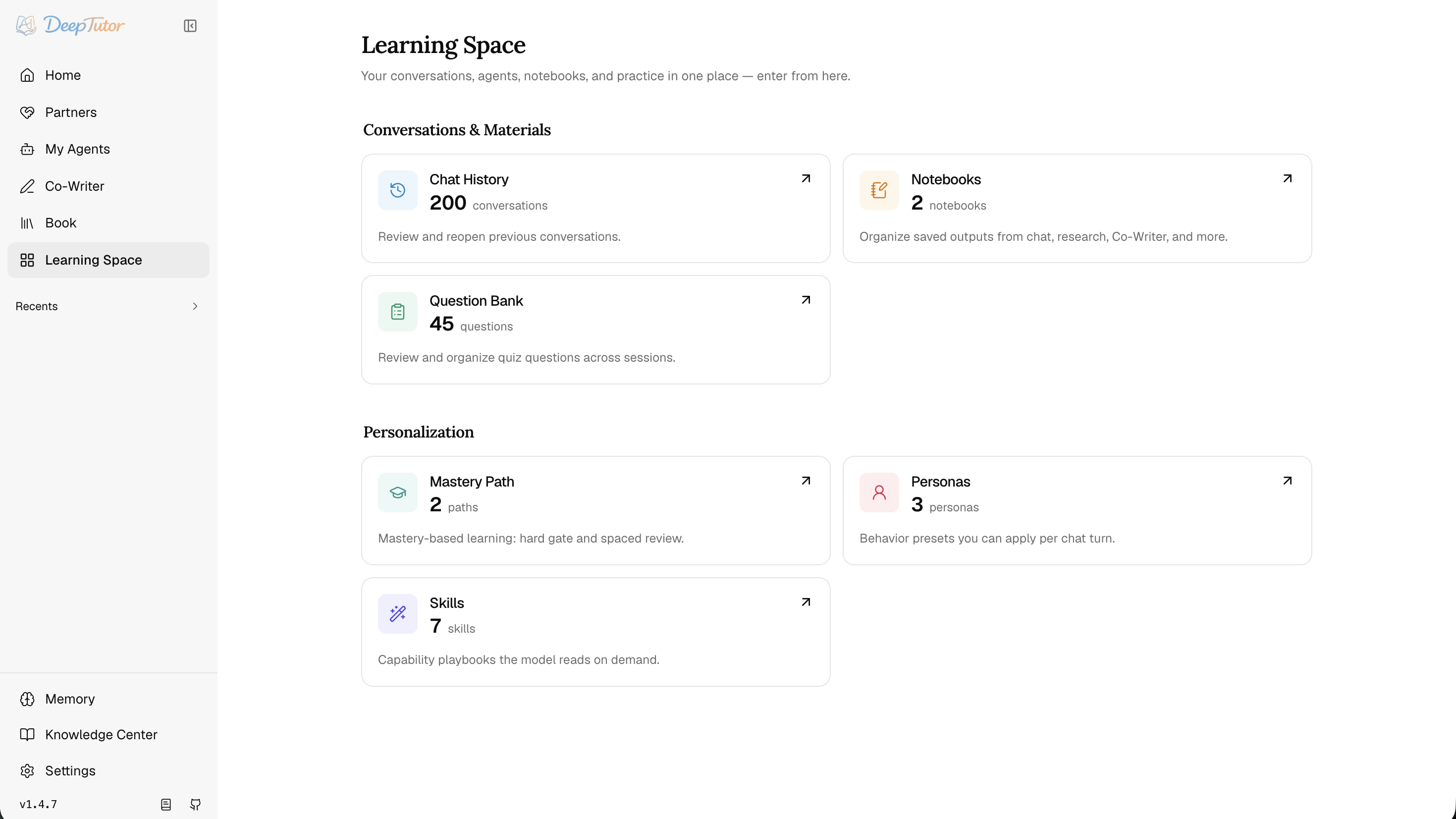
Learning Space is the library and personalization layer — where the things that persist live. Conversations & Materials holds your chat history, notebooks, and a question bank (each saved question keeps your answer, the reference answer, and an explanation). Personalization holds mastery paths, personas (behavior presets such as peer, research-assistant, teacher), and skills (SKILL.md playbooks the model reads on demand). Everything here can be reused from Chat, Partners, Co-Writer, and Book.
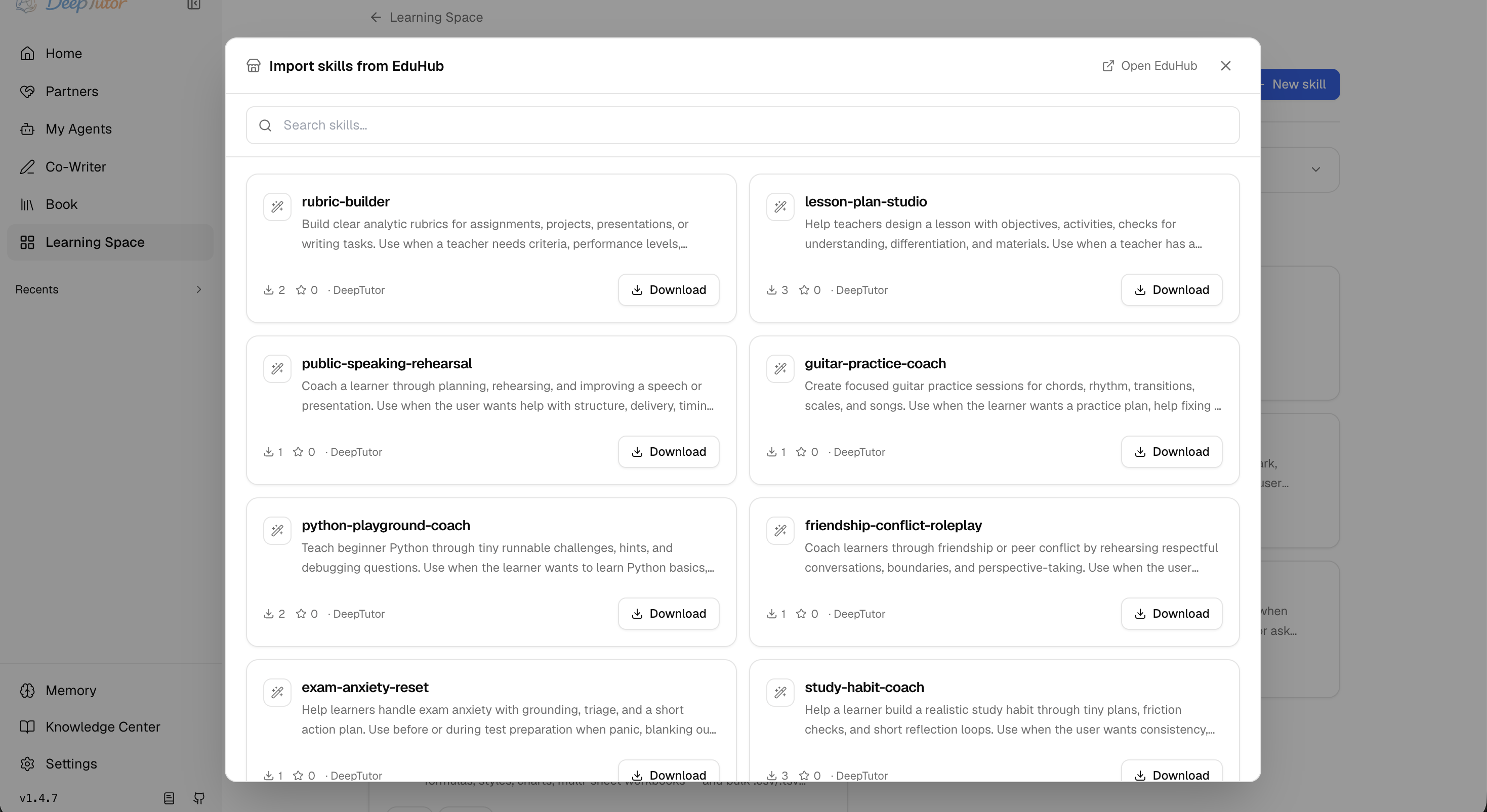
You don't have to write every skill yourself — Import from EduHub browses the community catalog and downloads a skill straight into your library through a security gate (see Ecosystem).
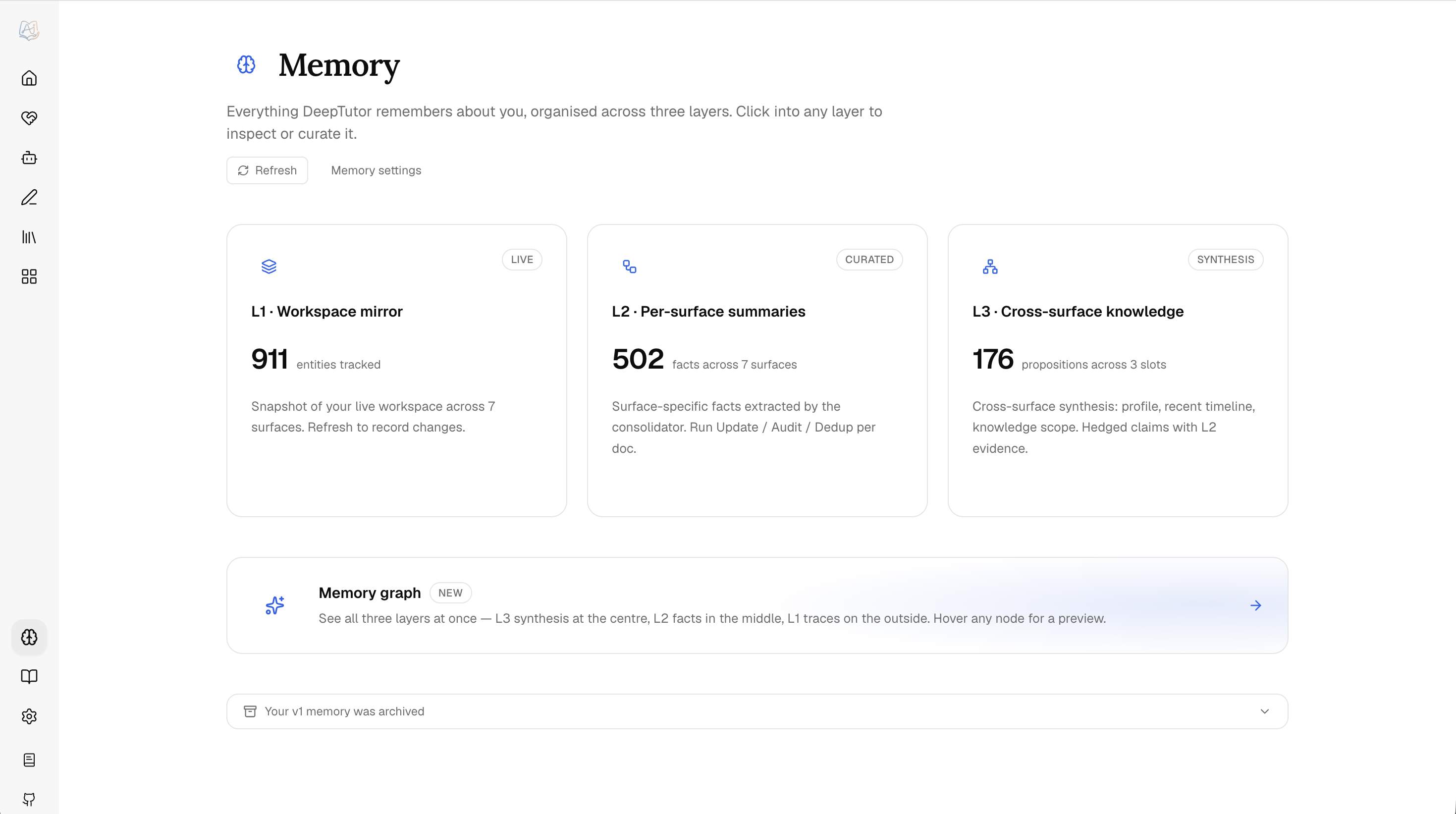
Memory is a file-backed, three-layer system you can read, curate, and audit — deliberately not a hidden vector store. L1 is the workspace mirror plus an append-only event trace (trace/<surface>/<date>.jsonl); L2 is per-surface curated facts (L2/<surface>.md); L3 is cross-surface synthesis (L3/<profile|recent|scope|preferences>.md). Because L2 cites L1 and L3 cites L2, nothing in your profile is unaccountable.
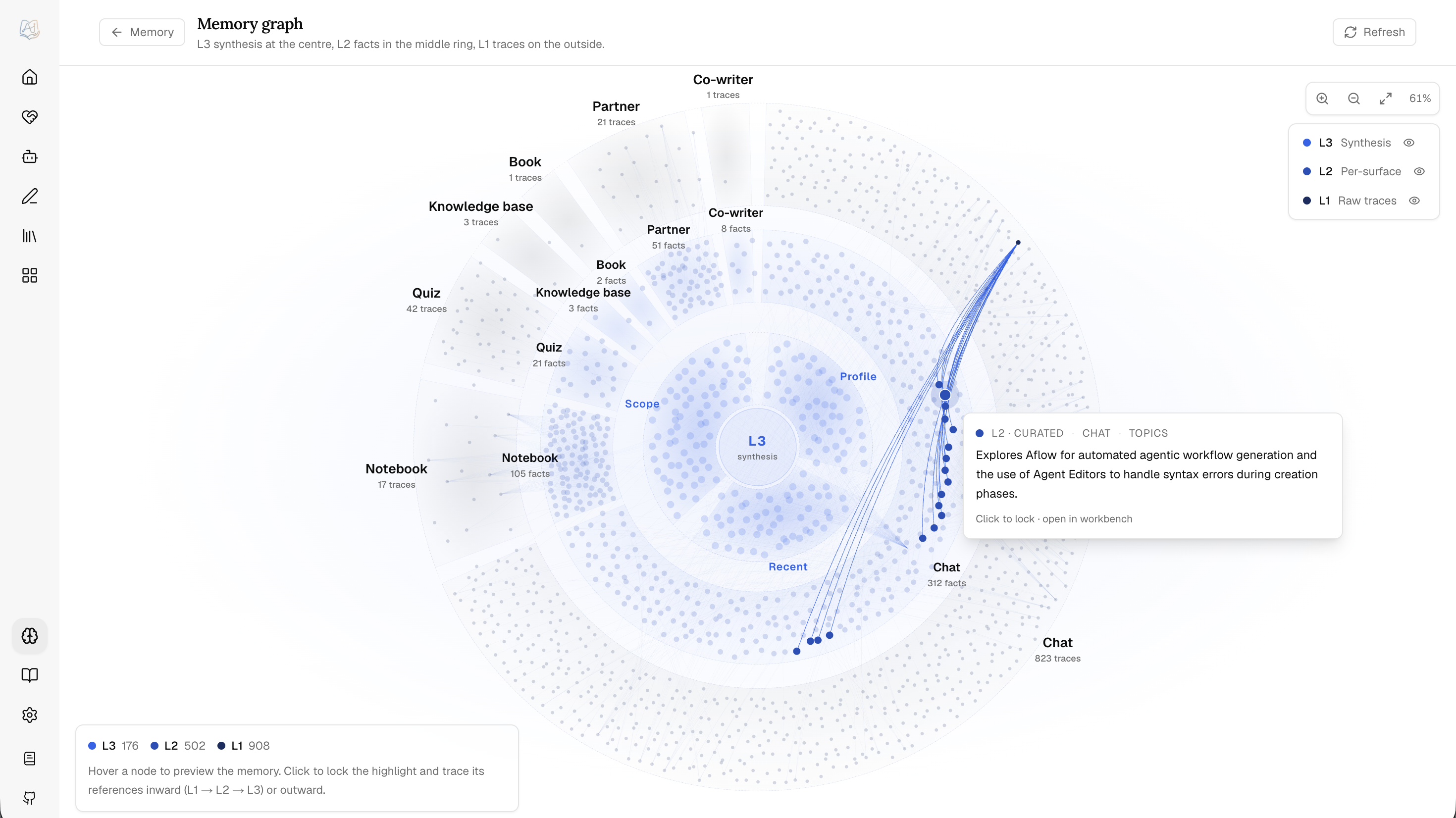
The Memory Graph shows the whole pyramid — L3 synthesis at the centre, L2 in the middle ring, L1 traces on the outside — so you can trace any synthesized claim back to the exact raw event behind it. Memory is tracked across chat, notebook, quiz, kb, book, partner, and cowriter surfaces; the consolidator's Update / Audit / Dedup budgets are tuned in Settings → Memory.
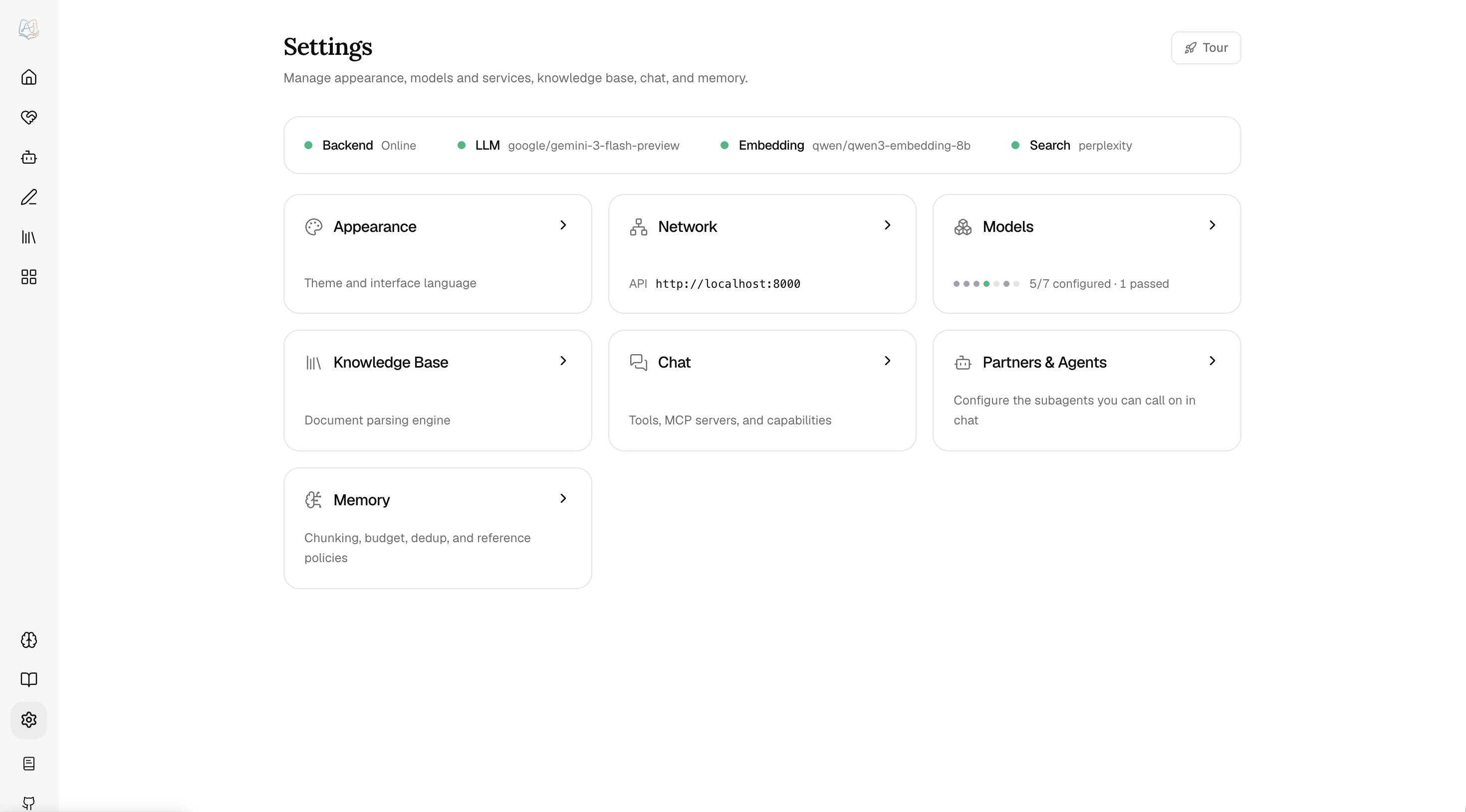
Settings is the operational control plane, with a live status strip (Backend, LLM, Embedding, Search) and one card per area: Appearance (theme, UI language, code-block styling), Network (API base, ports, CORS), Models (LLM, Embedding, Search, Text-to-Speech, Speech-to-Text, Image Generation, Video Generation), Knowledge Base (document parsing engine), Chat (tools, MCP servers, per-capability parameters, attachment caps), Partners & Agents (the subagents you can consult from a turn), and Memory (the consolidator's budgets).
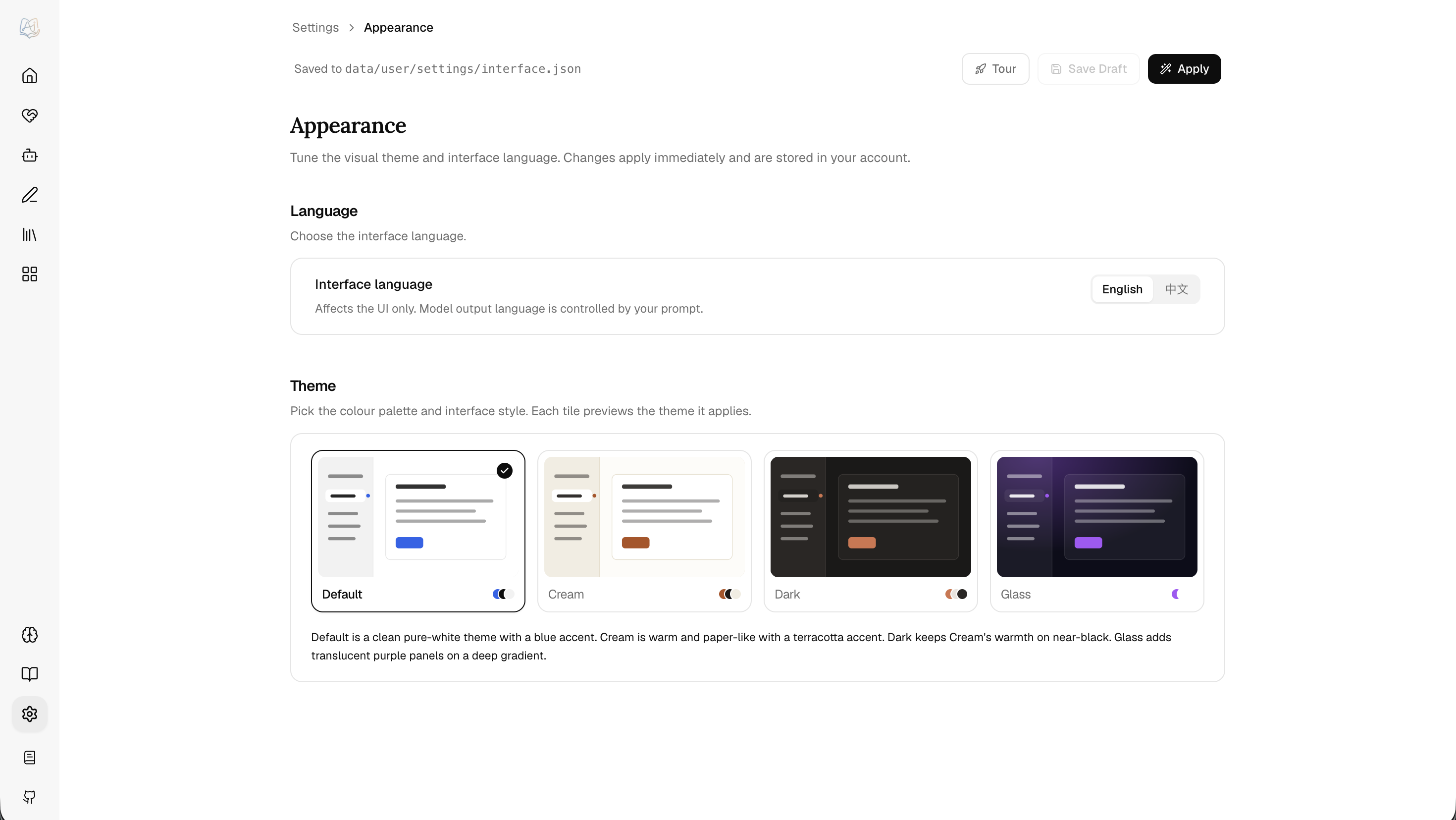
Most sections use a draft-and-apply flow, so you can test a provider before committing it. Four themes ship in the box — Default, Cream, Dark, and Glass. Project-root .env files are intentionally ignored; runtime configuration lives under data/user/settings/*.json unless DEEPTUTOR_HOME or deeptutor start --home points the app elsewhere.
Authentication is off by default — DeepTutor runs single-user. Turn it on and one data/ tree hosts an admin workspace, isolated per-user workspaces, and partner workspaces side by side:
data/
├── user/                    # Admin workspace + global settings
├── users/<uid>/             # Per-user scope: chat history, memory, notebooks, KBs
├── partners/<id>/workspace/ # Partner (synthetic-user) scope
└── system/                  # auth/users.json · grants/<uid>.json · audit/usage.jsonl
The first registered user becomes admin and owns model catalogs, provider credentials, shared knowledge bases, skills, and per-user grants. Everyone else gets an isolated workspace and a redacted Settings page — admin-assigned models, KBs, and skills show up as scoped, read-only options, never as raw API keys.
Enable it: turn auth on in data/user/settings/auth.json, restart deeptutor start, register the first admin at /register, then add users from /admin/users and assign models, KBs, skills, partners, tool/MCP policy, and code-execution access through grants.
PocketBase stays a single-user integration — keep
integrations.pocketbase_urlblank for multi-user deployments unless you've wired up an external user store.
One deeptutor binary, two ways in: an interactive REPL for people who live in the terminal, and structured JSON for other agents that drive DeepTutor as a tool. Same capabilities, tools, and knowledge bases either way.
deeptutor chat opens an interactive REPL; deeptutor run <capability> "<message>" fires a single turn and exits. Both speak the same --capability, --tool, --kb, and --config flags.
deeptutor chat                                              # interactive REPL
deeptutor chat --capability deep_solve --kb my-kb --tool rag
deeptutor run chat "Explain the Fourier transform" --tool rag --kb textbook
deeptutor run deep_research "Survey 2026 papers on RAG" \
  --config mode=report --config depth=standard
Everything the Web app does is here too — knowledge bases (kb), sessions (session), partners (partner), skills (skill), notebooks, memory, and config. Full list below.
DeepTutor is built to be operated by another agent. Add --format json to any run and each turn streams NDJSON — one event per line (content, tool_call, tool_result, done, …), every line tagged with its session_id. Runs are headless-safe: an ask_user pause with no TTY auto-resolves with an empty reply instead of hanging.
# One shot, machine-readable
deeptutor run deep_solve "Find d/dx[sin(x^2)]" --tool reason --format json

# Chain turns in one stateful session — capture the id, reuse it
SID=$(deeptutor run deep_research "Survey 2026 papers on RAG" \
  --config mode=report --config depth=standard --format json \
  | jq -r 'select(.type=="done").session_id')
deeptutor run deep_question "Quiz me on that survey" --session "$SID" --format json
The repo ships a root SKILL.md — a ~150-line handover doc that teaches any tool-using LLM the whole surface in one read. Hand it to Claude Code, Codex, or OpenCode (they pick up SKILL.md automatically), or wrap deeptutor run as a tool in a LangChain / AutoGen loop. Full recipes: Agent Handoff.
| Command | Description |
|---|---|
deeptutor init | Create or update data/user/settings for the current workspace |
deeptutor start [--home PATH] | Launch backend + frontend together |
deeptutor serve [--port PORT] | Start only the FastAPI backend |
deeptutor run <capability> <message> | Run a single capability turn (chat, deep_solve, deep_question, deep_research, visualize, math_animator, mastery_path); add --format json for NDJSON output |
deeptutor chat | Interactive REPL with capability, tool, KB, notebook, and history controls |
deeptutor partner list/create/start/stop | Manage IM-connected partners |
deeptutor kb list/info/create/add/search/set-default/delete | Manage LlamaIndex knowledge bases |
deeptutor skill search/install/list/remove/login/logout/publish/update | Manage skills, install from hubs, and publish your own (eduhub:<slug> by default, see Ecosystem) |
deeptutor memory show/clear | Inspect L2/L3 memory docs or clear L1/all memory |
deeptutor session list/show/open/rename/delete | Manage shared sessions |
deeptutor notebook list/create/show/add-md/replace-md/remove-record | Manage notebooks from Markdown files |
deeptutor book list/health/refresh-fingerprints | Inspect books and refresh source fingerprints |
deeptutor plugin list/info | Inspect registered tools and capabilities |
deeptutor config show | Print configuration summary |
deeptutor provider login <provider> | Provider auth (openai-codex OAuth login; github-copilot validates an existing Copilot auth session) |
The CLI-only package lives in packaging/deeptutor-cli. In this checkout, install it from source:
python -m pip install -e ./packaging/deeptutor-cli
It isn't published to PyPI yet, so the main Get Started section keeps the source-install path.
DeepTutor skills use the open Agent-Skills format — a folder with a SKILL.md playbook (YAML frontmatter + Markdown) and optional reference files. Nothing about it is DeepTutor-specific, so any registry that speaks the format becomes a source for your library. DeepTutor ships with EduHub — our own education-focused skill registry — wired in as the default hub.
EduHub is the community hub DeepTutor launched for sharing teaching-oriented agent skills — Socratic tutors, flashcard builders, essay feedback, exam blueprints, concept explainers, and more. It is built into DeepTutor, so there's nothing to configure: a bare slug or an eduhub: prefix resolves to it.
Find and install — in the browser, open Learning Space → Skills → Import from EduHub to browse the catalog and download a skill straight into your library. From the terminal:
deeptutor skill search "socratic tutor"               # search EduHub (the default hub)
deeptutor skill install socratic-tutor                # fetch → verify → register
deeptutor skill install eduhub:socratic-tutor@1.2.0   # pin a hub and a version
deeptutor skill list                                  # local skills with their hub provenance
Publish your own — package a SKILL.md and share it back to the community:
deeptutor skill login                                 # browser sign-in to EduHub
deeptutor skill publish ./my-skill                    # interactive: pick a track + tags, then upload
deeptutor skill update                                # roll back or release a new version
EduHub is also a standalone, ClawHub-compatible registry, so agents that aren't DeepTutor (Claude Code, Codex, …) can use it directly through the eduhub CLI — npx eduhub install socratic-tutor.
Whatever the source, every import passes the same safety gate before anything touches your workspace:
--allow-unverified;always: is stripped, so a downloaded skill can never force itself into every system prompt;.hub-lock.json for audits and updates.In multi-user deployments, installing is admin-only: a new skill lands in the admin catalog and stays invisible to other users until a grant assigns it, so an admin can vet it before rolling it out.
Because DeepTutor speaks the open Agent-Skills format, ClawHub works as a first-class source too — it's built in alongside EduHub. Pick it with the hub prefix:
deeptutor skill search "git release notes" --hub clawhub
deeptutor skill install clawhub:git-release-notes@1.0.1
Add more registries in settings/skill_hubs.json: a type: "clawhub" entry points at any compatible HTTP API (EduHub and ClawHub both speak it), type: "command" wraps whatever fetch CLI a registry ships, and "default" chooses the hub used for bare slugs. All of them feed the same import gate.
DeepTutor is an open-source project led by Bingxi Zhao within the HKUDS Group, and it iterates in a fully open-source form, built together with the community. So far, we DO NOT have paid online products of any form. Feel free to reach out at bingxizhao39@gmail.com for discussions, ideas, or collaboration.
Heartfelt thanks to Chao Huang, director of the Data Intelligence Lab @ HKU, and to our HKUDS labmates for their warm support — especially Jiahao Zhang, Zirui Guo, and Xubin Ren. We're also deeply grateful to the open-source community: your stars, issues, pull requests, and discussions shape DeepTutor every single day.
DeepTutor also stands on the shoulders of outstanding open-source projects that gave us both tools and inspiration:
| Project | Role / Inspiration |
|---|---|
| LlamaIndex | RAG pipeline and document-indexing backbone |
| nanobot | Ultra-lightweight agent engine that powered the original TutorBot (HKUDS) |
| LightRAG | Simple & fast RAG (HKUDS) |
| AutoAgent | Zero-code agent framework (HKUDS) |
| AI-Researcher | Automated research pipeline (HKUDS) |
| OpenClaw | Open agent gateway and skill ecosystem behind ClawHub |
| Codex | Agent-native coding CLI that inspired our CLI workflow |
| Claude Code | Agentic coding CLI that inspired the DeepTutor agent loop |
| ManimCat | AI-driven math animation generation for Math Animator |
We want DeepTutor to keep iterating and improving — and ultimately to become a gift we give back to the open-source community. Our roadmap is updated continuously; vote on items there or propose new ones. If you'd like to contribute, see the Contributing Guide for branching strategy, coding standards, and how to get started.
We hope DeepTutor becomes a gift for the community. 🎁
Licensed under the Apache License 2.0.
Public repository for Agent Skills