
Open Sources
Curated repos, tools, and frameworks shaping the developer ecosystem.
Live data from GitHub.
Curated repos, tools, and frameworks shaping the developer ecosystem.
Live data from GitHub.
by jliu-ts
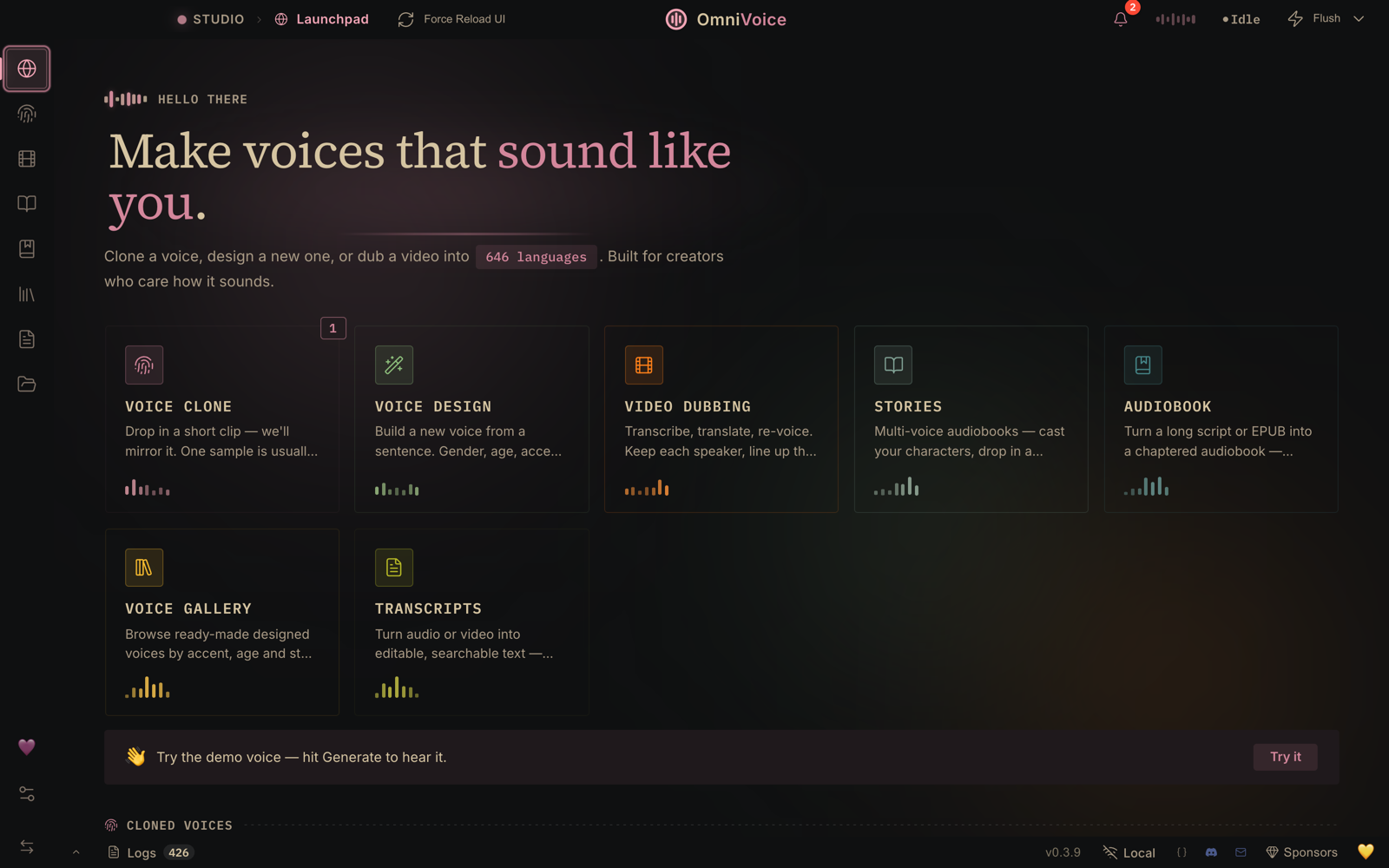
Local voice clone, video dubbing, dictation and audiobook maker. The open-source ElevenLabs alternative.
Real-time dictation, zero-shot voice cloning, and cinematic video dubbing — all on your desktop.
No accounts. No API keys. No cloud. Everything runs on your machine. Open-source, 646 languages.
Quickstart · Features · Why OVS · Engines · API · Donate · Contributing · Discord · 简体中文








Your voice is the most personal data you have. So why rent it back from a cloud? Every mainstream voice tool ships your audio to someone else's server and bills you monthly for the privilege. OmniVoice Studio flips that: clone, design, dub, and dictate on your own hardware — 646 languages, no meter running, nothing leaving your machine.
[!WARNING] Active beta. Things may break between releases — for the newest fixes, run from source. Bug reports and PRs are very welcome: open an issue or join Discord.
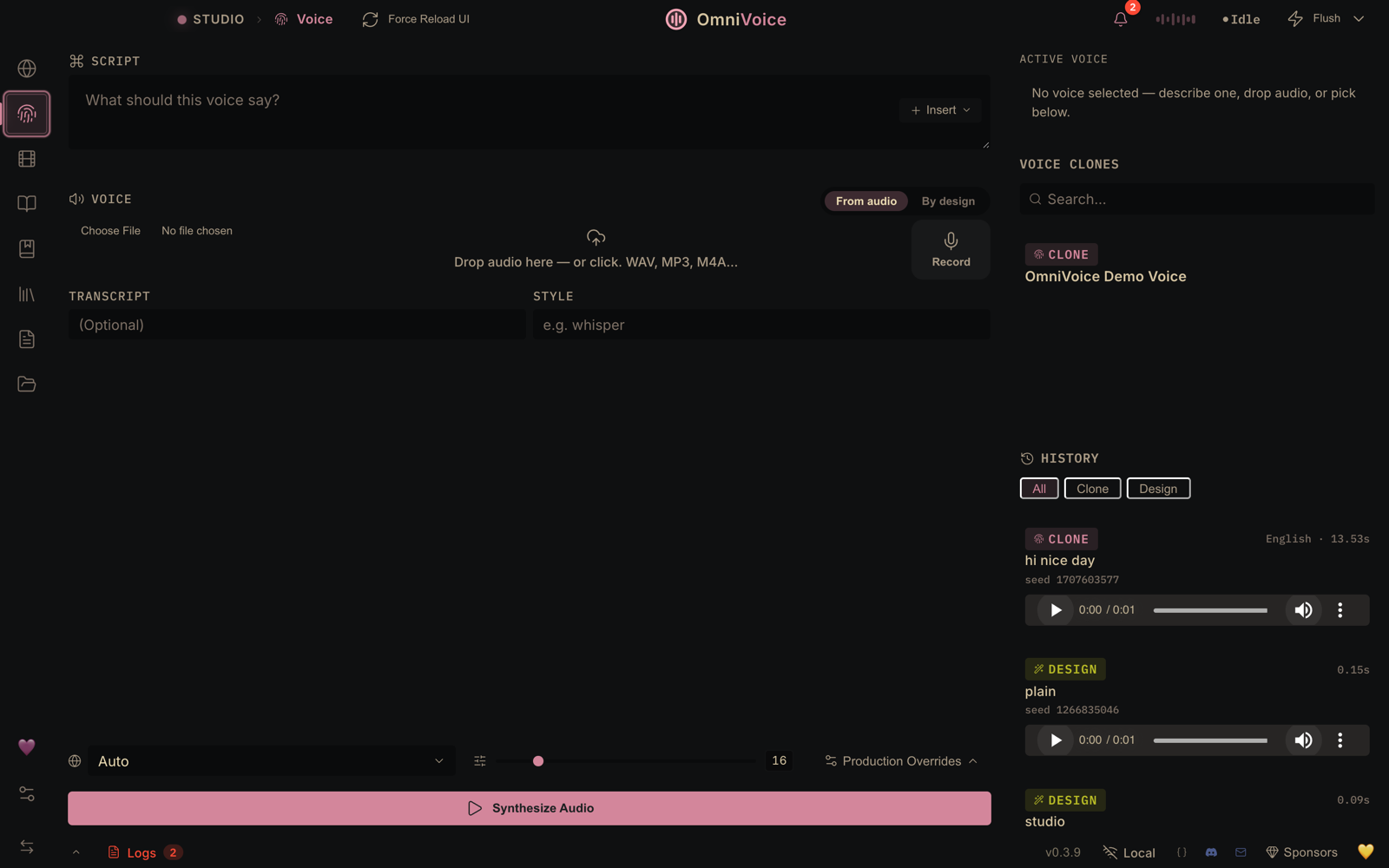
Studio Generate & clone in one workspace — a 3-second clip mirrors any voice, 646 languages, zero-shot. |
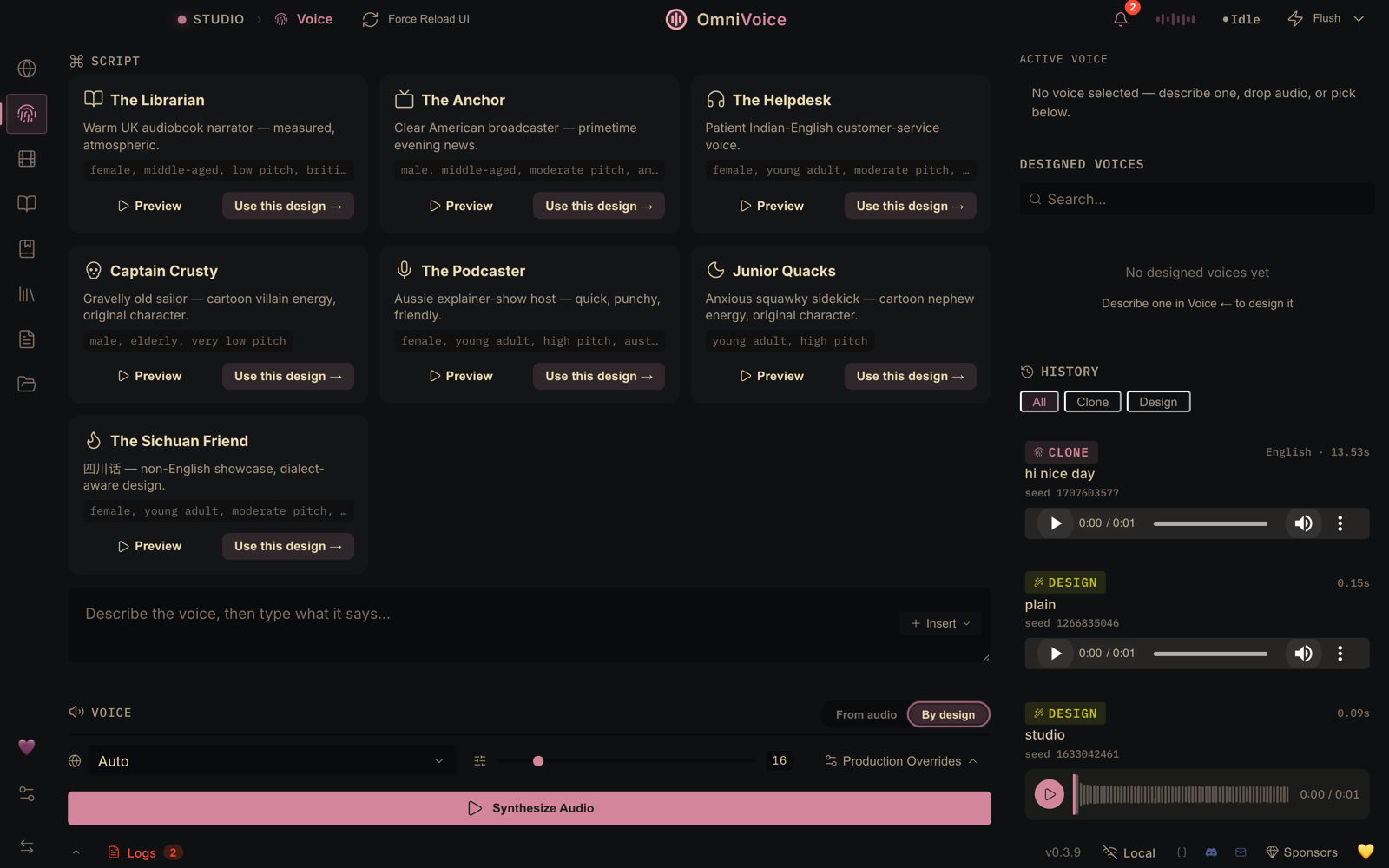
Voice Design Build new voices from scratch — gender, age, accent, pitch, emotion, dialect. |
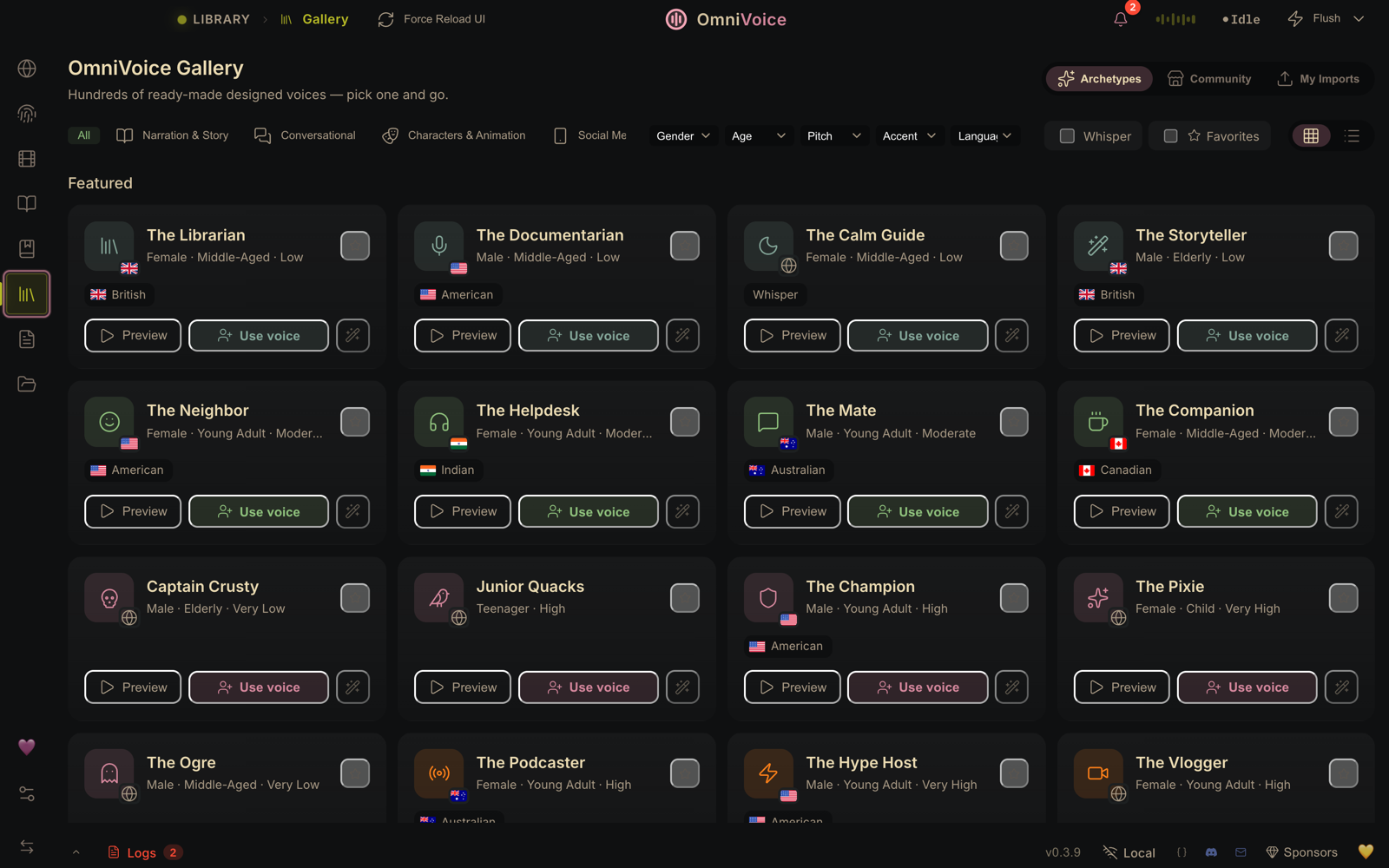
Voice Gallery Browse ready-made archetype voices with language filters — or build your own library. |
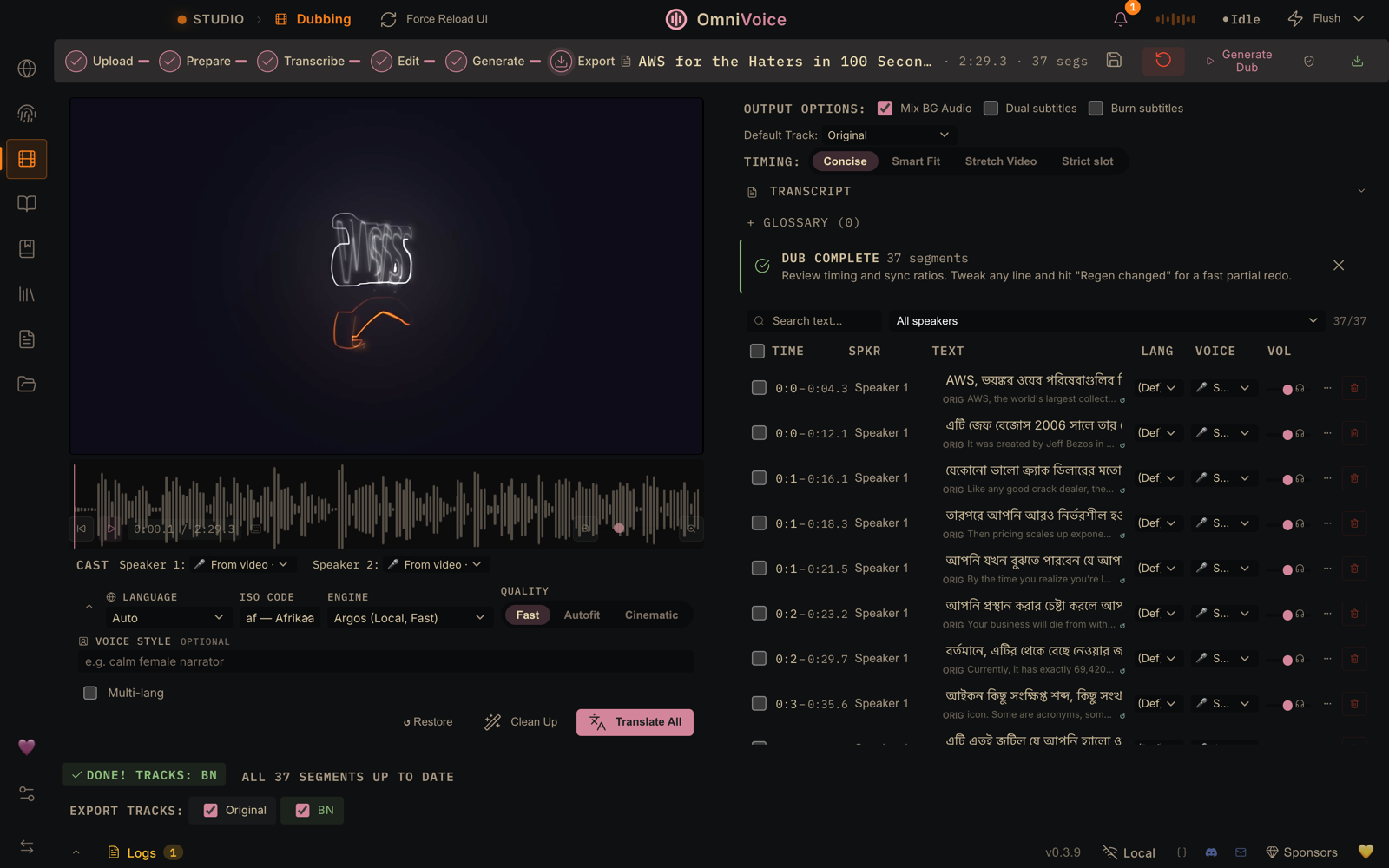
Video Dubbing A real dub, end to end: 37 segments transcribed, translated to Bengali, re-voiced, and timed — ready to export as MP4. |
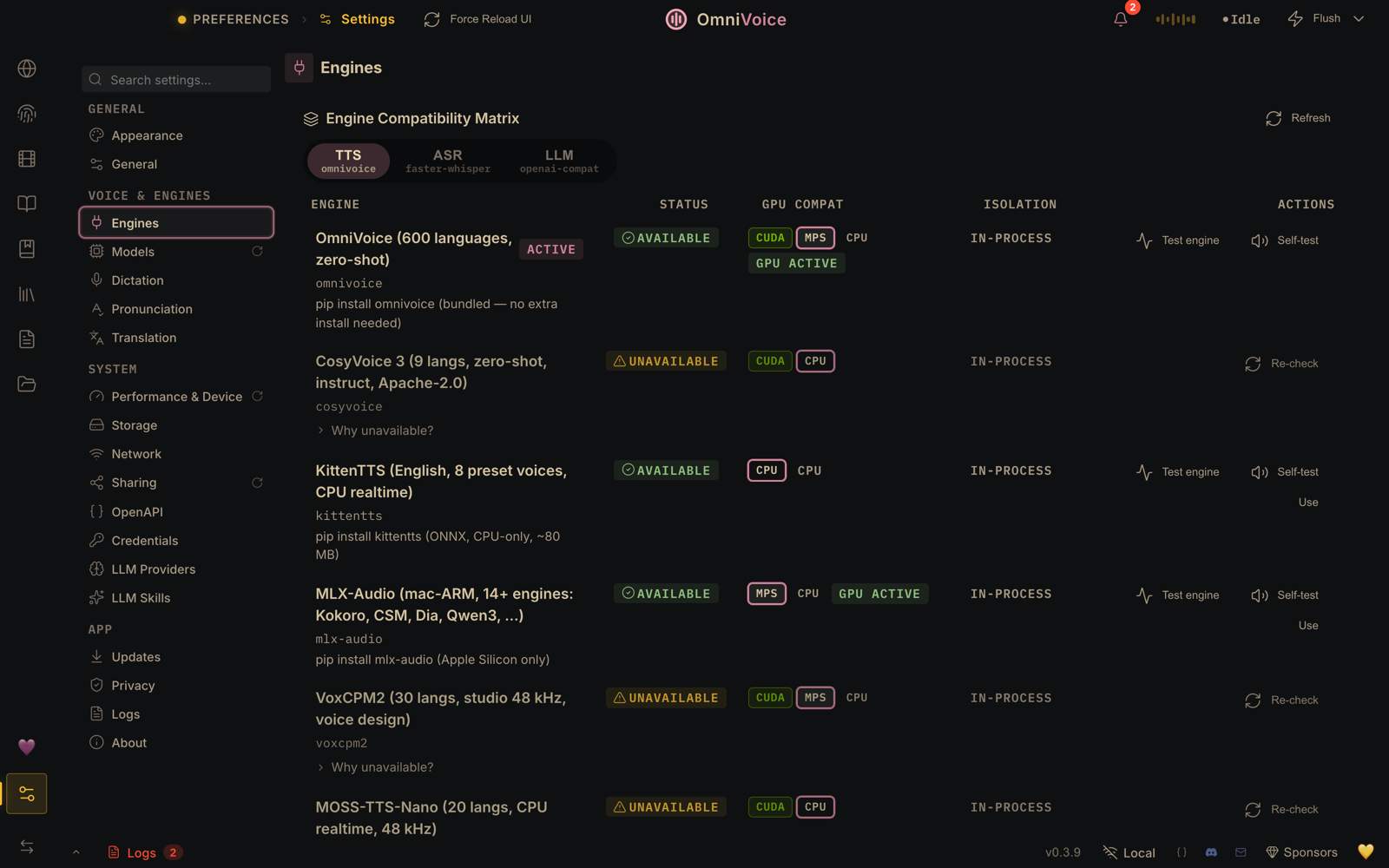
Settings → Engines The engine compatibility matrix — 14 TTS engines with per-engine GPU preflight, no silent CPU fallback. |
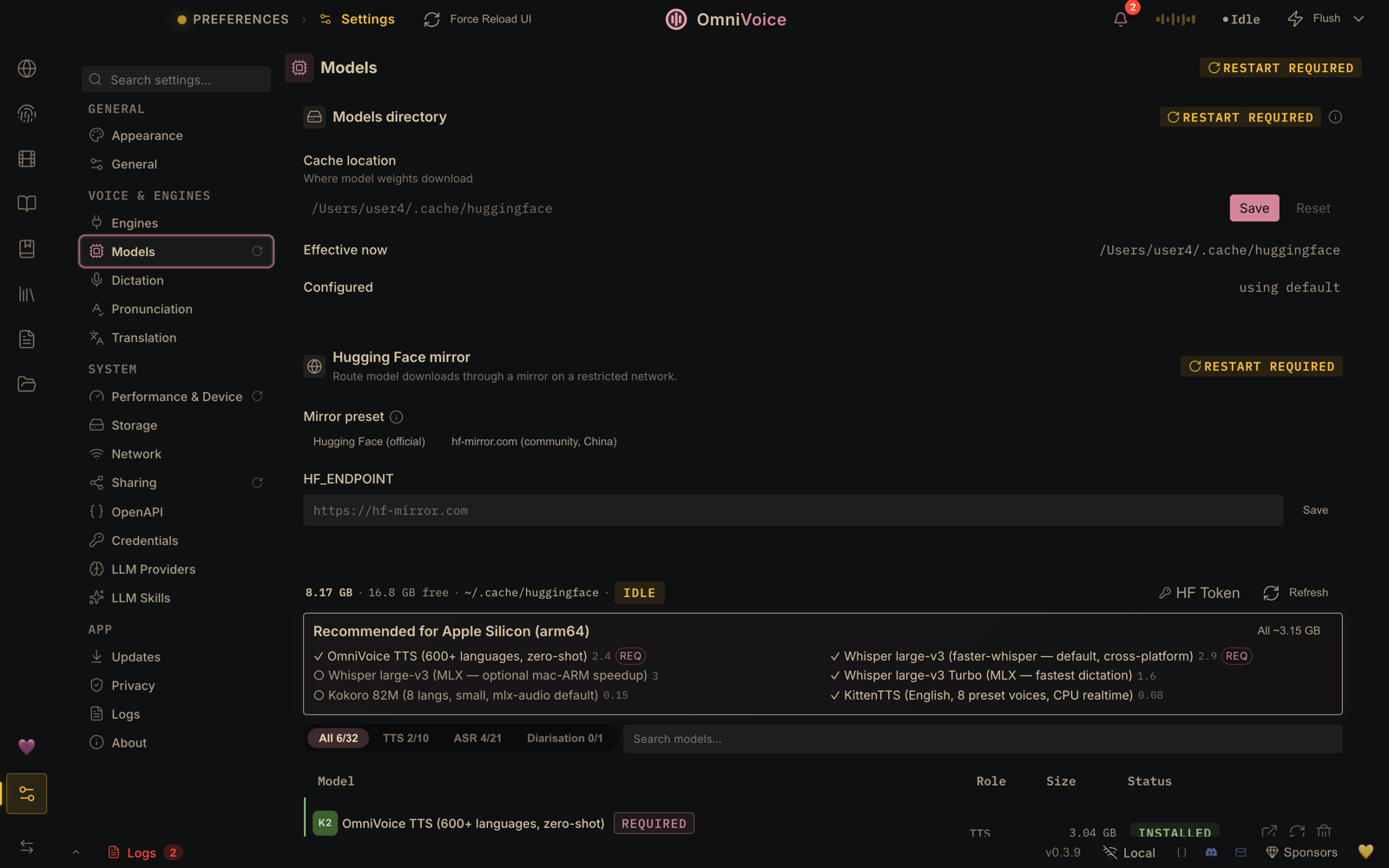
Settings → Models One-click model store — auto-detects your platform (CUDA / MPS / CPU) and recommends the right models. |
The eight headliners — and twelve more waiting under the fold.
🎙️ Voice Cloning3-second clip → mirror any voice. |
🎨 Voice DesignGender, age, accent, pitch, speed, |
🎬 Video DubbingYouTube URL or file → transcribe → |
📖 Audiobook EditorImport text, EPUB, or PDF. Auto-chapter, |
🎭 StoriesMulti-voice editor. Assign voices |
⌨️ Dictation Widget⌘+⇧+Space from any app. |
🔐 100% LocalNo keys, no cloud, no accounts. |
🤖 MCP ServerUse OmniVoice from Claude, |
TTSBackend, add any engine in ~50 lines..ovsvoice bundles: identity + watermark.-000?style=for-the-badge&logo=apple&logoColor=white)
-0078D4?style=for-the-badge&logo=windows&logoColor=white)
-FCC624?style=for-the-badge&logo=linux&logoColor=black)
Pick your OS and follow the guide end-to-end:
palashdeb/omnivoice-studioFeels slow? docs/performance.md covers where generation time actually goes, the tuning knobs, and the three classic causes of "it got slow".
Coming from CorentinJ/Real-Time-Voice-Cloning (now archived)? There's a dedicated migration guide: docs/migration/real-time-voice-cloning.md.
Run the built-in self-check first — Settings → About → "Run
self-check" in the app, or uv run python backend/main.py --diagnose from
a checkout (--deep also test-loads the active engine). Then see
docs/install/troubleshooting.md for the
top 10 install errors. The in-app error UI deeplinks to those entries when
something breaks at runtime, and Settings → About → "Save diagnostic
bundle" packages scrubbed logs + the self-check report for bug reports.
For Hugging Face token setup, see docs/setup/huggingface-token.md. For diarization-specific gating, see docs/features/diarization.md. For download speed, the ⚡ fast-download (Xet) status, and restricted-network / mirror options, see docs/downloading-models.md.
ElevenLabs charges $5–$330/mo and processes your audio on their servers. OmniVoice Studio runs on your hardware, with no usage limits.
| ElevenLabs | OmniVoice Studio | |
|---|---|---|
| Pricing | $5–$330/mo, per-character billing | Free & open-source (AGPL-3.0) · Commercial license for proprietary use |
| Voice Cloning | ✅ 3s clip | ✅ 3s clip, zero-shot |
| Voice Design | ✅ Gender, age | ✅ Gender, age, accent, pitch, style, dialect |
| Audiobook / Stories | ❌ | ✅ Full audiobook editor + multi-voice stories (EPUB/PDF import, .m4b export) |
| Languages | 32 | 646 |
| Video Dubbing | ✅ Cloud-only | ✅ Fully local |
| Data Privacy | Audio sent to cloud | Nothing leaves your machine |
| API Keys | Required | Not needed |
| GPU Support | N/A (cloud) | CUDA · Apple Silicon · ROCm (Linux) · CPU |
| Desktop App | ❌ | ✅ macOS · Windows · Linux |
| TTS Engines | 1 | 14 — full matrix |
| ASR Engines | 1 | 10 — full lineup |
| MCP Server | ❌ | ✅ Use from Claude, Cursor, any MCP client |
| Self-check | ❌ | ✅ Diagnostics suite, error journal, scrubbed debug bundles |
| Customizable | ❌ Closed | ✅ Fork it, extend it, ship it |
Professional-grade voice AI, minus the subscription and the cloud.

| Minimum | Recommended | |
|---|---|---|
| OS | Windows 10, macOS 12+ (Apple Silicon), Ubuntu 24.04+ (glibc 2.39+) | Any modern 64-bit OS |
| RAM | 8 GB | 16 GB+ |
| VRAM (GPU) | 4 GB (auto-offloads TTS to CPU) | 8 GB+ (NVIDIA RTX 3060+) |
| Disk | 10 GB free (models + cache) | 20 GB+ SSD |
| Python | 3.10+ (managed by uv) | 3.11–3.12 |
| GPU | Optional — CPU works | NVIDIA CUDA · Apple Silicon MPS · AMD ROCm (Linux only) |
[!TIP] On GPUs with ≤8 GB VRAM, OmniVoice automatically offloads TTS to CPU during transcription — no config needed. A dedicated GPU is not required; the entire pipeline runs on CPU (just slower).
[!NOTE] AMD GPUs: ROCm acceleration is Linux-only and opt-in — pick "AMD GPU (ROCm)" on the first-run setup screen or set
OMNIVOICE_TORCH_VARIANT=rocm(docs/install/linux.md). In Docker/Podman, pull the dedicated ROCm image instead:ghcr.io/debpalash/omnivoice-studio:rocm(docs/install/docker.md). On Windows, AMD GPUs (incl. Ryzen AI iGPUs) run CPU-only: PyTorch has no Windows ROCm wheels, so Windows GPU acceleration is NVIDIA/CUDA-only (docs/install/windows.md).
[!IMPORTANT] macOS Intel (x86_64) is unsupported for the local backend: the app UI installs, but the Python backend cannot run because PyTorch no longer ships Intel-Mac wheels (#889). Intel-Mac users can still point the UI at a remote backend on another machine — see docs/install/macos.md.
14 engines, one picker. OmniVoice (default, 600+ languages) is always available; seven more are opt-in and auto-detected (CosyVoice 3, GPT-SoVITS, VoxCPM2, MOSS-TTS-Nano, KittenTTS, MLX-Audio, Sherpa-ONNX), plus six lazy-installed heavyweights (IndexTTS 2, OmniVoice GGUF, Supertonic 3, MOSS-TTS-v1.5, dots.tts, Confucius4-TTS). Switch in Settings → TTS Engine; the choice applies everywhere synthesis happens.
| Engine | Languages | Clone | Instruct | Linux | macOS ARM | Windows | License |
|---|---|---|---|---|---|---|---|
| OmniVoice (default) | 600+ | ✅ | ✅ | ✅ CUDA/CPU | ✅ MPS | ✅ CUDA/CPU | Built-in |
| CosyVoice 3 | 9 + 18 dialects | ✅ | ✅ | ✅ CUDA/CPU | ✅ MPS | ✅ CUDA/CPU | Apache-2.0 |
| GPT-SoVITS | 5 | ✅ | — | ✅ CUDA/CPU | — | ✅ CUDA/CPU | MIT |
| VoxCPM2 | 30 | ✅ | ✅ | ✅ CUDA/CPU | ✅ MPS | ✅ CUDA/CPU | Apache-2.0 |
| MOSS-TTS-Nano | 20 | ✅ | — | ✅ CUDA/CPU | ✅ CPU | ✅ CUDA/CPU | Apache-2.0 |
| KittenTTS | English | — | — | ✅ CPU | ✅ CPU | ✅ CPU | MIT |
| MLX-Audio (Kokoro, Qwen3-TTS, CSM, Dia, …) | Multi | Varies | Varies | ❌ | ✅ Native | ❌ | Varies |
| Sherpa-ONNX | 20+ | — | — | ✅ CUDA/CPU | ✅ CPU | ✅ CUDA/CPU | Apache-2.0 |
| IndexTTS 2 ⚡ | Multi | ✅ | — | ✅ CUDA | — | ✅ CUDA | Apache-2.0 |
| OmniVoice GGUF ⚡ | 600+ | ✅ | ✅ | ✅ CPU | ✅ CPU | ✅ CPU | Built-in |
| Supertonic 3 ⚡ | 31 | — | — | ✅ CPU | ✅ CPU | ✅ CPU | OpenRAIL-M |
| MOSS-TTS-v1.5 ⚡ (8B) | 31 | ✅ | — | ✅ CUDA/CPU | ✅ CPU | ✅ CUDA/CPU | Apache-2.0 |
| dots.tts ⚡ (2B) | 24 | ✅ | — | ✅ CUDA/CPU | ✅ CPU | ❌ | Apache-2.0 |
| Confucius4-TTS ⚡ | 14 | ✅ | — | ✅ CUDA/CPU | ✅ CPU | ✅ CUDA/CPU | Apache-2.0 |
CUDA = GPU-accelerated · MPS = Apple Silicon Metal · CPU = runs everywhere, slower for large models · KittenTTS and MOSS-TTS-Nano run realtime on CPU · MLX-Audio is Apple Silicon only · ⚡ = lazy-registered (installed on first use)
Clone matters beyond single-clip generation: Video Dubbing (and any Batch job with a pinned voice) needs reference-audio cloning to preserve speaker identity, so picking a Clone-less engine (KittenTTS, Sherpa-ONNX, Supertonic 3) as the active engine fails those jobs up front with an actionable message instead of silently falling back to OmniVoice.
MOSS-TTS-v1.5 (8B, ~16 GB), dots.tts (2B, ~9 GB), and Confucius4-TTS are heavyweight opt-ins that run in their own isolated venv from a local clone. None claims Apple-Silicon MPS (CPU on Macs); dots.tts has no Windows path; Confucius4 wants CUDA (CPU works, ~17× realtime). Details: MOSS-TTS-v1.5 · dots.tts · Confucius4-TTS.
10 engines — they power dictation, video dubbing, and subtitles. WhisperX is the cross-platform default (~100 languages, word-level timing); the rest are opt-in and auto-detected. Switch in Settings → Engines. Nine run fully on-device; the tenth (OpenAI-compatible) is an optional remote client for Qwen3-ASR or any compatible server.
| Engine | OMNIVOICE_ASR_BACKEND | Languages | Best for |
|---|---|---|---|
| WhisperX (default) | whisperx | ~100 | Dubbing & subtitles — word-level timing via wav2vec2 forced alignment |
| Faster-Whisper | faster-whisper | ~100 | Fast transcription on Linux / macOS / Windows (CTranslate2) |
| Faster-Whisper (isolated) | faster-whisper-isolated | ~100 | Same as Faster-Whisper but crash-isolated in a subprocess — an ASR crash won't take down the app |
| MLX Whisper | mlx-whisper | ~100 | Native Apple Silicon speed (Apple MLX / Metal) |
| PyTorch Whisper | pytorch-whisper | ~100 | CUDA / CPU fallback via 🤗 Transformers (no cuDNN 8 needed) |
| Parakeet TDT | nemo-parakeet | English + 25 EU | SOTA accuracy at ~10× realtime even on CPU, auto language detection (NVIDIA NeMo, CUDA/CPU) |
| Moonshine | moonshine | English | Edge / low-latency, ONNX |
| FunASR | funasr | 50+ | All-in-one multilingual — built-in VAD + inline speaker diarization (SenseVoice) |
| sherpa-onnx (live dictation) | sherpa-onnx-asr | 25 EU + 90+ | Live, faster-than-real-time dictation — small streaming/offline ONNX models (Parakeet TDT v3/v2, streaming Zipformer & Paraformer, Whisper Tiny), CPU, identical on macOS / Windows / Linux. Picked per-model in Settings → Voice. |
| OpenAI-compatible ⚠️ remote | openai-compat-asr | Server-dependent | A path to Qwen3-ASR today (self-hosted server, no transformers wait), any OpenAI-compatible transcription endpoint, or OpenAI's own API — no install, configure + test the connection in Settings → Engines (ASR tab). Audio leaves your machine to whatever server you point it at; see docs/engines/openai-compatible-asr.md. |
Whisper-family engines cover ~100 languages; FunASR / SenseVoice adds an all-in-one multilingual path with built-in voice-activity detection and inline speaker diarization. sherpa-onnx powers the live dictation model picker — you talk and text appears as you speak. Every engine runs on-device — no API keys, no cloud.
GPU without efficient float16? On older NVIDIA GPUs (Maxwell/Pascal, GTX 16xx) or after a CTranslate2/cuDNN mismatch, the CTranslate2 ASR engines (WhisperX, Faster-Whisper) can't run
float16and OmniVoice automatically retries onint8— no config needed. If transcription still fails, pin the compute type with theASR_COMPUTE_TYPEenv var (escape hatch):ASR_COMPUTE_TYPE=int8(orfloat32for CPU). Set it toint8and restart the backend.
┌─────────────────────────────────────────────────────────────┐
│                    Frontend (React)                          │
│  DubTab · VoiceConsole · Stories · Audiobook · Gallery     │
│  Dictation · BatchQueue · Diagnostics · MCP Client          │
├─────────────────────────────────────────────────────────────┤
│                  Backend (FastAPI)                           │
│  100+ API endpoints · SSE+WSS streaming · SQLite            │
├──────────┬──────────┬──────────┬──────────┬────────────────┤
│ WhisperX │  Demucs  │OmniVoice │ Pyannote │ Engine Routing  │
│  (+7 ASR │  Source  │  (+10    │ Diariz-  │ ↳ GPU preflight │
│ engines) │  Sep.    │  TTS)    │ ation    │ ↳ No silent CPU │
└──────────┴──────────┴──────────┴──────────┴────────────────┘
         CUDA / MPS / ROCm / CPU (auto-detected + routed)
Already have a script, agent, or tool that speaks OpenAI's audio API? Point it at http://localhost:3900/v1 — no key needed, no code changes. The backend ships a drop-in surface for the audio endpoints, wired to whichever TTS/ASR engine you have active (and yes, voice accepts your cloned voice-profile IDs).
| Endpoint | What it does |
|---|---|
POST /v1/audio/speech | TTS — text in; mp3 / wav / flac / opus / pcm out. tts-1 / tts-1-hd map to your active engine; OpenAI voice names (alloy, …) are accepted. |
POST /v1/audio/transcriptions | STT — audio file in; json, text, verbose_json, srt, or vtt out. whisper-1 maps to your active ASR engine. |
GET /v1/audio/voices | OmniVoice extension — lists every voice profile and engine, so clients can discover your clones. |
curl http://localhost:3900/v1/audio/speech \
  -H "Content-Type: application/json" \
  -d '{"model": "tts-1", "voice": "alloy", "input": "Generated on my own hardware.", "response_format": "wav"}' \
  --output speech.wav
from openai import OpenAI
client = OpenAI(base_url="http://localhost:3900/v1", api_key="none")  # any string works — nothing checks it

result = client.audio.transcriptions.create(model="whisper-1", file=open("clip.wav", "rb"))
print(result.text)
Want the whole surface (100+ endpoints)? The full REST API reference is embedded in the app — Settings → OpenAPI Reference (Scalar-powered), or the {} button in the footer.

No local GPU? The official notebook (notebooks/OmniVoice_Studio_Colab.ipynb) boots the full app — web UI included — on a free Colab T4: it builds the frontend in-notebook, installs the backend with uv (reusing Colab's preinstalled CUDA PyTorch), and opens the UI through Colab's built-in port proxy. No third-party tunnels, no API keys. It then walks the whole feature surface as a guided API tour with inline playback: multilingual TTS, voice cloning and design, saved voice profiles, transcription, AI-watermark detection, the OpenAI-compatible API, a multi-voice story, a chaptered m4b audiobook, and a miniature video dub with vocal-isolation stems.
Teach your AI agent (Claude Code, Cursor, Codex, …) to use OmniVoice with one command:
npx skills add debpalash/omnivoice-studio
Ships two skills: omnivoice — speak and transcribe through your local install (including your cloned voices) from any agent, free and offline; and oss-maintainer — the maintainer methodology this project is run with, for anyone running their own OSS project with an agent.
| Category | Features |
|---|---|
| Longform | Audiobook editor (text/EPUB/PDF → chaptered .m4b), Stories multi-voice editor, two-pass loudnorm mastering, crash-resume for interrupted renders, pronunciation control + SSML-lite prosody |
| Dubbing | Full pipeline (transcribe→translate→synthesize→mux), scene-aware splitting, lip-sync scoring, streaming TTS, per-speaker voice assignment, Smart Fit timing + second-pass QC, dedicated Dub home |
| Voice | Zero-shot cloning, voice design, A/B comparison, voice preview widget, gallery with favorites/tags, portable persona bundles (.ovsvoice), voice console workspace |
| Audio | Demucs vocal isolation, per-segment gain, selective track export, stem/SRT/VTT/MP3 export, unlimited-length TTS via sentence-chunked generation |
| Multi-Lang | Multi-language batch picker, batch dubbing queue with sequential GPU execution |
| Diarization | Pyannote ML diarization, auto speaker clone extraction, per-speaker voice assignment |
| ASR | 9 engines (WhisperX, Faster-Whisper, isolated Faster-Whisper, MLX Whisper, PyTorch Whisper, Parakeet TDT, Moonshine, FunASR/SenseVoice, sherpa-onnx live dictation), crash-isolated subprocess backend |
| TTS | 14 engines (OmniVoice, CosyVoice 3, GPT-SoVITS, VoxCPM2, MOSS-TTS-Nano, KittenTTS, MLX-Audio, Sherpa-ONNX, + lazy: IndexTTS 2, OmniVoice GGUF, Supertonic 3, MOSS-TTS-v1.5, dots.tts, Confucius4-TTS), engine routing with GPU preflight |
| Infra | Docker deployment, CUDA/MPS/ROCm auto-detect, cuDNN 8 compat, VRAM-aware model offloading, engine routing (no silent CPU fallback), diagnostics suite & error journal, restricted-network mirror support |
| AI Provenance | AudioSeal invisible watermarking (SynthID-like), video logo overlay, watermark detection API |
| UX | Undo/redo, keyboard shortcuts, drag-and-drop, session persistence, glassmorphism design system, UI scale fix for Linux/WebKitGTK |
| Real-time Events | WebSocket event bus — instant sidebar refresh on data mutations, exponential backoff reconnect |
| State Management | Zustand store migration — uiSlice, pillSlice, dubSlice, generateSlice, prefsSlice, glossarySlice |
| Desktop | Cross-platform Tauri installers (macOS DMG — Apple Silicon; Intel unsupported for the local backend, #889 — Windows MSI, Linux deb/AppImage), auto-update infrastructure, single-instance enforcement, close-to-tray, macOS Gatekeeper fix |
| Dictation | Global system-wide hotkey (⌘+⇧+Space), frameless floating widget, streaming ASR via WebSocket, auto-paste, customizable hotkey, local-LLM transcript refinement |
| Batch Pipeline | Full batch TTS: extract → transcribe → translate → generate → mix → export, with live progress tracking |
| MCP Server | OmniVoice as a local TTS/STT provider for Claude, Cursor, and any MCP client |
| Remote Backend | Point the desktop UI at a remote backend URL with bearer auth (Tailscale-documented) |
| Reliability | Stall watchdog on bootstrap splash, per-engine GPU compatibility matrix, actionable errors for non-executable engine binaries, setuptools auto-repair |
OmniVoice Studio is built by one developer using Claude Code and AI agents — and the agent bills are real (thousands of dollars over the last three months). If OmniVoice has created value for you, covering a slice of those bills keeps development full-time.
This month's agent bill fund


More apps from the creator of OmniVoice Studio — same local-first philosophy: Opal 💠 (play everything — the media player for the AI era) · memxt 🧠 (local memory for Claude Code & coding agents). A ⭐ on those helps too → details below.
OmniVoice is free and AGPL-3.0 — no paid tier, no SaaS revenue. Sponsors keep development going, and in return get a logo slot here, in the app, and (for top tiers) on the project website. It's a thank-you, never a paywall. See tiers & become a sponsor →
Your logo here — become a sponsor
💡 GitHub also shows a Sponsor button at the top of this repo, wired to the same links via .github/FUNDING.yml.

| Channel | What happens there |
|---|---|
#announcements | Release news and the big moments — new versions land here first |
#releases + #changelog | Every build and exactly what's inside it |
#issues | Bug reports as forum posts — triaged straight into GitHub issues |
#ideas | Feature requests, discussed and voted on |
#discuss-ideas | Design talk before things get built |
#general | Setup help, GPU troubleshooting, and showing off your dubs |
Yes please — bug fixes, new TTS engine adapters, UI improvements, docs, translations. All of it.
Where OmniVoice is genuinely competitive: voice cloning from a clean reference clip (state-of-the-art open diffusion TTS), language coverage (646 languages vs. their 32), and everything structural — no per-character billing, no usage caps, no audio leaving your machine, full pipeline customizability (14 TTS engines, 10 ASR engines, your choice of translation).
Where ElevenLabs still wins: out-of-the-box consistency and polish, especially for English TTS. Their one model is heavily tuned; our quality depends on which engine you pick, your hardware, and — for cloning — the reference audio (a dry, close-mic clip clones dramatically better than a noisy or echoey one).
For dubbing specifically: a dub is a chain — transcription → translation → cloning → synthesis — only as good as its weakest link on your source material. If parts come out incoherent, check the segment table's original text first: when the transcription is already wrong, switch the ASR engine or use cleaner source audio — that's usually the fix, not the voice.
Try it on your real material — it's free and takes one download. Many users replace ElevenLabs outright; some keep both. Both outcomes are fine with us.
TTSBackend in backend/services/tts_backend.py and add it to the _REGISTRY dictionary — ~50 lines. The fourteen built-in engines all work this way; see TTS Engines.
If you do opt in (also togglable anytime under Settings → Privacy → "Help improve OmniVoice"), what's sent is anonymous, content-free usage stats: generations (engine, language, generation time, character count, error type), plus app lifecycle — an install ping, updates (version-to-version), crashes (error class and a bucketed uptime, never logs), error types (capped, deduplicated), and a single uninstall ping if you remove it. Never your text, audio, file names, or anything identifying — enforced in code by a property allowlist (backend/core/analytics.py), not just a promise. Source builds have no analytics destination at all, so they never even ask. Your own numbers live in Settings → Usage, computed locally, sent nowhere.
scripts/uninstall.sh (macOS/Linux) or scripts\uninstall.ps1 (Windows) — it prints every folder with its size as a dry-run first, then deletes on --yes. The full per-platform path list and app-removal steps are in docs/install/uninstall.md.
OmniVoice Studio is free and open-source software under the GNU Affero General Public License v3.0 (AGPL-3.0).
Free for any use — including commercial and internal business use. Run it, sell the audio you produce with it, dub your own or clients' videos, roll it out across your team — all free, no license needed. As a network copyleft license, AGPL adds one obligation: if you modify OmniVoice Studio and offer that modified version to others over a network, you must make the complete corresponding source of your modified version available to them under the same AGPL-3.0 terms.
A commercial license is available for organizations that want to embed OmniVoice Studio in a closed-source or proprietary product or service without the AGPL-3.0 copyleft obligations. Pricing tiers coming soon. Inquiries: OmniVoice@palash.dev.
The bundled omnivoice/ TTS model by Han Zhu remains Apache-2.0 upstream. See LICENSE for the full, binding terms, and LICENSE-NOTICE.md for the plain-language summary and scope.
OmniVoice Studio is built on the shoulders of exceptional open-source work:
| Project | Role |
|---|---|
| OmniVoice (k2-fsa) | Zero-shot diffusion TTS engine — the core voice synthesis model |
| WhisperX | Word-level speech recognition and alignment |
| Demucs (Meta) | Music source separation for vocal isolation |
| Pyannote | Speaker diarization — who said what |
| CTranslate2 | Optimized Transformer inference on CPU and GPU |
| AudioSeal (Meta) | Invisible neural audio watermarking for AI provenance |
| Tauri | Native desktop app framework |
| Supertone / Supertonic 3 | ONNX TTS engine — 31 languages, CPU-efficient |
| Sherpa-ONNX | WASM-ready universal TTS/ASR runtime |
| GPT-SoVITS | Zero-shot TTS engine — 5 languages, RTF 0.014 |
Like the local-first philosophy? It runs in the family — same maker, same rule: your data stays on your machine.
Opal 💠Play everything. The media player for the AI era. Video, anime, comics, torrents, Jellyfin & Plex — one player for all of it, with local AI memory and context built in. Written in Zig, runs on macOS & Windows.
|

memxt 🧠The fastest benchmarked open-source AI memory system. Local long-term memory for Claude Code and coding agents — an MCP server on SQLite + embeddings, 100% on your machine. Your agent finally remembers yesterday.
|
If you read this far, you're our kind of person.
⭐ Star this repo so others can find it too.
💬 Join the Discord to share what you build.
❤️ Support development — fund the AI agent bills that keep OmniVoice shipping.
LEAKED SYSTEM PROMPTS FOR CHATGPT, CLAUDE, GEMINI, GROK, PERPLEXITY, CURSOR, LOVABLE, REPLIT, AND MORE! - AI SYSTEMS TRANSPARENCY FOR ALL! 👐




