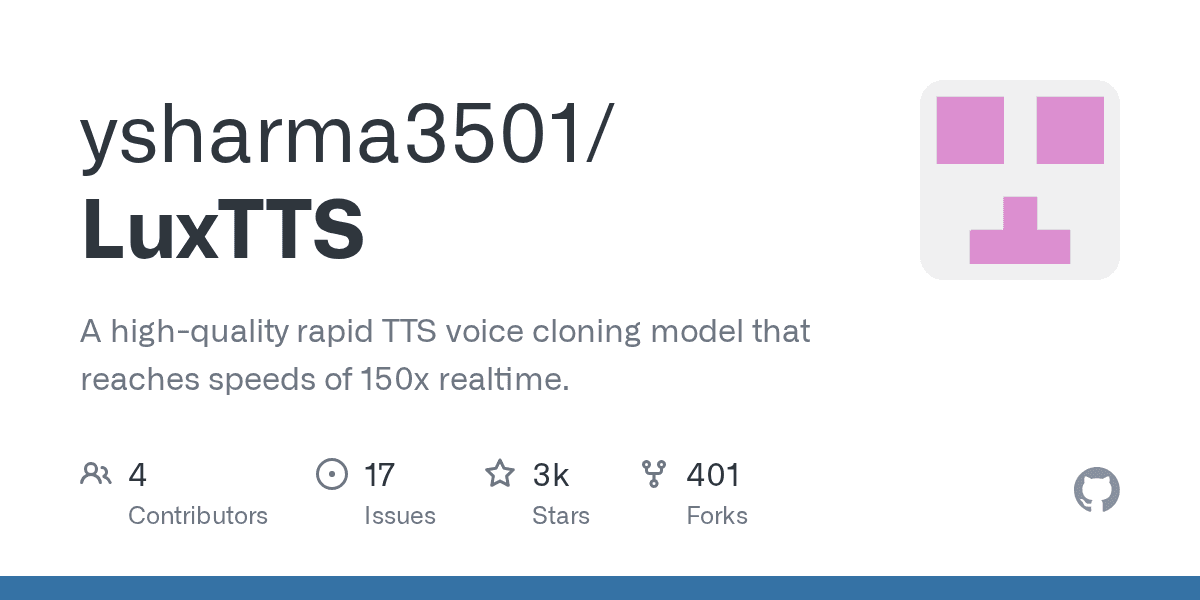
Beyond its impressive speed, LuxTTS stands out for its clarity. It generates speech at 48kHz, a significant upgrade from the 24kHz limitation common in many other TTS models. This higher fidelity ensures more natural and realistic cloned voices, crucial for applications ranging from personalized digital assistants to content creation. Its architecture is a distilled version of the original ZipVoice, optimized for a mere 4 steps of inference and featuring a custom 48kHz vocoder.
The emergence of models like LuxTTS underscores a critical shift in the AI landscape: the push towards highly efficient, open-source solutions that democratize access to powerful technology. While specialized platforms like Reson8 focus on highly accurate, industry-specific automatic speech recognition (ASR) for diverse languages, LuxTTS targets the generative side, empowering users to create custom voices with ease. This accessibility fosters innovation, allowing smaller teams and individual developers to experiment with advanced voice cloning without prohibitive computational costs.
The model’s efficiency means complex voice AI tasks can now be executed quickly on standard hardware, eliminating the need for expensive cloud infrastructure in many cases. This capability is particularly impactful for rapid prototyping and local development workflows. With over 3,300 stars and 400 forks on its GitHub repository, LuxTTS has quickly garnered significant community interest, indicating its value to the developer ecosystem.
As open-source AI tools gain prominence, the importance of robust security practices grows. Recent incidents, such as the GlassWorm malware campaign, which targeted over 400 code repositories on platforms like GitHub and npm, highlight the potential for supply chain attacks within the open-source community. This necessitates vigilance from developers integrating such tools, ensuring code integrity and secure deployment practices to mitigate risks. LuxTTS, while a powerful tool, reminds us that the benefits of open-source innovation come with a responsibility to maintain a secure development environment.
For Developers
Leverage LuxTTS for rapid prototyping and local deployment of voice-enabled applications, minimizing cloud compute costs.
For Founders
Explore creating highly personalized user experiences with custom voice interactions, offering unique product differentiation.
For Content Creators
Generate high-quality voiceovers and audio content at scale, maintaining voice consistency across projects.
For Security-Conscious Teams
Implement rigorous supply chain security measures when integrating any open-source project, including scanning for vulnerabilities.
LuxTTS is an open-source text-to-speech (TTS) model that offers state-of-the-art voice cloning capabilities. It's designed to be lightweight and efficient, achieving speeds of 150x real-time on a single GPU while requiring under 1GB of VRAM. LuxTTS generates high-fidelity speech at 48kHz clarity, making it suitable for local deployment.
LuxTTS delivers voice cloning at 150x real-time on a single GPU. This speed is significantly faster than many other text-to-speech models, enabling rapid prototyping and deployment of voice-enabled applications. The model's efficiency minimizes the need for expensive cloud infrastructure.
LuxTTS offers several benefits, including its high speed, high audio quality (48kHz), and low VRAM requirement (under 1GB). It allows developers to create custom voices easily and efficiently on standard hardware. As an open-source tool, LuxTTS fosters innovation and democratizes access to advanced voice cloning technology.
LuxTTS is a distilled and optimized version of ZipVoice. LuxTTS is based on the ZipVoice architecture but has been streamlined for faster performance, requiring only 4 steps of inference. It also features a custom 48kHz vocoder for high-fidelity audio output.
Yes, LuxTTS has quickly gained significant community interest, with over 3,300 stars and 400 forks on its GitHub repository. This indicates its value and utility to the developer ecosystem. The model's efficiency and accessibility make it a popular choice for rapid prototyping and local development workflows.
More insights on trending topics and technology