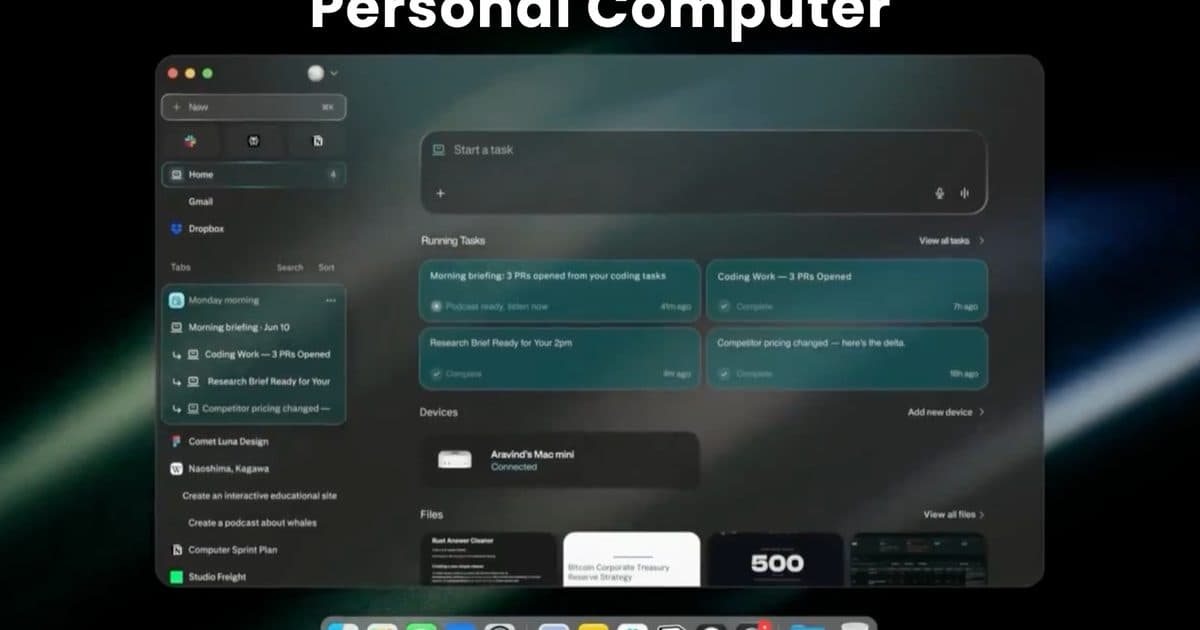
For small business owners, the value proposition arguably becomes even stronger. Imagine pointing Personal Computer at your Gmail account and telling it to watch for client inquiries, draft replies based on your past communications, and only alert you when human intervention is absolutely essential. It connects to a suite of popular services, including Gmail, Slack, GitHub, Notion, and Salesforce, enabling it to monitor triggers and execute proactive tasks across them. As Aravind Srinivas, CEO of Perplexity, stated at the conference, "A traditional operating system takes instructions; an AI operating system takes objectives."
However, the path for AI agents isn't entirely clear. Just recently, a federal judge blocked Perplexity's Comet web browser agent from making purchases on Amazon.com without Amazon's authorization, according to Bloomberg. While Personal Computer emphasizes user control and audit trails, this ruling highlights the ongoing legal and ethical complexities surrounding autonomous AI actions, especially when interacting with third-party platforms. It signals that user consent, while important, does not always override platform terms of service or a company's right to control access to its systems.
While individuals will undoubtedly find innovative uses, the steep $200 monthly price tag reveals the true target audience: businesses. This isn't consumer-grade automation dressed up for the enterprise; it's the other way around. The real "unlocks" are geared towards teams drowning in repetitive workflows, founders who cannot yet afford to scale their human workforce, and operations relying on piecemeal solutions. Nothing else on the market combines this level of local-cloud integration with such a diverse array of models and hands-off execution.
For Developers
Consider leveraging Personal Computer to automate GitHub monitoring, Slack summaries, and other repetitive coding-adjacent tasks, potentially freeing up significant time for more complex problem-solving.
For Small Businesses & Founders
Evaluate the $200/month investment as a virtual assistant that handles client communications, report generation, and data synchronization across platforms like Gmail and Salesforce, improving operational efficiency without hiring.
For Enterprise Decision-Makers
Explore the enterprise version's enhanced security and compliance features for automating complex workflows across your organization, particularly in areas suffering from workflow bottlenecks.
For Everyday Users
While the $200 monthly cost and Mac-only requirement make it inaccessible for casual use, observe how this technology evolves. Its focus on objective-driven AI could eventually trickle down into more consumer-friendly autonomous agents.
Perplexity's Personal Computer is a cloud-based AI agent designed to operate as a persistent digital worker. It runs on a user-provided Mac mini and manages complex tasks asynchronously for weeks or months by coordinating across 19-20 different AI models. It aims to transform traditional computing by taking high-level objectives rather than mere instructions.
The Personal Computer operates 24/7 on a user's Mac mini, gaining local access to files and applications. It coordinates across 19 to 20 AI models, including specialized versions of Claude, Gemini, and Grok, to handle complex workflows. Users provide a high-level objective, and the Personal Computer breaks it down into subtasks, managing them from start to finish.
Access to Perplexity's Personal Computer requires a Perplexity Max subscription, which costs $200 per month. The service is initially available for Mac users via a waitlist. This subscription provides access to the cloud-based AI agent that runs on a user-provided Mac mini.
No, Perplexity's Personal Computer is not a physical hardware device. It is sophisticated software, a persistent evolution of their earlier Perplexity Computer. It is designed to run continuously on a user-provided, always-on machine like a Mac mini.
Every task performed by Personal Computer executes within a sandboxed cloud environment, with each task getting its own isolated filesystem and browser. Every action requires explicit user confirmation, and a built-in audit trail logs every command, providing transparency and control. This prevents the AI from accessing local directories without permission.
More insights on trending topics and technology