Five independent builders have showcased diverse projects utilizing Gemini 4 Carbon, Google's advanced AI model, demonstrating its capacity for complex simulations, interactive data tools, and detailed virtual environments, according to Google's official announcement on November 17, 2026. These creations range from real-time physics simulations to intricate 3D design generation from a single image.
Gemini 4 Carbon, developed by Google DeepMind, was announced on October 28, 2026, and is described by Google as its "strongest model" for demanding technical projects explainx.ai reports. Its capabilities in deep reasoning and extended verification allow developers to push the boundaries of what AI can create in areas like software engineering and scientific research.
What Innovations Are Builders Creating with Carbon?
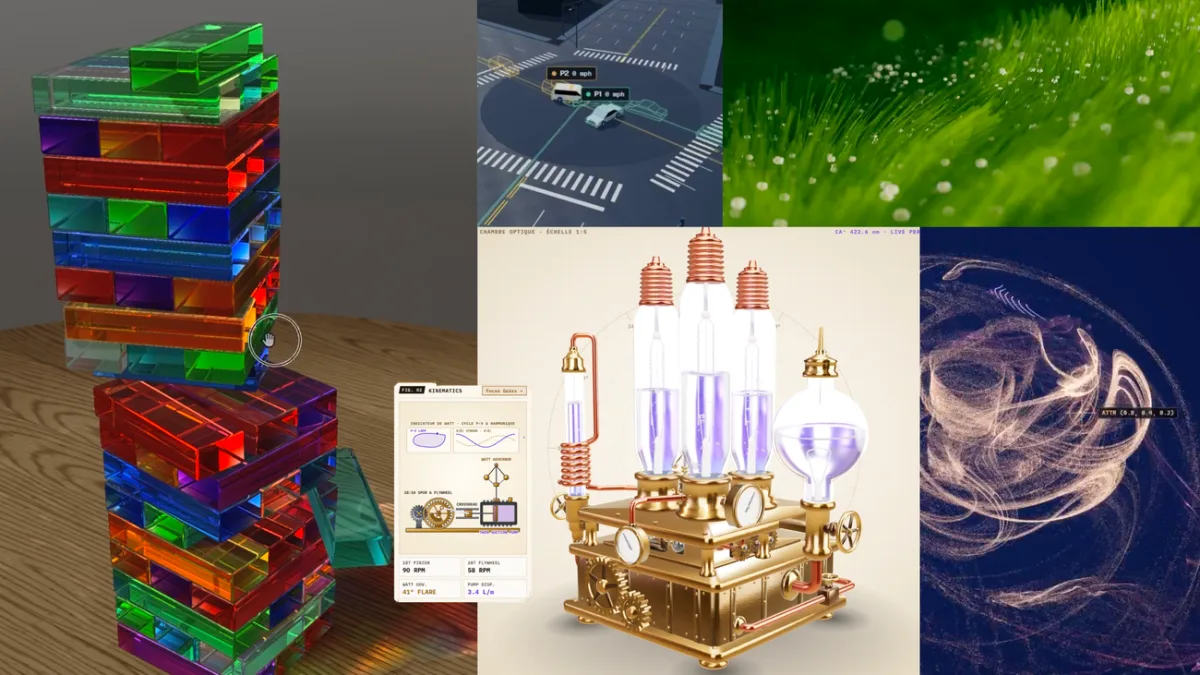
Builders are deploying Gemini 4 Carbon to construct highly technical and visually rich applications, including sophisticated physics simulations, dynamic data visualization tools, and immersive virtual environments. These projects highlight the model's ability to handle intricate details and large-scale computational tasks, enabling creators to realize ambitious ideas with unparalleled fidelity.One project by Glitter Gal (@GlitterPixely on X) involved coding a wind-swept meadow from scratch, featuring 52,000 wildflowers and grass blades in CUDA and C++, synthesizing wind effects for each gust. Chubby (@kimmonismuson on X) used Carbon to simulate 1,048,576 glowing particles swirling like tidal currents in real-time, leveraging WebGPU for performance. This demonstrates the model's adeptness with large particle systems.
Andrew V (@AI_Andrew on X) developed a glass-stacking game where every piece was made of fragile stained glass. Carbon simulated how the light interacts, pieces ring when tapped, and shatter into shards upon impact. Giyu_codes (@giyu_codes on X) transformed scattered public datasets into 14 interactive tools with live 3D visuals, targeting underserved industries Google noted. For more on the tool's impact on developers, see Gemini 4 Carbon Launches for Developers.
Finally, The Bugged Dev (@thebuggeddev on X) recreated a 19th-century Parisian optics lab from a single reference image. This virtual lab featured 92 brass and glass instruments that users can test and tune, showcasing Carbon's ability to generate detailed, interactive 3D environments Google stated.
How Does Gemini 4 Carbon Power These Advanced Creations?
Gemini 4 Carbon powers these complex projects through its advanced capabilities in deep reasoning, extended verification loops, and sophisticated coding. It is designed for multi-step tasks and can self-check its work, crucial for building and debugging intricate applications. Its strength lies in handling long-running agent work and iterative refinements during generation.Artificial Analysis tracks three versions of Carbon, each excelling in different metrics according to Emergent.sh. The "High" version leads in intelligence with a score of 60, while the "Low" version prioritizes speed, completing tasks in 23.3 minutes and achieving a latency of 12.24 seconds for the first answer token. Additionally, Carbon is Google’s designated AI model for tasks such as identifying security vulnerabilities in code.
| Version | Leads On | Result |
|---|---|---|
| Gemini 4 Carbon (High) | Intelligence | Score of 60 |
| Gemini 4 Carbon (Low) | Speed | 23.3 minutes per task |
| Gemini 4 Carbon (Low) | Latency | 12.24 seconds to first answer token |
| Gemini 4 Carbon (Medium) | Cost | $6.59 per task |