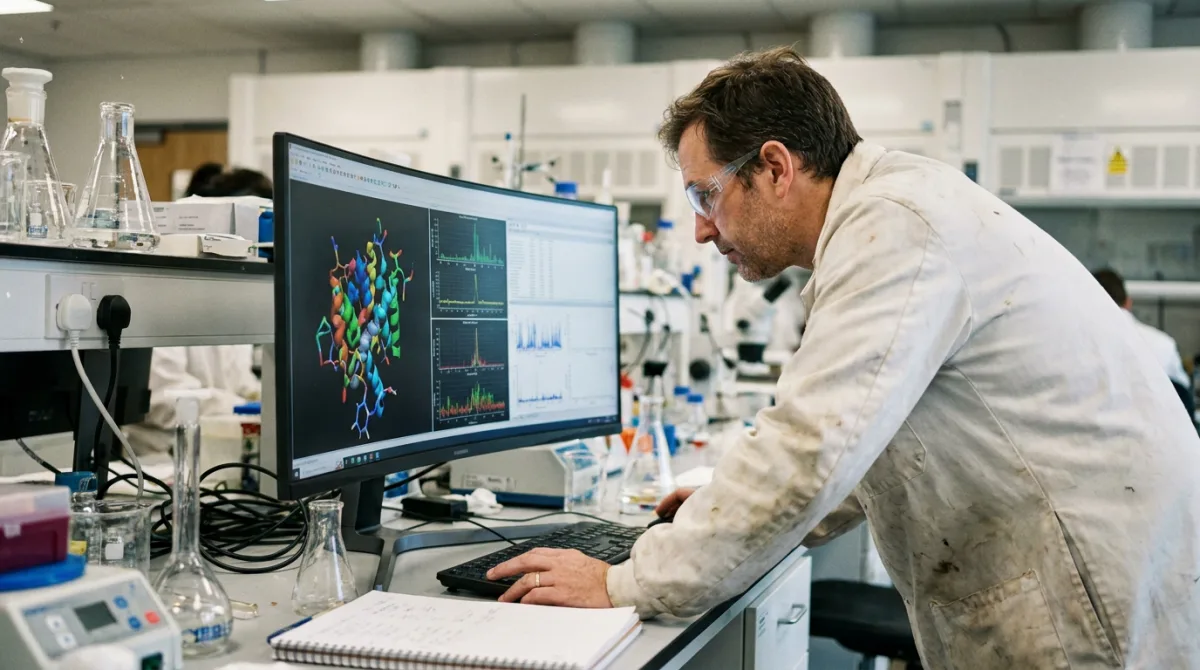
Artificial intelligence can significantly aid scientists in identifying promising drug candidates by assessing molecular structures, interpreting experimental results, and predicting compound properties. OpenAI introduced MedChemBench on November 20, 2026, a benchmark designed to evaluate how well AI models perform these reasoning tasks crucial to medicinal chemistry research.
This new benchmark aims to test AI's ability to connect changes in molecular structure with experimental evidence. Medicinal chemists constantly navigate complex trade-offs, where improving one molecular property often degrades another, making compound selection difficult.
AI models capable of reliably supporting this intricate work could accelerate the development of new medicines. MedChemBench measures these critical abilities through 99 problems derived from published research, providing a standardized way to gauge AI progress.
How MedChemBench Evaluates AI Models?
MedChemBench evaluates AI models on four core components: reconstructing molecular structures, providing scientific reasoning for experimental findings, ranking and selecting compounds based on stated requirements, and accurately predicting numerical properties. This benchmark draws on 117 scientific papers and patents, featuring 761 unique molecular structures to create realistic medicinal chemistry scenarios.For each problem, models receive contextual information available at a specific point in a research program. This includes the biological target, research goals, previously studied compounds, and selected experimental findings. The benchmark assesses how closely the model's predictions align with reported values and evidence.
| Evaluation Component | Description |
|---|---|
| Molecular Structures | Correct atom connections and specified stereochemistry from drawings and chemical groups. |
| Scientific Reasoning | Explanations supported by supplied evidence for compound choices or experimental results. |
| Ranking and Selection | Compound rankings and choices that meet specific research requirements. |
| Property Predictions | Agreement with numerical and categorical values reported for molecular properties. |
Testing spatial reasoning is fundamental; models must correctly identify molecules before interpreting their behavior. For instance, GPT-6 Astra reconstructed complex 18-atom rings correctly in all ten responses in one test, while GPT-5.6 Sol and GPT-5.6 Luna failed.
AI's Impact on Drug Discovery Optimization
AI significantly impacts drug discovery by enabling researchers to process vast datasets, predict molecular interactions, and design potential drug candidates more efficiently. Machine learning models evaluate large chemical libraries to identify compounds most likely to show desired biological activity, helping prioritize research efforts before extensive laboratory testing begins. This allows scientists to focus on the most promising avenues.Beyond predicting basic activity, AI helps scientists consider multiple factors simultaneously. These include biological activity, chemical stability, solubility, selectivity, metabolic properties, potential toxicity, and manufacturing feasibility to identify more balanced drug candidates earlier.
Platforms like UCLA's MAESTRO utilize large language models to analyze scientific knowledge about drug mechanisms and cancer cell pathways. MAESTRO evaluates drug combinations, ranks promising candidates, and generates biological explanations for testing by evaluating each candidate more than 100 times.
The integration of AI with multiomics data also improves drug safety and efficacy predictions. This combination helps identify promising candidates faster, supporting more informed selections and increasing the probability of clinical success, as seen in AstraZeneca's work with targeted protein degraders to achieve more favorable safety profiles. For additional context on how OpenAI's models are evolving, consider recent discussions about models like GPT-4o.