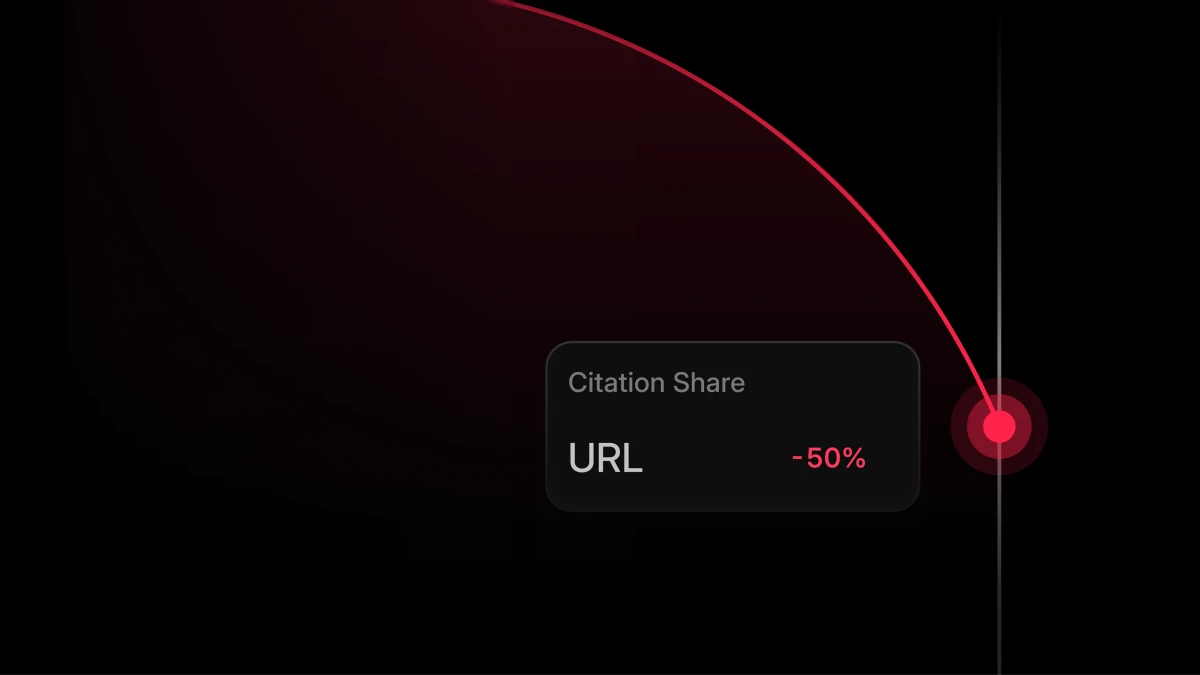
The median half-life of an AI citation is 11 days for what are termed "burst pages," which quickly lose citation share after peaking, according to research conducted by Profound between September 2025 and September 2026.
This finding signals a significant shift in how information gains and maintains authority within AI search, contrasting sharply with traditional SEO models where content often accrues value over time.
The rapid decay means that unlike classic web search, where a ranking could be held for extended periods, authority in AI search expires rather than accumulates.
AI Citation Durability Trends
AI citations exhibit distinct decay patterns: 78% of cited pages lose half their peak share within two weeks of peaking, classified as burst pages with an 11-day median half-life. The remaining 22% are "sustained pages," featuring a longer median half-life of 27 to 29 days, depending on the specific answer engine.Most AI citations are single events, falling to half their peak share quickly after an initial burst of citations. This is largely due to the vastness of the source pool available to answer engines like Perplexity and ChatGPT.
The probability of a page being cited a second time at the same rate is low. Pages tied to a specific date or event also tend to fade faster than evergreen content.
Content Family | Median Half-Life |
|---|---|
Report (News, announcements) | 27 days |
Explain (Guides, documentation) | 28 days |
Sell (Product, pricing pages) | 28 days |
Choose (Comparisons, listicles) | 29 days |
How Do Answer Engines Compare?
The behavior of citations varies significantly across AI models; a sustained page cited by Claude is 2.8 times as likely to retain half its peak share after eight weeks compared to one cited by ChatGPT. This divergence highlights that each engine makes independent decisions on what to cite and for how long.Some engines, specifically Perplexity and Claude, tend to return to pages repeatedly, spreading their citations over weeks. Others, including ChatGPT, Google AI Overviews, Google AI Mode, and Google Gemini, often cite a page intensively for a few days before stopping.
The correlation between how long a page lasts on one engine versus another is very low, ranging from 0.03 to 0.09. This means an SEO strategy needs to account for each platform's unique behavior, as winning or losing on one does not predict performance on others.
A page cited by five or more engines is significantly more likely to maintain its share. Such broadly cited pages are 5.5 times as likely to remain above half their peak share after eight weeks compared to pages cited by only one engine.
Implications for Content Strategy
For marketers and content creators, the rapid decay of AI citations necessitates a shift from aiming for long-term ranking to a strategy focused on continuous, specific content publication. Unlike traditional search, which rewarded established authority, answer engines are under no obligation to revisit previously cited sources.This means brands must consistently publish fresh content that is specific enough to be chosen by AI models, and then published frequently enough to remain eligible as older citations decay. This strategy can help address issues such as those where Google AI Search has previously disregarded user queries or provided inaccurate information.