ChatGPT has developed its own internal retrieval index, named Labrador, comprising a family of vertical indexes for various content types, according to a Peec AI report published in September 2026. This system operates alongside external search providers, contradicting previous assumptions that ChatGPT relied solely on Bing and Google .
For two years, the consensus among SEO professionals was that ChatGPT sourced its information primarily through external search engines. This new finding indicates a significant strategic shift by OpenAI to build its own independent data retrieval capabilities.
The existence of Labrador suggests that OpenAI is moving towards greater autonomy in how ChatGPT accesses and processes information, impacting how content creators and businesses optimize for AI visibility.
What Is Labrador and Its Scope?
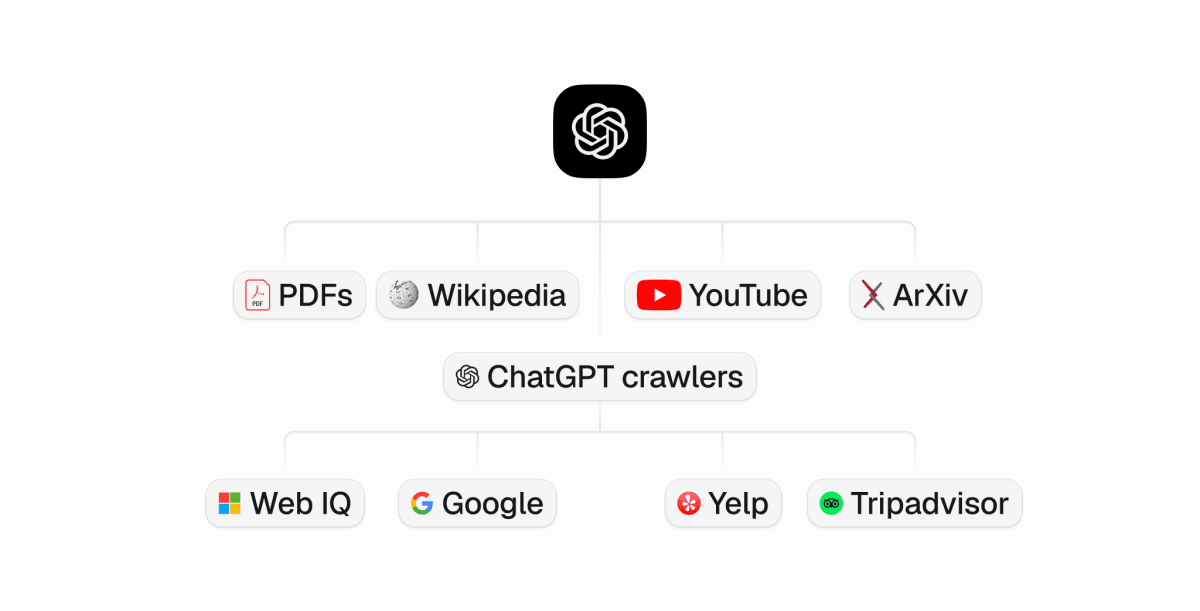
Labrador is OpenAI's proprietary search index, a collection of specialized indexes designed to retrieve diverse content types, including web pages, PDFs, and multimedia, allowing ChatGPT to reduce its reliance on third-party search engines. It covers general web content, PDF documents, YouTube videos, news articles, arXiv papers, Wikipedia entries, local information, financial data, legal texts, medical research, shopping results, and images .This family of indexes stores typical data points, such as full page content, crawl dates, and publication dates, similar to the architecture of traditional search engines like Google . OpenAI's job postings further corroborate this, seeking engineers skilled in "designing and operating indexing systems, retrieval pipelines, and serving layers" to manage databases at an "exabyte scale" .
Labrador Index Type | Content Focus |
|---|---|
General Web | Broad internet content |
PDF/arXiv | Academic papers, documents |
YouTube | Video content |
News | Timely articles (daily, weekly, historical) |
Local | Geographically specific information |
Finance/Legal/Medical | Specialized industry data and texts |
Shopping/Images | Product information and visual media |
The development of Labrador is not a recent undertaking. Testimony during Google's antitrust trial revealed that OpenAI began building its own search index in 2023 . OpenAI aimed to answer 80% of queries from its own index by the end of that year, despite acknowledging a much longer timeline for full independence.
How Does ChatGPT's Index Integrate External Sources?
ChatGPT integrates its own Labrador index with information from at least eight external providers, including Bing, Google, Yelp, and Microsoft's Web IQ, ensuring comprehensive and diverse search results. This hybrid approach allows ChatGPT to leverage its internal index while still drawing on the vast datasets of established search and data platforms .For instance, an experiment showed increased website traffic in Google Search Console when ChatGPT was queried about a site, indicating continued reliance on Google's index . Additionally, ChatGPT uses a web crawler called OAI-Searchbot to build its index and caches pages to ensure rapid responses at scale .
OpenAI actively conducts A/B testing, particularly for shopping results, to evaluate the performance of its own index against scraped results. This ongoing validation helps to refine the blend of internal and external data sources for optimal user experience and information accuracy. This also impacts how AI could disrupt retail media’s $38 billion search ad market, as explored in a related Trending Society article.