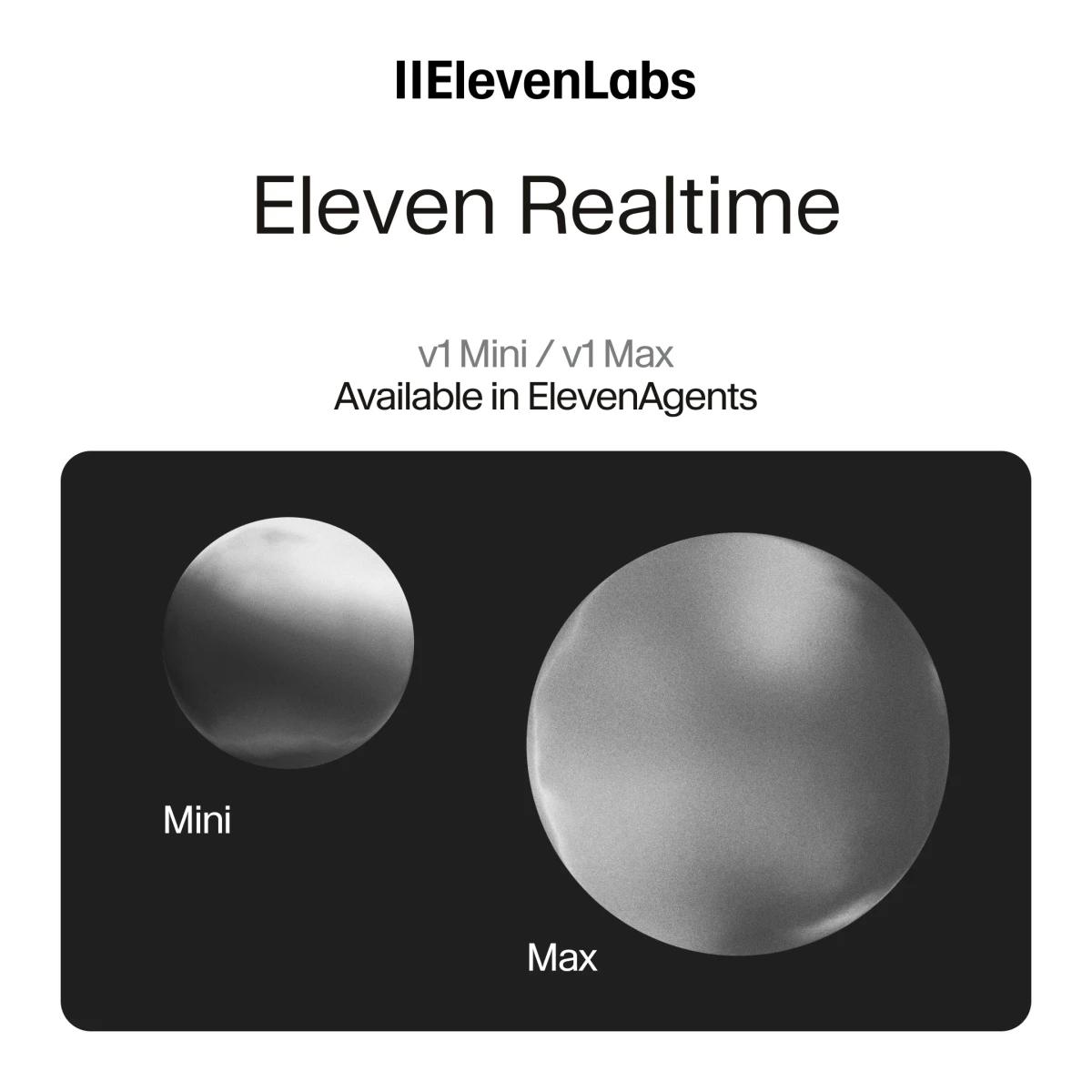
ElevenLabs launched Eleven Realtime, a new Speech-to-Speech model class featuring v1 Mini and v1 Max, to simplify natural voice agent creation, supporting over 90 languages and 17,000 voices as of November 2026, ElevenLabs announced. These models integrate components, removing configuration hurdles for developers.
Building natural-sounding voice agents traditionally involves complex decisions across multiple components. Developers often manage speech recognition, voice activity detection, turn-taking, and text-to-speech separately.
Eleven Realtime aims to streamline this process by offering complete, optimized voice agents that are tuned end-to-end, making deployment easier.
What Are Eleven Realtime Models?
Eleven Realtime models are comprehensive voice agents optimized for specific applications, eliminating the need for complex component configuration. They function as Speech-to-Speech models, taking audio input and providing audio output directly, simplifying the development process for conversational AI. Both v1 Mini and v1 Max support more than 90 languages and access ElevenLabs' library of over 17,000 voices.The Eleven Realtime v1 Mini model focuses on natural conversations at a lower cost, suitable for AI assistants, educational tools, and interactive characters. Most general use cases can effectively utilize this version.
For more intricate tasks, the Eleven Realtime v1 Max model handles complex workflows, ideal for customer support, lead qualification, and multi-step processes where agents follow defined procedures and logic.
How Do They Perform on Benchmarks?
Eleven Realtime models demonstrate strong performance across independent benchmarks for reasoning, speed, and conversational dynamics, competing with highly integrated 'fused' models. For instance, v1 Max achieved 98.8% correctness in speech reasoning on Big Bench Audio, while maintaining low latency. Its performance indicates a balance between accuracy and speed, outperforming many models on key metrics, The Decoder reports.Artificial Analysis evaluated both models across Big Bench Audio for speech reasoning, Full-Duplex-Bench for conversational dynamics, and the Speech Agent Arena for human preference and task success.
On Big Bench Audio, v1 Max correctly answered 98.8% of 1,000 reasoning questions, with v1 Mini achieving 75.9%. V1 Max starts speaking in an average of 0.57 seconds, and v1 Mini in 0.62 seconds, highlighting efficiency.
In conversational dynamics, Full-Duplex-Bench scores were 95.8% for v1 Mini and 94.1% for v1 Max, indicating strong turn-taking and interruption handling. In the Speech Agent Arena, human preference scores were 998 for v1 Max and 988 for v1 Mini during blind conversations.
For tool-use tasks, v1 Max completed 87.1%, while v1 Mini completed 60.3%, making Max suitable for complex integrations. The company emphasized that previous models like Eleven v4 focused on emotive qualities, while Realtime prioritizes practical, real-time interactions.
How Do Developers Integrate These New Models?
Developers can integrate Eleven Realtime models through ElevenAgents or directly via the Realtime API, which is compatible with OpenAI's Realtime API. This allows existing OpenAI integrations to switch endpoints and model names. The underlying cascaded architecture produces text at every step, offering clear visibility into agent comprehension and decision-making for debugging and guardrail implementation.Using ElevenAgents provides a complete platform with channels like phone and web, knowledge bases, and monitoring. For those with existing OpenAI Realtime API integrations, switching to ElevenLabs simply involves updating the endpoint URL to "wss://api.elevenlabs.io/v1/convai/realtime" and specifying the model name.
Model | Primary Use Case | Speech Reasoning Accuracy | Average Start Speak Time | Conversational Dynamics |
|---|---|---|---|---|
Eleven Realtime v1 Mini | Natural conversations, AI assistants, teachers | 75.9% | 0.62 seconds | 95.8% |
Eleven Realtime v1 Max | Complex tasks, customer support, lead qualification | 98.8% | 0.57 seconds | 94.1% |