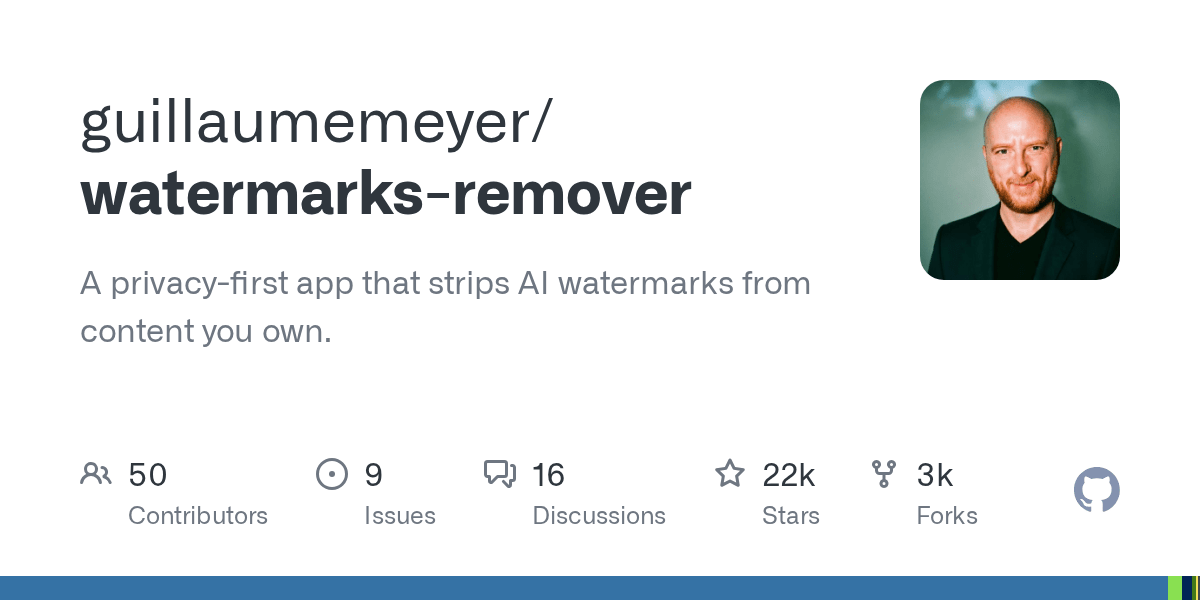
An open-source tool called Watermarks Remover has gained massive traction, amassing over 22,300 stars on GitHub for its ability to strip AI provenance marks from digital content. Created by developer Guillaume Meyer, the privacy-focused app targets multiple watermarking techniques across text, images, and documents, according to its repository which was last updated in September 2026.
The project emerged as a direct response to AI companies, like Anthropic, embedding invisible watermarks in their models' outputs. Meyer's tool offers a multi-layered approach to remove these signals. It provides developers with methods to clean content they own for privacy or hygiene reasons, sparking a broad conversation about content ownership and digital provenance in the age of generative AI.
How Does 'Watermarks Remover' Work?
The tool operates on a two-layer system to target different types of watermarks. The first layer performs deterministic cleaning of invisible characters and file metadata, while the second layer uses best-effort text rewriting to disrupt statistical watermarks embedded in word choices. This dual approach offers users granular control over the cleaning process.Layer A focuses on verifiable, lossless cleaning. It strips out invisible Unicode characters, such as zero-width spaces and bidirectional control characters, that can be used as carriers for hidden data. It also removes provenance metadata like C2PA manifests, EXIF data, and XMP packets from a wide range of file containers, often using optional external utilities like `exiftool` and `qpdf` for thorough scrubbing.The watermarks-remover optionally uses `c2patool` / `exiftool`.
Layer B addresses more complex statistical watermarks, which are embedded in the patterns of word and token selection by an LLM. Since these marks are part of the prose itself, removal requires rewriting the text. The tool can use another language model to paraphrase the content, disrupting the original statistical signal. The project's documentation notes this is a best-effort approach that involves a trade-off, as rewriting can degrade the original tone and quality of the copy.
What Formats and Watermarks Are Covered?
Watermarks Remover supports an extensive list of file formats, automatically detecting the content type and applying the appropriate cleaning strategy. Its coverage spans text, documents, images, and even audio/video containers. The tool is designed to address watermarking schemes from major AI vendors, including Unicode-based marks, C2PA file metadata, and statistical sampling patterns.
| File Format | Cleaning Action |
|---|---|
| PNG / JPEG / WebP | Drops C2PA, AI XMP, and other metadata segments. |
| Scrub document-level metadata and can optionally perform a deep structural rewrite with `qpdf`. | |
| DOCX / XLSX / PPTX | Scrubs `docProps` and `customXml` to remove provenance. |
| MP4 / MOV / M4A | Removes ISOBMFF `jumb` / `uuid` boxes used for C2PA and other generator tags. |
| HTML / Markdown | Strips `meta` tags, JSON-LD, `data-ai*` attributes, and YAML frontmatter keys. |
| WAV / MP3 / FLAC | Drops C2PA chunks, specific ID3v2 frames, and other metadata carriers. |
The tool is also packaged as an agent skill, allowing AI assistants like Claude Code to invoke it directly within a development workflow.
I am all for content attribution. I am against the watermarking technique, and that’s a very significant distinction.
— Guillaume Meyer, Creator, Watermarks Remover
Extending Capabilities with Optional Backends
Beyond its core functions, the project's modular design allows for powerful extensions through optional, externally-managed backends. These modules, which often require significant computational resources, enable advanced features like pixel-level watermark removal from images and research-grade verification of cleaning effectiveness.For pixel-based image watermarks (such as Google's SynthID), the tool can integrate with `CtrlRegen`, a backend that uses a controllable regeneration process to remove the watermark while preserving image content. Another optional harness, `MarkDiffusion`, allows for the removal of other image watermarks like Tree-Ring and provides a framework for verifying the cleaning process. These heavy-duty features are distributed via Docker and are intended for users with specific technical requirements.
What This Means for Developers
- The project's popularity signifies a strong developer desire for control over AI-generated content, pushing back against mandated, opaque tracking mechanisms.
- Its layered architecture provides a practical solution for different needs: lossless metadata cleaning for production assets versus aggressive-but-lossy rewrites for internal or less sensitive text.
- The clear documentation of limitations and trade-offs sets a standard for transparency, acknowledging that perfect, cost-free watermark removal is not currently feasible for statistical marks.
- By offering distribution as an agent skill, a CLI, and a Dockerized service, the tool provides a flexible component that can be integrated into nearly any development or content pipeline.