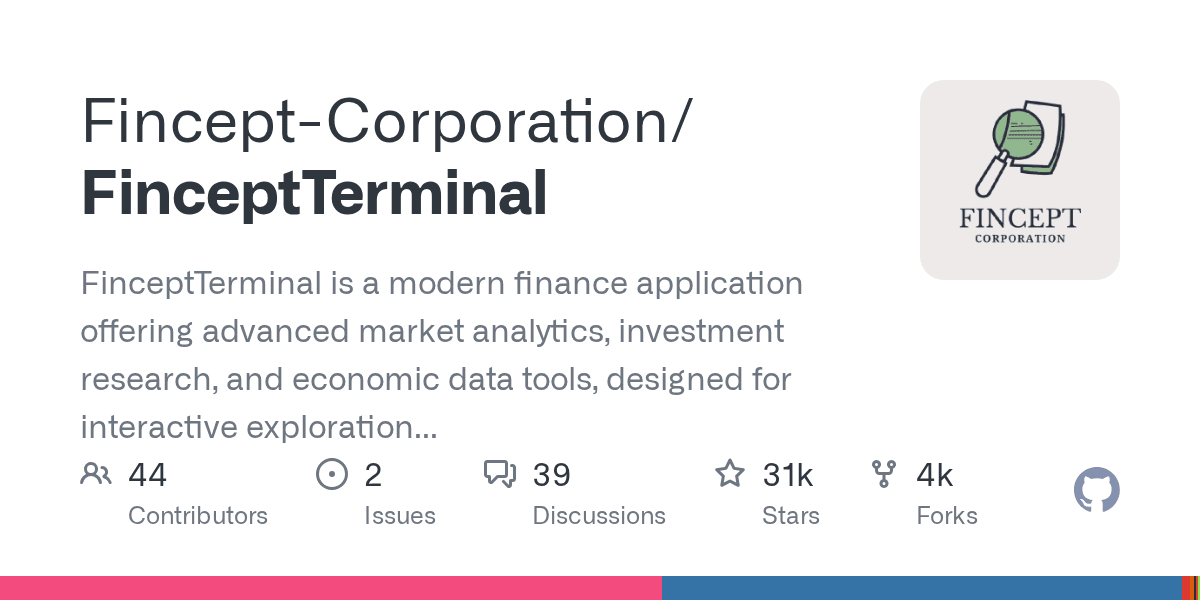
FinceptTerminal is a modern finance application providing advanced analytics and data tools through an open-core model. According to its official repository, the platform offers a free, open-source edition under an AGPL-3.0 license and a paid Enterprise version for commercial use with plans starting at $99 per user per month as of August 2026.
Built as a native C++20 desktop application with a Qt6 user interface, FinceptTerminal aims to challenge established financial data providers like the Bloomberg Terminal. The project maintains two distinct editions that run on the same data core. The free version is geared towards students, hobbyists, and academic researchers, while the closed-source Enterprise edition targets professional firms with additional features and support.
How Do the Free and Enterprise Editions Compare?
The primary difference lies in licensing, cost structure, and feature availability. The free version is governed by a strong copyleft license and requires users to cover their own data and large language model (LLM) API costs. The Enterprise edition is proprietary and includes data, AI credits, and live trading support in its subscription fee.Feature | Open Source (Free) | Enterprise (Paid) |
|---|---|---|
License | AGPL-3.0 (strong copyleft) | Proprietary |
Cost | Free, plus user-provided API keys | $99 to $299 per user/month |
AI | Bring your own LLM key | 400-5,000 credits included |
Data | Public feeds and personal keys | Private datasets, deeper history |
Trading | Paper trading and integrations | Live broker routing and algo deployment |
What's Included in the Open-Source Build?
The free edition of FinceptTerminal provides a robust suite of tools for financial analysis and research. It includes a wide range of analytics modules, integration with multiple AI models, and extensive data connectivity. The build is a single, native binary with no browser-based runtimes like Electron.Key features of the open-source version include:
Analytics: Modules for DCF, portfolio optimization, derivatives pricing, and a QuantLib suite.
AI Agents: Support for 37 pre-built agents for trading and economic analysis, compatible with models from OpenAI, Anthropic, Gemini, and others. The platform's approach to agent capabilities is part of a broader trend, similar to frameworks seen in projects like AI Research SKILLs.
Data Connectors: Fincept Terminal features over 100 data connectors to sources such as FRED, Polygon, Yahoo Finance, and various government APIs.
Automation: A visual node editor and AI-powered quantitative lab for machine learning and factor discovery.
Understanding the AGPL-3.0 License
FinceptTerminal's open-source edition uses the AGPL-3.0, a strong copyleft license. This means any publicly accessible service running a modified version of the software must release its source code. This requirement is a key factor pushing commercial entities toward the proprietary Enterprise version.For individual developers, students, or researchers using the software for personal, non-distributed projects, the license carries no such obligations. However, for most corporate legal teams, the copyleft terms are a significant hurdle. Fincept positions its Enterprise edition as the solution for firms that need to integrate the terminal into their commercial workflows without managing copyleft compliance.
Fincept Terminal charges for commercial use, and it no longer sells a separate commercial license for the open-source repository. All business use cases are directed to the Enterprise subscription plans.