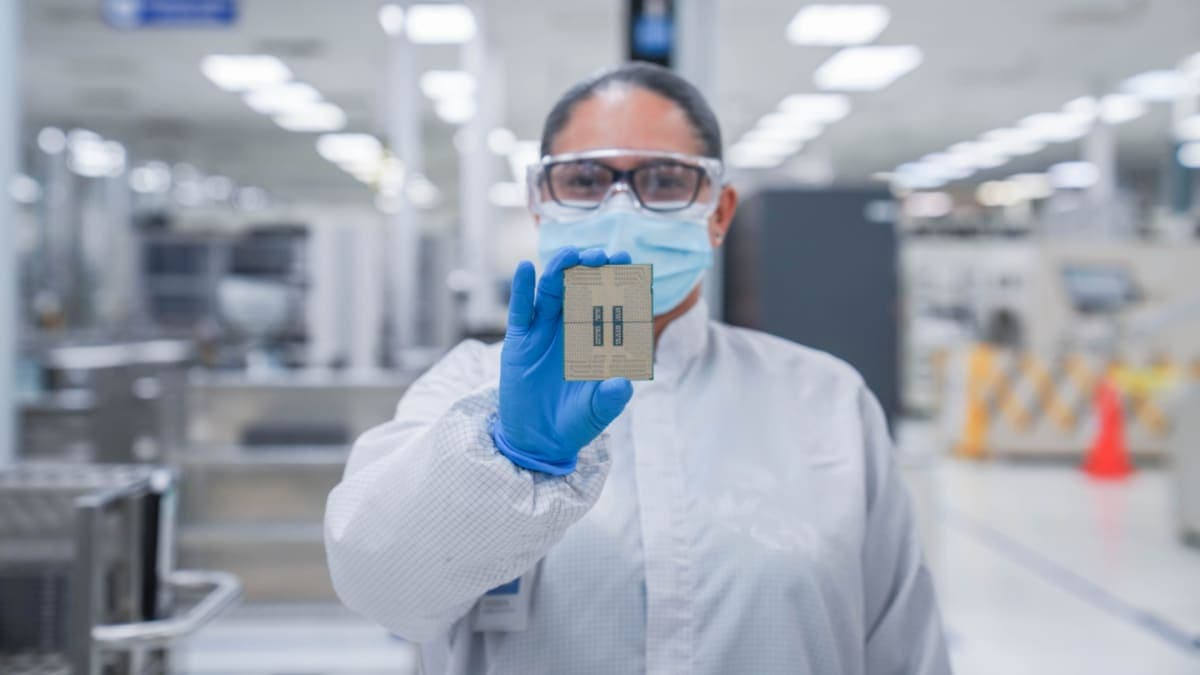
Google Selects Intel Xeon To Scale Its AI Infrastructure

Jeffrey Liu··2 min read·5 sources·AI
Google Selects Intel Xeon To Scale Its AI Infrastructure

Key Takeaways

  1. 1Google Cloud cemented a multi-year deal with Intel, embedding Xeon CPUs at the core of its AI infrastructure across global data centers.
  2. 2This strategic partnership reinforces Intel's position against rising Arm-based custom processors, specifically targeting AI inference and deployment workloads.
  3. 3Google and Intel will co-develop custom Infrastructure Processing Units (IPUs) to offload cloud tasks, freeing Xeon processors to focus entirely on AI tools and large language models.
  4. 4Future generations of Intel Xeon processors, including those built on advanced 18A process technology, will power Google's critical AI inference and general computing needs.

Alphabet's Google Cloud has solidified its commitment to Intel processors, signing a multi-year agreement to embed Intel Xeon CPUs at the core of its AI infrastructure. This expanded collaboration extends across multiple generations of Xeon chips and includes joint development of custom Infrastructure Processing Units (IPUs), securing Intel's role in powering Google's global data centers for AI workloads and general computing.

The deal comes as hyperscale cloud providers increasingly adopt custom Arm-based processors for AI tasks. This partnership reinforces Intel's position in a competitive market, specifically addressing the growing demand for CPUs that handle the deployment and inference stages of AI models, which differ from the GPU-intensive training phase.

Intel Xeon Processors Retain Core Cloud Role

Google Cloud instances like C4 and N4 already utilize Xeon 6 processors. This new multi-year agreement ensures that the pattern continues, with future generations of Xeon chips powering a broad range of workloads including AI inference and general-purpose computing across Google's global infrastructure, according to Intel. This commitment highlights the persistent need for x86 architecture, particularly for backward compatibility and the significant single-thread performance that Xeon CPUs offer.

While graphics processing units (GPUs) are essential for training complex AI models, central processing units (CPUs) remain critical for running those models in production. CNBC reports that Intel produces its latest Xeon processor using its advanced 18A process technology.

Custom IPUs Offload Infrastructure Tasks

Beyond CPUs, Intel and Google are expanding their co-development of custom Infrastructure Processing Units (IPUs), a collaboration that began in 2022. These IPUs are specialized, ASIC-based accelerators designed to offload fundamental cloud infrastructure tasks like networking, storage, and security from the main host CPUs.

By moving these functions to dedicated hardware, the IPUs free up Xeon processors to focus entirely on application execution, including AI tools and large language models. This separation improves system efficiency and optimizes resource allocation across large cloud deployments, enabling more predictable performance in hyperscale AI environments. TechRadar notes that 90% of AI servers running custom silicon are projected to rely on Arm's instruction set architecture, making Intel's strategy with IPUs crucial for retaining market share.

Amin Vahdat, SVP and Chief Technologist for AI Infrastructure at Google, emphasized that "CPUs and infrastructure acceleration remain a cornerstone of AI systems—from training orchestration to inference and deployment." This combined approach of robust CPUs and specialized IPUs underpins Google's strategy for scaling AI efficiently.


What This Means For You

1

For Investors (Intel)

This multi-year agreement with Google solidifies a major revenue stream and validates Intel's strategy in the competitive AI chip market. Watch for Intel's execution on its 18A process technology and IPU development to gauge its ability to maintain this momentum against rising competition.

2

For Cloud Developers

Google Cloud's deep commitment to Intel Xeon and custom IPUs signals continued optimization for x86-based AI inference and general computing. Plan to leverage these advancements for improved performance and efficiency in your AI workloads on Google Cloud, especially for inference and deployment.

3

For IT Infrastructure Managers

Google's long-term commitment to Intel Xeon for its AI infrastructure reinforces the stability and performance of x86 architecture for enterprise AI and general computing. Continue to evaluate Intel Xeon-based solutions for your on-premise or hybrid cloud deployments, anticipating robust support and performance for AI inference.

4

For Competitor Strategy Teams (e.g., AMD, Arm-based chip makers)

Google's multi-year deal with Intel underscores the enduring relevance of x86 for critical AI inference and general cloud workloads, even amidst the push for custom silicon. Focus your R&D and market positioning on highly specialized AI training accelerators or niche inference applications where x86 compatibility and Intel's IPU strategy are less dominant.

FAQ

Google Cloud has signed a multi-year agreement to integrate Intel Xeon CPUs into its AI infrastructure. This expanded collaboration includes future generations of Xeon chips and joint development of custom Infrastructure Processing Units (IPUs), securing Intel's role in powering Google's global data centers for AI workloads and general computing.

While GPUs are crucial for training complex AI models, Intel Xeon CPUs are critical for running those models in production, specifically for AI inference and general-purpose computing. Xeon processors also offer strong single-thread performance and backward compatibility, which are important for Google's broad range of workloads.

Intel and Google are co-developing custom IPUs, which are specialized accelerators designed to offload cloud infrastructure tasks like networking, storage, and security. By moving these functions from the main host CPUs, IPUs free up Xeon processors to focus entirely on application execution, including AI tools and large language models, improving system efficiency.

Related Articles

More insights on trending topics and technology

Newsletter

We read 100+ sources so you don't have to.

One email. Delivered weekly. The AI and tech stories actually worth your time.