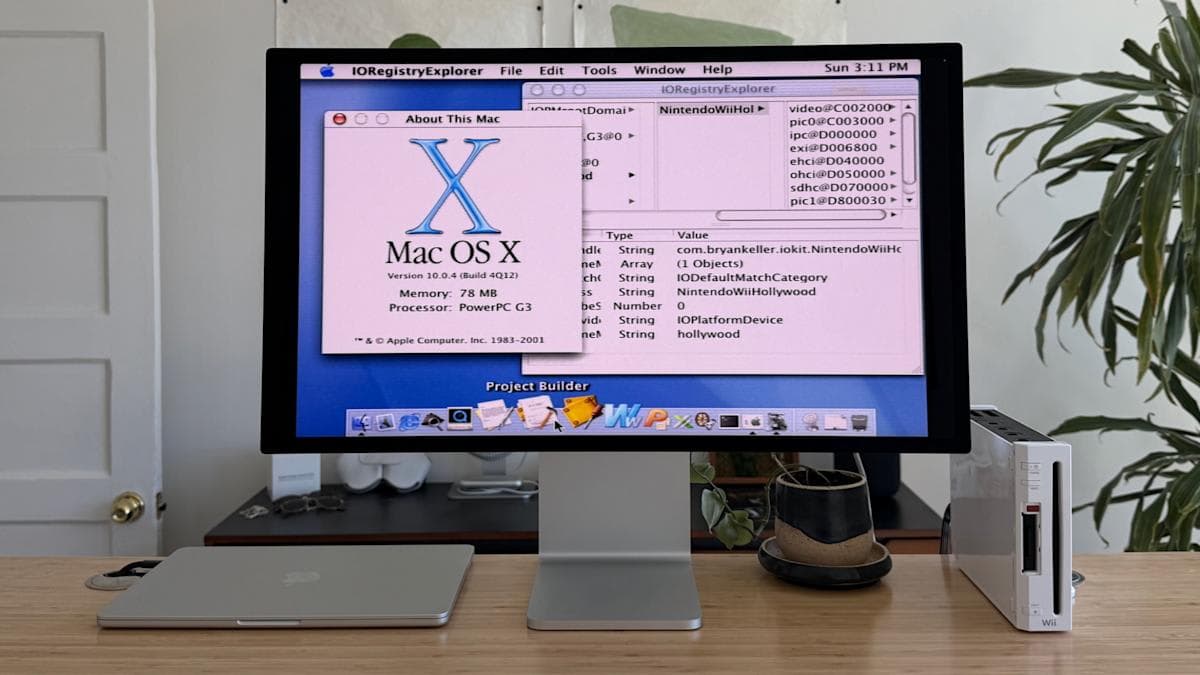
Keller, a developer, first conceived the idea in 2013 during his college years. However, a comment made five years ago by Redditor u/CussdomTidder—stating definitively that porting Mac OS X to the Wii was impossible—reignited his motivation. Keller saw the dismissive remark as a personal challenge, much like a legendary basketball player taking criticism to heart.
Why Mac OS X on a Nintendo Wii?
The underlying hardware of the Nintendo Wii played a significant role in making this improbable feat possible. The Wii utilizes a PowerPC processor, a CPU architecture that older Macs, including those capable of running Mac OS X 10.0, also used. This shared lineage minimized one of the primary technical hurdles for Keller. The console's widely documented hackability also provided a fertile ground for experimentation; other hackers have previously managed to run operating systems like Windows 95, Windows NT, Linux, and NetBSD on the platform.
Keller's initial inspiration also came from observing that Windows NT had been successfully ported to the Wii. This provided a concrete proof-of-concept, pushing him to attempt a similar project with Mac OS X. "Last year, when I saw that Windows NT had been ported to the Wii, I felt a renewed sense of motivation," Keller wrote, detailing his journey on his blog.
Overcoming Technical Hurdles
Bringing Mac OS X 10.0 (Cheetah) to the Wii required a deep dive into the console's architecture. Keller developed a custom boot loader to initialize the system. He then patched the kernel (the core of the operating system) to allow it to communicate with the Wii's unique components. This involved writing new drivers for the system-on-a-chip (SoC) called "Hollywood," which manages the Wii's I/O and graphics, a different setup than the PCI buses found in traditional Macs.
Keller created specific drivers for the Wii's SD Card and its framebuffer (which controls what appears on the screen). He even managed to get the Wii's USB ports functioning, enabling the use of a mouse and keyboard for interaction with the operating system. This intricate process of hardware abstraction allowed the ancient Mac OS X to interface with the gaming console's unconventional hardware. The developer called the entire process "deeply satisfying," acknowledging that the initial skepticism only pushed him further.
"In the end, I learned (and accomplished) far more than I ever expected," Keller noted. This endeavor proves that technical challenges, especially those deemed impossible, can yield significant learning and innovation when pursued with determination. The detailed steps and code are available on Keller's GitHub for those interested in exploring the project further.