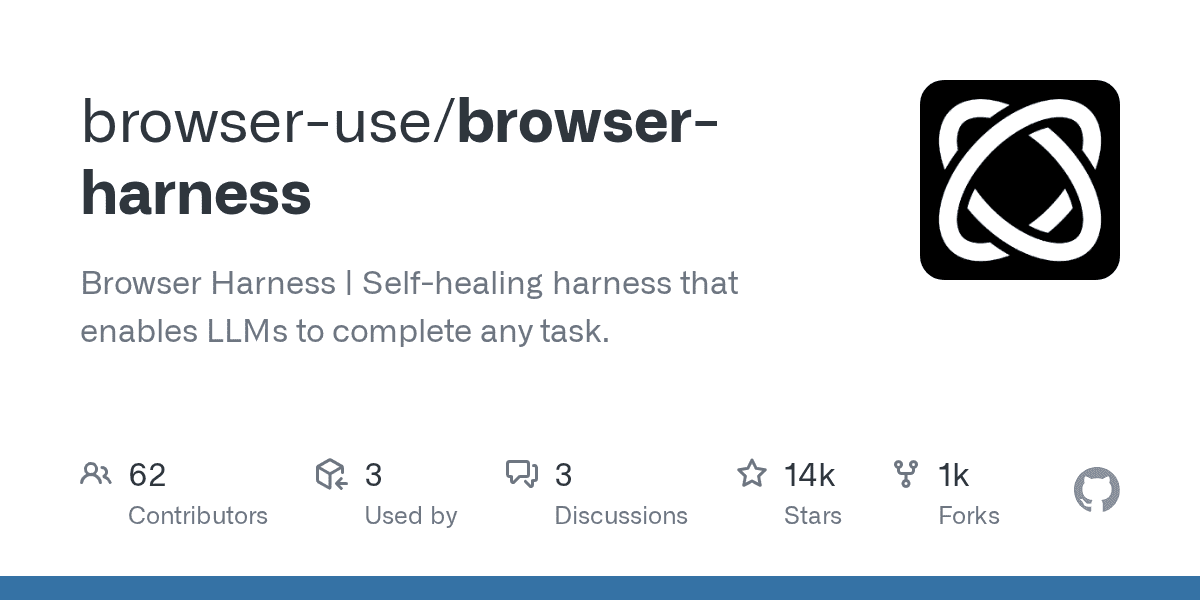
Browser Harness is an open-source framework that allows Large Language Models (LLMs) to control a web browser and autonomously write missing code to complete tasks. As of June 2026, the project on GitHub has gained over 14,100 stars, according to the repository page, demonstrating significant developer interest in its self-healing approach to web automation.
The tool provides a direct, thin connection between an LLM and a real browser, giving the AI agent the freedom to operate without restrictive intermediaries.
What is the Self-Healing Harness?
The core of Browser Harness is its self-improving capability. It uses a lightweight connection to a browser, often via the Chrome DevTools Protocol (CDP). Unlike rigid automation frameworks, it allows an AI agent to dynamically generate code helpers when it encounters a new or broken part of a workflow, effectively learning as it operates.This architecture is designed for adaptability. The agent interacts with a workspace it can edit. If the agent determines a necessary helper function is missing to perform an action, such as uploading a file, it can write and save that function itself. This new code is then available for future runs, allowing the harness to improve with every task it completes.
The project is structured into a protected core package and an editable agent workspace. This separation ensures the fundamental stability of the harness while giving the LLM complete freedom to modify its own tools and site-specific skills.
How Does It Compare to Traditional Tools?
Traditional automation tools like Selenium or Playwright depend on pre-written, brittle scripts that break when a website's UI changes. Browser Harness gives the LLM agent the autonomy to inspect the browser state and generate new code on the fly to overcome these changes, making automation more resilient.
Feature Browser Harness Traditional (Selenium/Playwright) Core Principle LLM-driven, adaptive Pre-scripted, rigid Error Handling Agent writes new code ("self-heals") Script fails, requires manual developer fix Setup Connect LLM to browser harness Write detailed test and automation scripts Maintenance Learns and stores "skills" to reduce future failures High; scripts need constant updates
A key feature is the concept of "domain skills." The harness encourages the agent to save reusable, site-specific playbooks. When the agent figures out a non-obvious workflow, like navigating a specific checkout process on Amazon, it can save that knowledge. This community-driven approach allows the agent to become more effective over time.
Why Does This Matter for the Future of Browsing?
Tools like Browser Harness are the engines for the next generation of AI-native browsers. As companies like Perplexity and The Browser Company race to integrate AI, according to TechCrunch, the underlying technology for agents to reliably perform complex web tasks becomes critical.The market is shifting toward browsers with integrated AI agents that can summarize content, manage tasks, and automate workflows. Perplexity offers an AI browser for its premium subscribers, while The Browser Company's Dia project aims to create an AI-centric experience. These advanced user-facing features rely on robust backend agent technology like Browser Harness to function effectively.
This trend extends beyond consumer browsers into enterprise technology. Major consulting firms are also planning for a future built on agentic AI, with The Wall Street Journal reporting on corporate strategies designed to harness this new wave of automation for growth.
What This Means For Developers
Reduced Maintenance Costs: Automation scripts that can fix themselves drastically cut down on the engineering time spent updating brittle selectors and workflows when websites change.
Accelerated Prototyping: Developers can build complex web agents by describing a task in natural language and letting the harness figure out the implementation details, moving from idea to proof-of-concept faster.
Democratized Agent Building: The "skills" system allows the community to contribute site-specific knowledge, creating a shared library that makes the agent smarter for everyone without requiring deep coding expertise from each user.