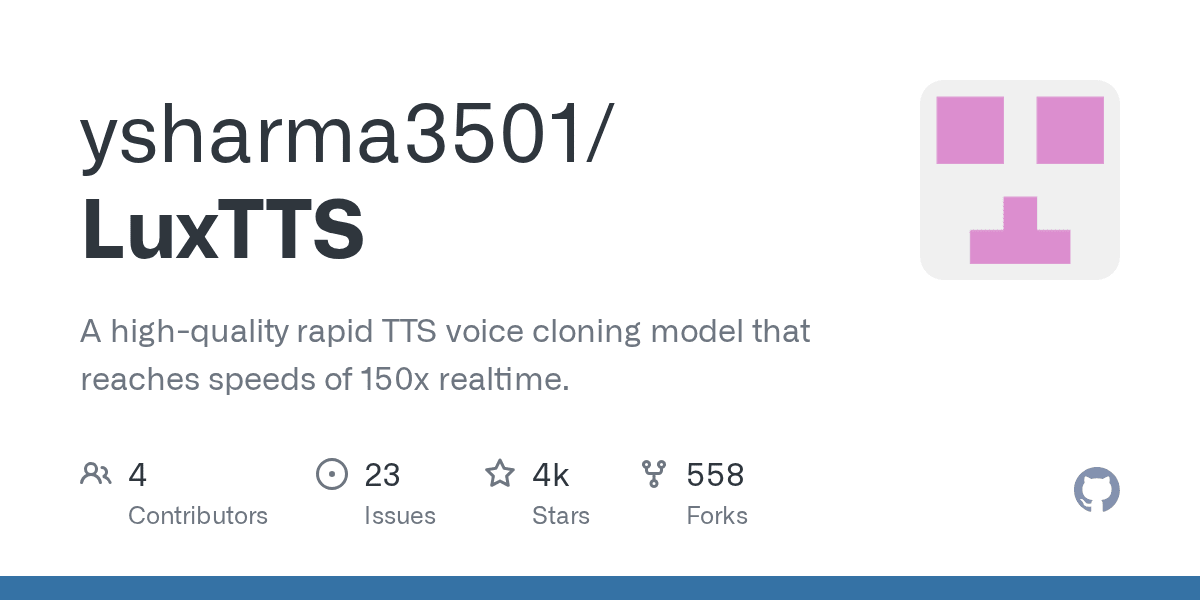
LuxTTS is an open-source text-to-speech model capable of high-quality voice cloning at speeds exceeding 150x real-time on a single GPU. According to its GitHub repository, the model achieves this performance as of June 2026 while requiring only 1GB of VRAM, making it highly accessible for local consumer hardware.
LuxTTS arrives in a rapidly evolving landscape of generative voice AI. Unlike large, cloud-based commercial services, its lightweight design targets developers and hobbyists who need fast, local, and realistic voice generation without expensive hardware. This approach, similar to other open-source efforts like Voice-Pro, democratizes access to powerful voice cloning technology.
How Does LuxTTS Achieve Its Speed?
LuxTTS achieves its remarkable speed through an efficient architecture based on ZipVoice but distilled down to just four sampling steps for inference. This simplified process, combined with a custom vocoder, allows the model to generate audio at over 150 times real-time speed on a GPU and even faster than real-time on a standard CPU.The model's extreme efficiency stems from this improved sampling technique, which drastically reduces the computational steps needed to produce audio. This design choice enables the model to operate within a tiny 1GB VRAM footprint, a critical feature for deployment on a wide range of consumer-grade graphics cards.
Future updates noted on the project's roadmap suggest even greater performance is possible. The developers plan to release code for float16 inference, an optimization that could nearly double the current generation speed without sacrificing significant quality.
Key Technical Differentiators
The primary differentiator for LuxTTS is its custom 48kHz vocoder, which produces significantly clearer audio than the 24kHz vocoders common in other models. This focus on high-fidelity audio, paired with its low resource requirements, sets it apart from larger, more demanding alternatives in the voice synthesis space.The jump from 24kHz to 48kHz moves the generated speech from a quality often associated with phone calls to something closer to studio recordings. This makes it suitable for more demanding applications like audiobooks or character voice-overs.
| Feature | LuxTTS | Base ZipVoice (Implied) |
|---|---|---|
| Vocoder Quality | Custom 48kHz | Default 24kHz |
| Inference Steps | 4 (distilled) | More (unspecified) |
| VRAM Usage | ~1GB | Higher (unspecified) |
| Speed (GPU) | >150x real-time | Slower |
What Does This Mean for Developers?
For developers, LuxTTS represents a practical and accessible tool for integrating high-quality, real-time voice cloning into applications. Its permissive Apache-2.0 license, simple Python implementation, and low hardware barrier make it ideal for rapid prototyping and deployment in projects ranging from custom voice assistants to dynamic content generation tools.Installation is handled via a standard `pip install` command from its requirements file. The GitHub page provides clear code snippets for loading the model on a GPU, CPU, or Apple's MPS for Macs, simplifying initial setup.
A growing community has already created user-friendly interfaces for LuxTTS, including Gradio and ComfyUI integrations. This ecosystem support is crucial for the adoption of open-source tools, as it lowers the barrier for non-programmers to experiment with the technology.