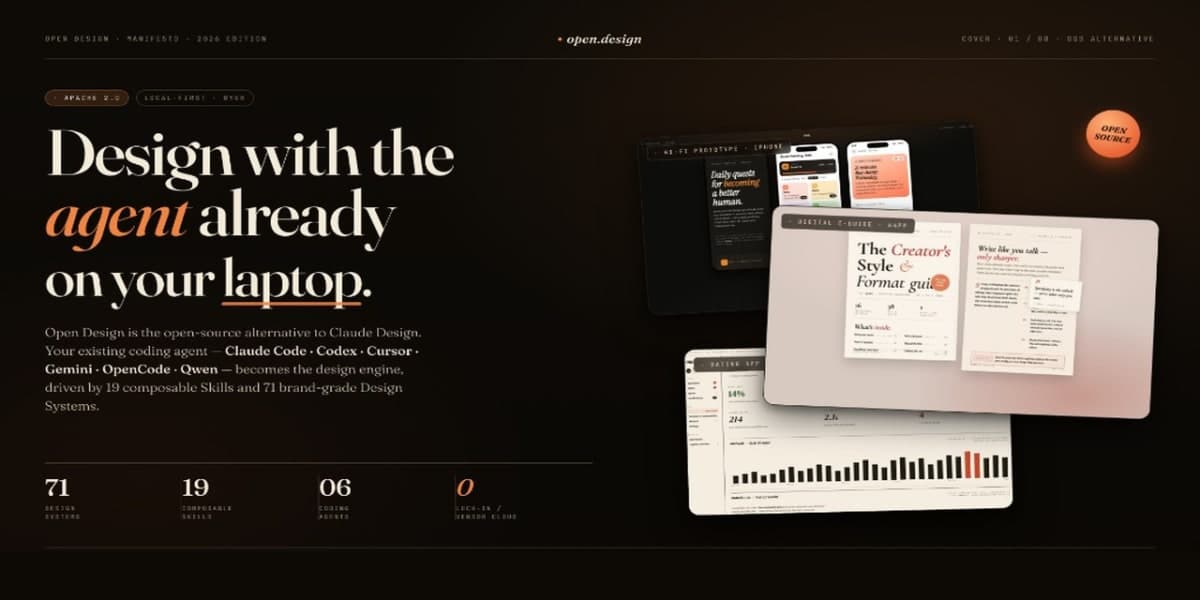
Open Design is an open-source, local-first alternative to Anthropic's Claude Design, offering a suite of tools for generating design artifacts from text prompts. According to its GitHub repository , which has gained over 57,600 stars since its release, the project supports 17+ coding agent CLIs and includes 142+ design systems, running as a native desktop or web application.
The project aims to replicate the workflow of generating design artifacts directly from large language models (LLMs), a concept popularized by Anthropic's closed-source tool. However, Open Design is built on an open, modular architecture that allows developers to use their preferred AI coding agents and deploy the application on their own infrastructure, including Vercel.
How Does Open Design Work?
Open Design operates through a local daemon and a web-based user interface. The daemon scans the user's system for existing AI coding agents installed on their `PATH`, such as GitHub Copilot CLI or Claude Code. This allows the tool to delegate design tasks to the user's chosen agent, avoiding reliance on a single, proprietary model. The entire project state, including conversations and artifacts, is stored locally in a SQLite database.When a user provides a prompt like "make me a pitch deck," the system first presents an interactive form to clarify the brief's objectives, audience, and tone. This pre-flight check aims to reduce rework by locking in key design decisions before generation begins. The selected agent then creates the artifact—a webpage, slide deck, or image—which is rendered in a sandboxed iframe for immediate preview.
How Does It Compare to Claude Design?
Open Design primarily differentiates itself by being open-source, local-first, and agent-agnostic. While Claude Design is a cloud-only service locked to Anthropic's models, Open Design offers flexibility at every layer. It allows developers to bring their own API keys (BYOK) for various models or use over a dozen different command-line agents they already have installed.| Feature / Spec | Claude Design (Anthropic) | Open Design |
|---|---|---|
| License | Closed-source | Apache-2.0 |
| Form Factor | Web (claude.ai) | Web app + local daemon |
| Deployable | No | Yes (Vercel, local) |
| Agent Runtime | Bundled (Opus) | Delegated to 17+ user CLIs |
| Skills | Proprietary | 259+ file-based, extensible |
| Design Systems | Proprietary | 142+ file-based, extensible |
| Claude Design Import | N/A | Yes |
| Persistence | Cloud-based | Local SQLite and file system |
What Can You Create With It?
The platform includes 259+ built-in 'Skills' for a wide range of design and operational tasks. These skills are pre-packaged prompt templates that guide the AI agent to produce specific outputs. The library is grouped by scenarios like marketing, engineering, product management, and finance.Prototypes: Single-page websites, SaaS landing pages, dashboards, and mobile app screens with pixel-accurate device frames.
Decks: Magazine-style presentations, weekly updates, and product walkthroughs.
Media: Images, cinematic videos, and motion graphics using integrated models like Seedance 2.0 and HyperFrames.
Documents: PM specifications, engineering runbooks, financial reports, and invoices.
What Does This Mean for Developers?
Open Design champions a "Bring Your Own Agent" (BYOA) model, treating powerful coding AIs as interchangeable components rather than walled-garden products. This gives developers control over their tools, data, and expenses, directly countering the platform lock-in of closed-source alternatives. By building on existing CLIs, it integrates into a developer's established workflow instead of forcing a new one.However, this approach also shifts the security responsibility to the user. The architecture's reliance on spawning user-installed CLIs means developers must trust the agents on their system. This is a critical consideration in an environment where supply chain attacks are common. The recent coordinated takedown of the Glassworm botnet, which infected over 300 GitHub repositories through compromised packages and extensions, serves as a stark reminder of the risks inherent in the open-source ecosystem.