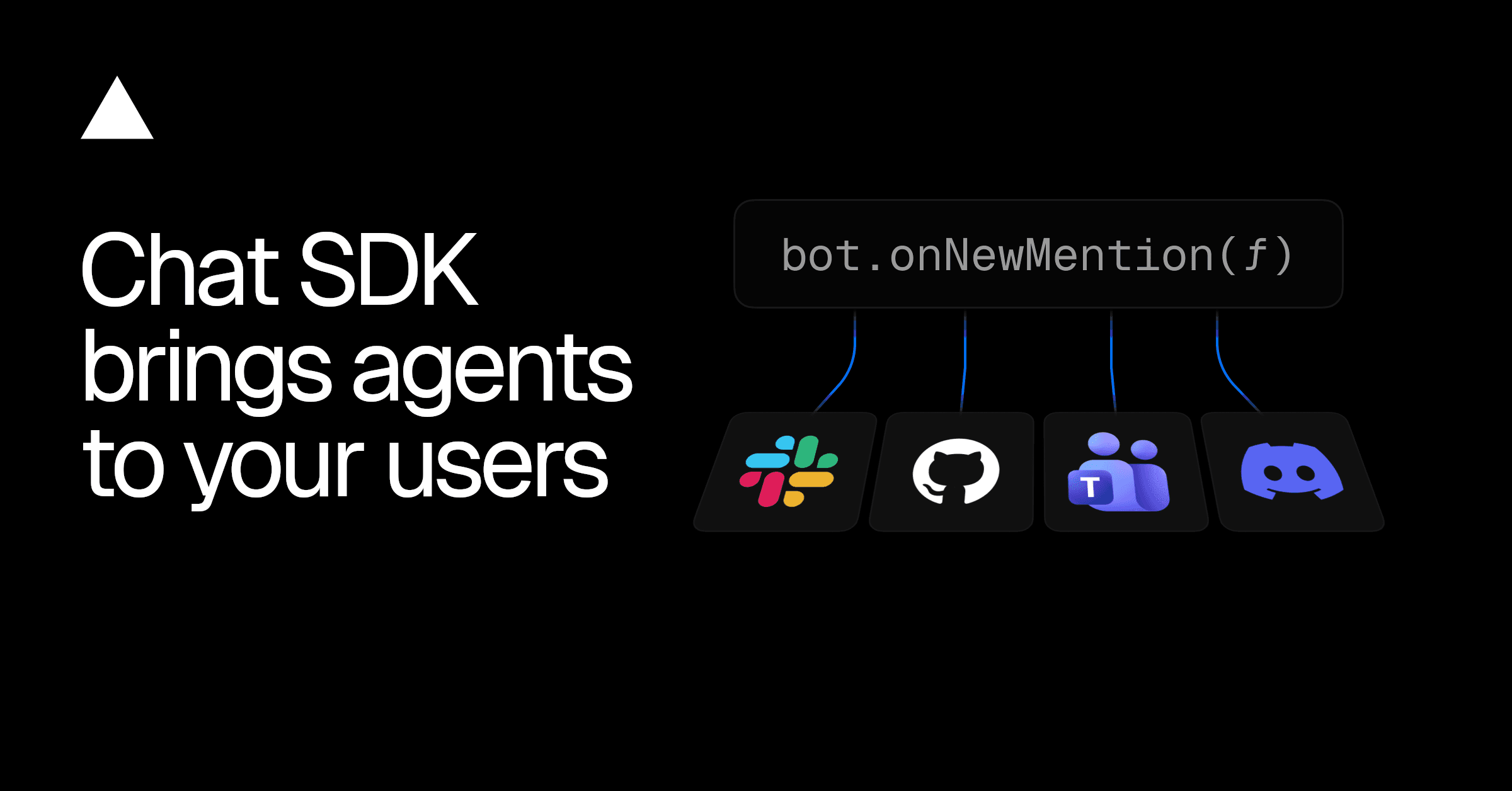
Developing a new AI agent often begins with a single platform in mind, only for its utility to quickly demand presence across every communication channel. This initial success often spirals into an "integration adventure" for developers, who find themselves wrestling with disparate messaging APIs to bring their agents to users where they already work. Vercel's Chat SDK solves this by providing a unified TypeScript library, enabling developers to build and deploy sophisticated bots across seven major chat platforms from a single codebase.
Chat SDK abstracts the complexities of individual messaging APIs into a simple framework, allowing agents to function seamlessly across platforms like Slack, Microsoft Teams, and WhatsApp. It handles platform-specific nuances such as streaming, formatting, and UI component rendering, drastically reducing development overhead. By using a single set of code, developers ensure their AI agents are instantly accessible and consistent wherever users need them, without constant re-engineering.
Initially, Vercel employees building internal agents faced this exact challenge. Agents were powerful, but required individual interfaces or bespoke integrations for each new platform, from Slack to GitHub and Linear. The core insight: instead of forcing users to come to the agents, agents needed to meet users in their existing workflows, according to Vercel. This realization drove the creation of Chat SDK, mirroring how the AI SDK unified various model provider APIs.
The Chat SDK simplifies agent deployment by providing platform-specific adapters that manage unique behaviors, meaning developers only need to write their core application logic once. This includes standardizing how streaming text, a crucial feature for real-time AI responses, is handled across diverse platforms. For example, Discord and Teams use a fallback streaming path with automatic Markdown-to-native conversion, preventing raw `bold` syntax from appearing before a message resolves.
UI components like tables, cards, modals, and buttons also adapt automatically. Developers define these elements once using JSX, and Chat SDK renders them natively on each platform. A Table() component, for instance, translates into Block Kit tables for Slack, GFM Markdown for Discord, monospace text widgets for Google Chat, and code blocks for Telegram. If a platform lacks native support for an element, Chat SDK provides a graceful fallback, ensuring functionality without custom code.
Even for agents targeting a single platform, Chat SDK delivers value by auto-converting channel and user names to clear text, providing essential context for AI models. It also ensures that when an agent @-mentions someone, the notification triggers correctly. Crucially, the SDK includes full conversational context, like link previews and referenced posts, directly in agent prompts. It also converts standard Markdown to Slack’s native variant automatically, even during live streaming.
Chat SDK natively integrates with the AI SDK, allowing developers to pipe streaming LLM responses directly to any supported chat platform without additional configuration. The `post()` function accepts an AI SDK text stream, and the adapter layer intelligently renders it with live formatting where the platform allows. This deep integration streamlines the creation of interactive, real-time AI agents.
Beyond messaging, Chat SDK handles critical state management requirements. It supports pluggable state adapters for thread subscriptions, distributed locks, and key-value caches. While Redis has been available since launch, PostgreSQL is now a production-ready option, enabling teams already using Postgres to persist bot state without adding new infrastructure. The PostgreSQL adapter automatically creates necessary tables and supports TTL-based caching and namespaced state, with groundwork laid by community contributor @bai in PR #154.
The SDK's reach continues to expand, with new support for WhatsApp, one of the world's largest messaging platforms. The WhatsApp adapter manages messages, reactions, multimedia downloads, and location sharing, rendering cards as interactive reply buttons. It adheres to WhatsApp's 24-hour messaging window, allowing bots to respond only within that period. This feature was largely contributed by @ghellach in PR #102. The expansion of cross-platform capabilities for AI agents aligns with a broader industry push for AI to be more accessible and useful, as seen with initiatives like Anthropic's Claude gaining the ability to use a person's computer to complete tasks.
Vercel's Chat SDK is a TypeScript library that allows developers to build and deploy AI agents across multiple chat platforms using a single codebase. It simplifies the process of integrating AI agents into platforms like Slack, Microsoft Teams, and WhatsApp by abstracting the complexities of individual messaging APIs.
The Chat SDK solves the problem of integrating AI agents across different communication channels, which typically requires developers to manage disparate messaging APIs. By providing a unified framework, the Chat SDK allows developers to write their core application logic once and deploy it across seven major chat platforms, reducing development overhead and ensuring consistency.
The Chat SDK uses platform-specific adapters to manage unique behaviors, such as streaming text and rendering UI components. For example, it automatically converts Markdown to native formatting for platforms like Discord and uses fallback streaming paths when necessary. UI components defined using JSX are rendered natively on each platform, with graceful fallbacks for platforms lacking native support.
Vercel's Chat SDK supports seven major chat platforms, including Slack, Microsoft Teams, WhatsApp, GitHub, Linear, Discord, Google Chat and Telegram. The SDK abstracts the complexities of each platform's API, allowing developers to deploy AI agents across all of them from a single codebase.
More insights on trending topics and technology