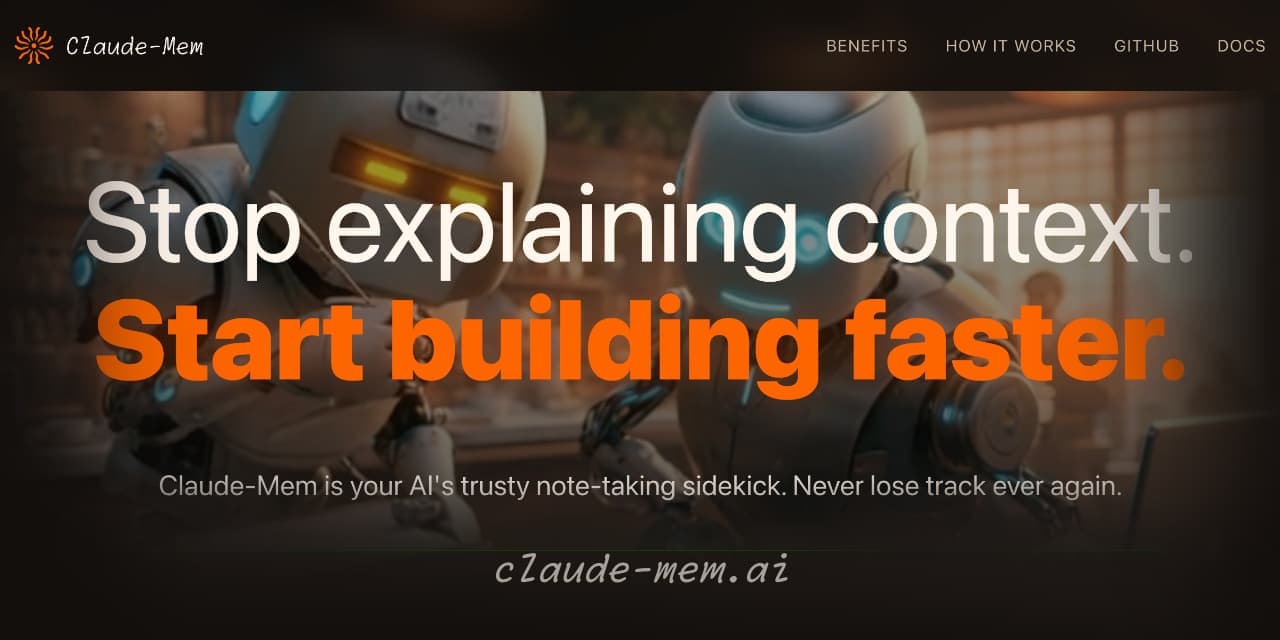
A new Anthropic Claude Code plugin, Claude-Mem, gives the AI persistent memory, solving a critical challenge as Claude Code gains the ability to control users' computers for complex development tasks. This tool automatically captures and compresses all of Claude's actions during coding sessions, then intelligently injects relevant context into future interactions, ensuring continuity and boosting developer velocity. The plugin’s introduction is timely, as Anthropic rolls out features allowing Claude to interact directly with macOS environments, including opening files and running dev tools.
This persistent memory system is crucial for developers relying on AI agents to manage intricate projects. By retaining knowledge across sessions, Claude-Mem transforms Claude Code from a stateless assistant into a knowledgeable partner, preventing the frustration of repetitive context setting. It ensures that Claude "remembers" project specifics, past debugging attempts, and previous code modifications, making subsequent interactions significantly more efficient.
Imagine a developer asking Claude Code to debug an authentication issue. Claude-Mem instantly recalls all prior attempts, relevant code sections, and even the developer’s specific preferences from previous sessions. This capability is vital now that Claude Code can directly control a user's macOS computer, prioritizing connectors to services like Slack or Google Calendar, or directly manipulating the browser, mouse, and keyboard when connectors are unavailable, according to Ars Technica. Without persistent memory, each new task or session would force Claude to re-learn the entire project's context, wasting valuable time and resources.
Claude-Mem integrates seamlessly into Claude Code via `/plugin marketplace add thedotmack/claude-mem`. It operates through five lifecycle hooks—SessionStart, UserPromptSubmit, PostToolUse, Stop, and SessionEnd—that observe Claude's interactions. These observations are stored in an SQLite database and semantically summarized using Chroma vector database for intelligent retrieval. The system even runs a Worker Service with a web viewer UI on port 37777, offering real-time memory streams.
The plugin leverages a token-efficient 3-layer workflow pattern for memory search. Claude uses specialized MCP tools: `search` generates a compact index of results, `timeline` provides chronological context, and `get_observations` fetches full details only for relevant IDs. This tiered approach achieves approximately 10x token savings by filtering information before detailed retrieval, as stated by Claude-Mem's GitHub documentation. For example, a search for "authentication bug" might return an index of relevant observation IDs. The developer can then select specific IDs to fetch full details without inundating Claude with unnecessary information.
Developers can query their project history using the `mem-search` skill with natural language. For privacy, users can employ `
For AI founders and builders in the content infrastructure space, Claude-Mem signals the immediate future of AI agent development. The ability to give AI agents persistent, searchable memory not only streamlines coding workflows but also unlocks a new era of complex, multi-session tasks. This empowers AI to handle larger, more nuanced projects, transforming it from a mere assistant into a true collaborator.
Claude-Mem is a plugin for Anthropic's Claude Code that gives the AI persistent memory for coding sessions. It captures and compresses Claude's actions, then injects relevant context into future interactions. This prevents repetitive context setting and boosts developer velocity.
Claude-Mem retains knowledge across sessions, transforming Claude Code into a knowledgeable partner. It remembers project specifics, past debugging attempts, and previous code modifications. This makes subsequent interactions more efficient, especially now that Claude Code can directly control macOS environments.
Claude-Mem integrates via `/plugin marketplace add thedotmack/claude-mem`. It operates through five lifecycle hooks: SessionStart, UserPromptSubmit, PostToolUse, Stop, and SessionEnd. These hooks observe Claude's interactions, which are stored in an SQLite database and semantically summarized using Chroma vector database for intelligent retrieval.
Claude-Mem uses a 3-layer workflow pattern for memory search, achieving approximately 10x token savings. Claude uses specialized MCP tools: `search` generates a compact index of results, `timeline` provides chronological context, and `get_observations` fetches full details only for relevant IDs.
Claude-Mem runs a Worker Service with a web viewer UI on port 37777, offering real-time memory streams. This allows developers to monitor Claude's observations and memory recall process.
More insights on trending topics and technology