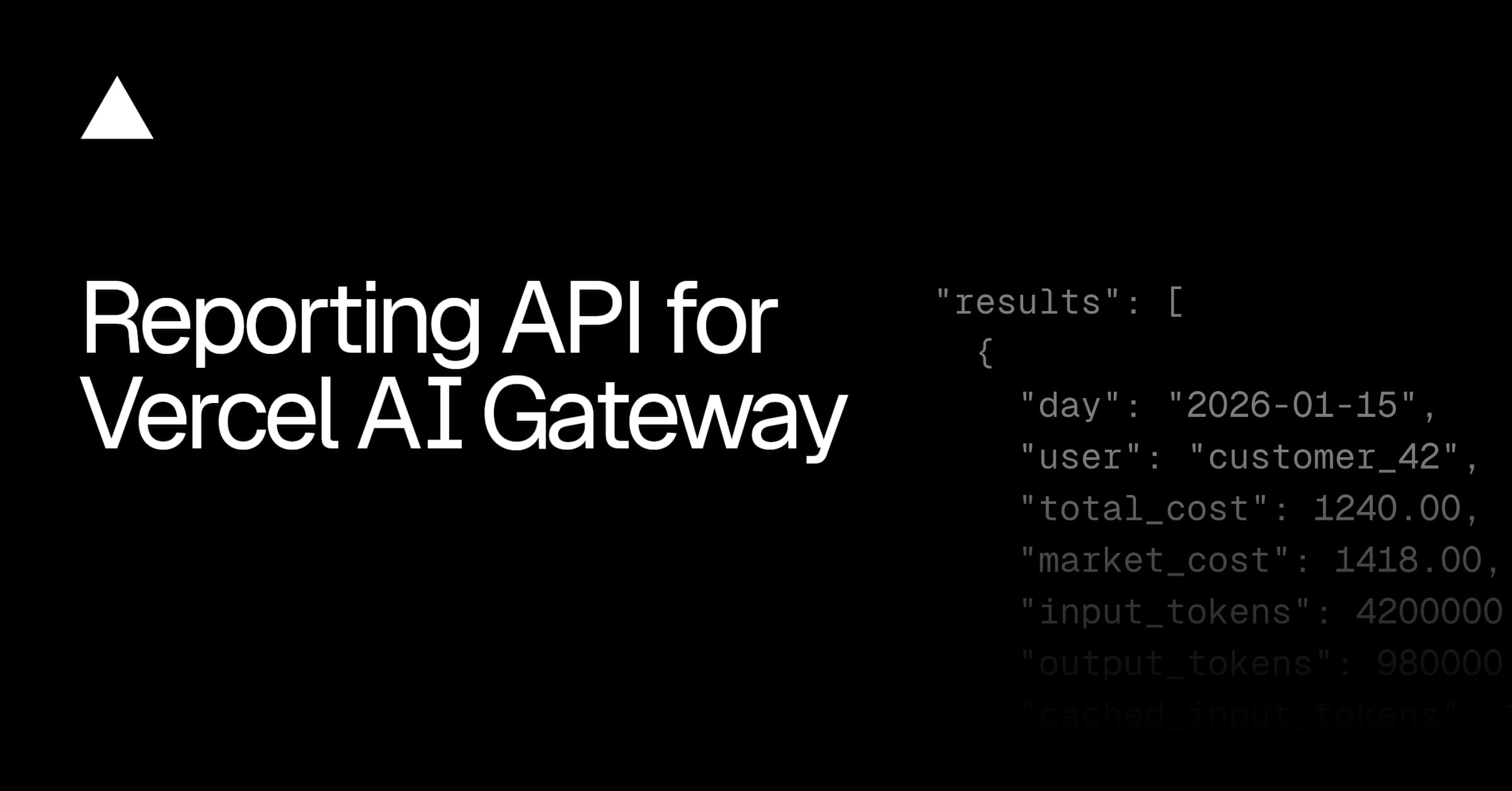

Developers shipping AI features often struggle with fragmented usage data spread across multiple providers, API keys, and dashboards. Vercel addresses this critical challenge with the beta launch of its AI Gateway Custom Reporting API, now available for Pro and Enterprise plans. This new API provides programmatic access to consolidated cost, token usage, and request volume data, including Bring Your Own Key (BYOK) requests, from a single endpoint, streamlining financial and operational oversight for AI deployments.
The rapid adoption of AI has introduced a new layer of complexity for engineering and finance teams: managing and attributing costs. Companies often piece together usage data from various provider consoles, leading to time-consuming manual reconciliation through spreadsheets. This fragmentation obscures critical context like internal user IDs, feature boundaries, and custom tags. The problem intensifies with BYOK (Bring Your Own Key) scenarios, where spend and usage scatter across numerous user-provided credentials.
This lack of a unified view means teams frequently face "after-the-fact reconciliation," reacting to bills rather than proactively managing expenditure. Such reactive approaches hinder real-time budgeting, accurate unit economics, and informed pricing decisions for AI-powered products.
Vercel's Custom Reporting API tackles this problem head-on by offering programmatic access to granular AI usage data. This single endpoint allows teams to query cost, token usage, and request volume for all traffic flowing through the AI Gateway, encompassing both Vercel-managed and BYOK credentials. The API breaks down spend by parameters like model, provider, user ID, and custom tags. This flexibility means teams track costs and usage per feature, per end customer, and per pricing tier, providing unprecedented clarity into AI operational expenses.
An early AI platform aggregating models for over Vercel's AI Gateway reported significant savings. During the private beta, this platform, serving 200,000+ users, consolidated its cost tracking and request management. This move replaced their third-party proxy system entirely and resulted in savings exceeding $80,000, according to Vercel. This demonstrates the immediate financial benefits of a unified reporting system.
Implementing the Custom Reporting API involves tagging requests with relevant metadata like `user` and `tags`. For customer-facing features, this means attaching a customer ID, their plan, and the specific feature they use to each request. This tagging system works across the AI SDK, Chat Completions API, Responses API, OpenResponses API, and Anthropic Messages API, ensuring data consistency regardless of the interface or language.
This structured data allows development and finance teams to shift from reactive reconciliation to proactive operational management. They can measure the cost of individual features across multiple teams, identify free-tier users nearing upgrade thresholds, and accurately calculate per-request unit economics before adjusting pricing. The ability to monitor internal usage across various models and providers helps catch sudden spikes before they inflate bills. This level of insight supports data-driven decisions for setting budgets, calculating margins, and refining pricing strategies.
Tech companies increasingly monitor token consumption as a key metric. Some firms, including Meta and OpenAI, use internal leaderboards and token metrics to evaluate employee AI usage, with one engineer reportedly consuming 210 billion tokens. Kevin Roose reported this trend in The New York Times, highlighting the shift in engineering incentives and costs, as noted by Let's Data Science. The AI Gateway's API offers a similar granular tracking capability for organizations.
Here's a quick look at what the API tracks:
| Metric Type | Breakdown Options |
|---|---|
| Cost | Model, Provider, User ID, Custom Tag, Credential Type |
| Token Usage | Model, Provider, User ID, Custom Tag, Credential Type |
| Request Volume | Model, Provider, User ID, Custom Tag, Credential Type |
For Founders
Implement custom tagging on AI requests from day one to ensure you have granular data for calculating per-feature profitability and setting accurate pricing models.
For Developers
Leverage the API to integrate cost and usage data directly into your internal dashboards, creating real-time visibility that helps optimize model choice and prevent unexpected spend.
For Finance Teams
Utilize the unified reporting to reconcile AI expenses across all providers and BYOK scenarios, simplifying audits and enabling precise budget forecasting.
Vercel's AI Gateway Custom Reporting API is a new tool that provides a single place to track all AI usage and costs, even when using your own API keys (BYOK). It gives you programmatic access to cost, token usage, and request volume data, helping streamline financial and operational oversight for AI deployments. The API is currently in beta for Pro and Enterprise plans.
The Vercel AI Gateway Custom Reporting API unifies AI usage data, providing a consolidated view of costs, token usage, and request volume across different AI providers and API keys. This allows for granular analysis of spend by model, provider, user ID, or custom tags, enabling better cost management and informed decision-making. One platform saved over $80,000 by consolidating cost tracking with the new API.
The API provides a unified view of AI costs, allowing teams to track expenses in real-time rather than reacting to bills after the fact. It breaks down spend by parameters like model, provider, user ID, and custom tags, enabling teams to track costs and usage per feature, per end customer, and per pricing tier. This allows for real-time budgeting, accurate unit economics, and informed pricing decisions for AI-powered products.
Implementing the Custom Reporting API involves tagging requests with relevant metadata like `user` and `tags`. For customer-facing features, this means attaching a customer ID, their plan, and the specific feature they use to each request. This tagging system works across the AI SDK, Chat Completions API, Responses API, OpenResponses API, and Anthropic Messages API, ensuring data consistency regardless of the interface.
More insights on trending topics and technology